

Key Takeaways
Why Situational Awareness Is the Foundation of Safe Driving
Crash research consistently shows that most collisions are preceded by a failure to notice - not a failure to steer or brake. A driver who perceives a hazard two seconds earlier than average has a dramatically larger window to respond without emergency maneuvering. This is the practical value of situational awareness: it converts potential crashes into routine decisions.
Defensive driving is often described as anticipating what other drivers might do wrong. Situational awareness is the mechanism that makes that anticipation possible. Without active, structured scanning, drivers rely on reaction alone - and human reaction time, even at its best, is too slow to compensate for close-range surprises at highway speed.
New and experienced drivers alike develop blind spots in their habits. New drivers often underestimate the importance of forward gaze distance; experienced drivers can grow complacent about mirror discipline. The techniques below are applicable regardless of experience level.
What you will need
Step-by-Step: Building Better Scanning and Spacing Habits
The following steps translate awareness principles into specific, repeatable behaviors you can begin applying on your next drive. They require no special equipment - only attention and practice.
Properly adjusted side and rearview mirrors
Eliminating unnecessary blind spots so mirror checks give accurate, complete information about surrounding traffic.
A vehicle in safe mechanical condition
Responsive brakes and steering are essential for acting on the hazards your awareness identifies.
Set your mirrors before you move
Before pulling away, adjust your side mirrors so that your own vehicle's body is barely visible at the inside edge of each mirror. Set the rearview mirror to frame the full rear window. This configuration minimizes blind spots and ensures each mirror check provides genuinely useful information rather than a redundant view of your door panel.
Extend your forward gaze to 12-15 seconds ahead
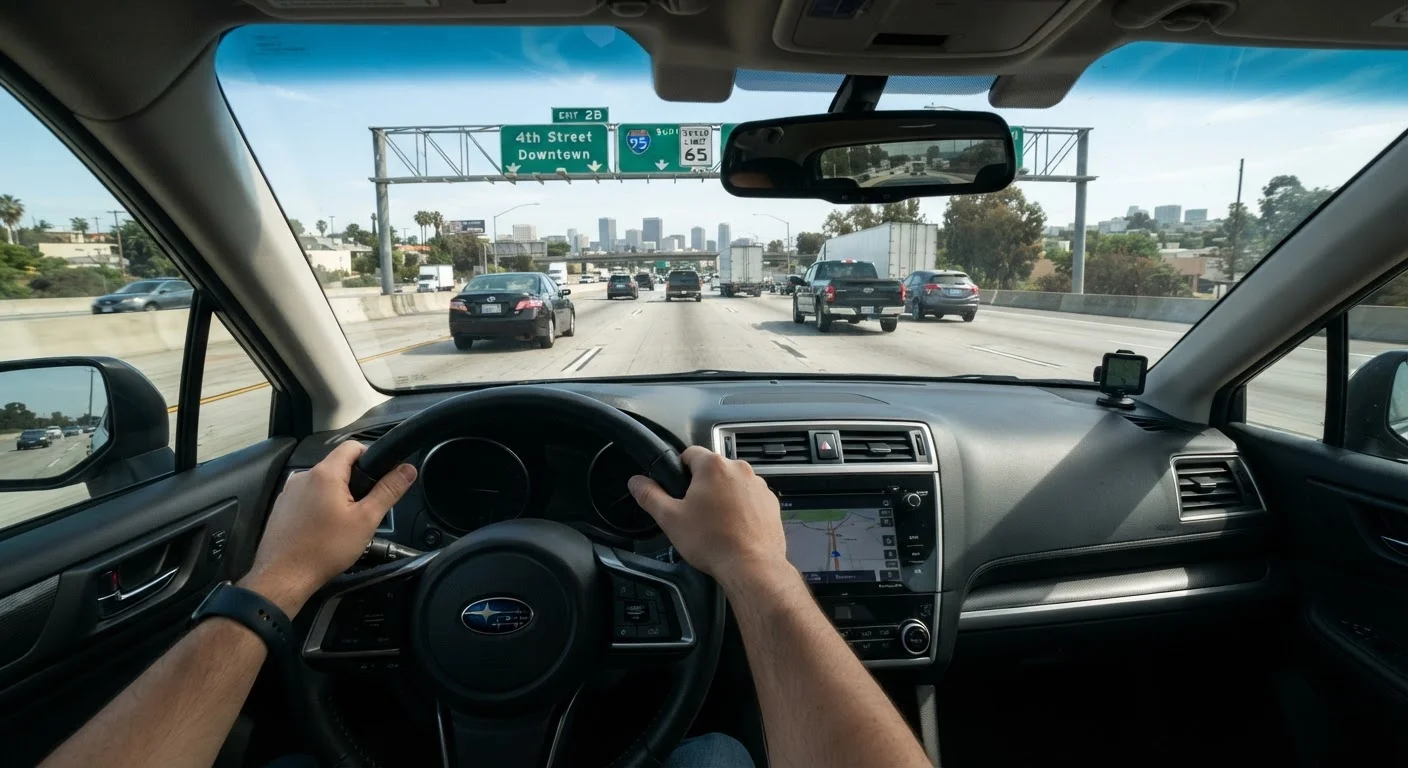
Most drivers focus on the vehicle directly in front of them. Professionals and defensive-driving instructors recommend looking at least 12-15 seconds down the road - roughly a city block in urban environments, or a quarter-mile on a highway. This additional lead time converts potential surprises into manageable decisions. Identify merging vehicles, slowing traffic, and road debris well before they demand reaction.
Scan in a structured pattern - don't just stare straight ahead
A disciplined scanning pattern moves your eyes continuously: far ahead, middle distance, close range, left mirror, right mirror, and back to far ahead. Professional drivers complete this cycle roughly every five to eight seconds. Staring at one point is a form of tunnel vision that dramatically narrows your awareness of the full traffic environment around you.
Maintain a following distance that gives you time to react
The three-second rule - choosing a fixed object ahead and counting at least three seconds between when the car in front passes it and when you do - is the widely taught minimum for dry, clear conditions. Increase this to four or five seconds in rain or heavy traffic, and to six or more seconds in ice or fog. A larger gap is not a courtesy; it is reaction time you are buying in advance. Following too closely dramatically increases rear-end crash risk even when you feel alert.
Read the behavior of traffic around you
Beyond individual vehicles, look for patterns. A cluster of brake lights two intersections ahead signals a slowdown you should begin managing now. A truck weaving slightly may indicate a distracted or fatigued driver - give it additional space. A vehicle sitting at an odd angle in a parking lot exit is likely to pull out without yielding. Learning to read intent from vehicle positioning, speed variation, and driver behavior turns passive observation into active risk management. Large trucks and motorcycles present specific recognition challenges worth studying separately.
Apply heightened attention at intersections and lane changes
Intersections account for a disproportionate share of crashes. Before entering any intersection - even on a green light - scan left, center, and right for vehicles that may be running a late red or failing to yield. For lane changes, check your mirror, signal early, check your blind spot with a physical shoulder check, and only then move. Rushing any element of this sequence is where incidents occur. Right-of-way rules at intersections are worth reviewing alongside these habits.
Use the 'Commentary Driving' Technique
Narrating what you see aloud - 'car braking at the light, cyclist approaching the shoulder, truck drifting right' - forces your brain to actively process the environment rather than passively register it. Even a few minutes of this practice per drive builds sharper scanning habits over time.
Scanning Doesn't Replace Mirror Checks
Forward scanning is essential, but blind spots exist in every vehicle. Always combine forward scanning with regular mirror checks and a physical head-check before changing lanes or merging. Technology such as blind-spot monitoring assists but does not replace active driver attention.
Handling Conditions That Demand Extra Awareness
Certain environments compress the margins that good situational awareness normally provides. In heavy urban traffic, the volume of potential hazards - pedestrians, cyclists, turning vehicles, double-parked cars - means your scanning cycle must be faster and your following distance must be generous despite lane pressure from other drivers.
At night, your forward gaze is limited by headlight range, which may be shorter than your stopping distance at highway speed. Night driving requires specific adjustments beyond simply switching on your lights. In adverse weather, assume other drivers' awareness and vehicle control are impaired, not just your own - widen your spacing accordingly.
Distracted driving is among the most common awareness killers on American roads. Even a momentary glance at a phone can erase several seconds of forward awareness - more than enough time for a hazard to enter your stopping distance undetected.
Situational Awareness Is a Skill, Not a Trait
No driver is born with good situational awareness - it is built through deliberate habit. Research consistently links poor hazard perception to higher crash involvement, particularly among new drivers. Practicing the techniques in this guide on every trip accelerates the development of these skills.