

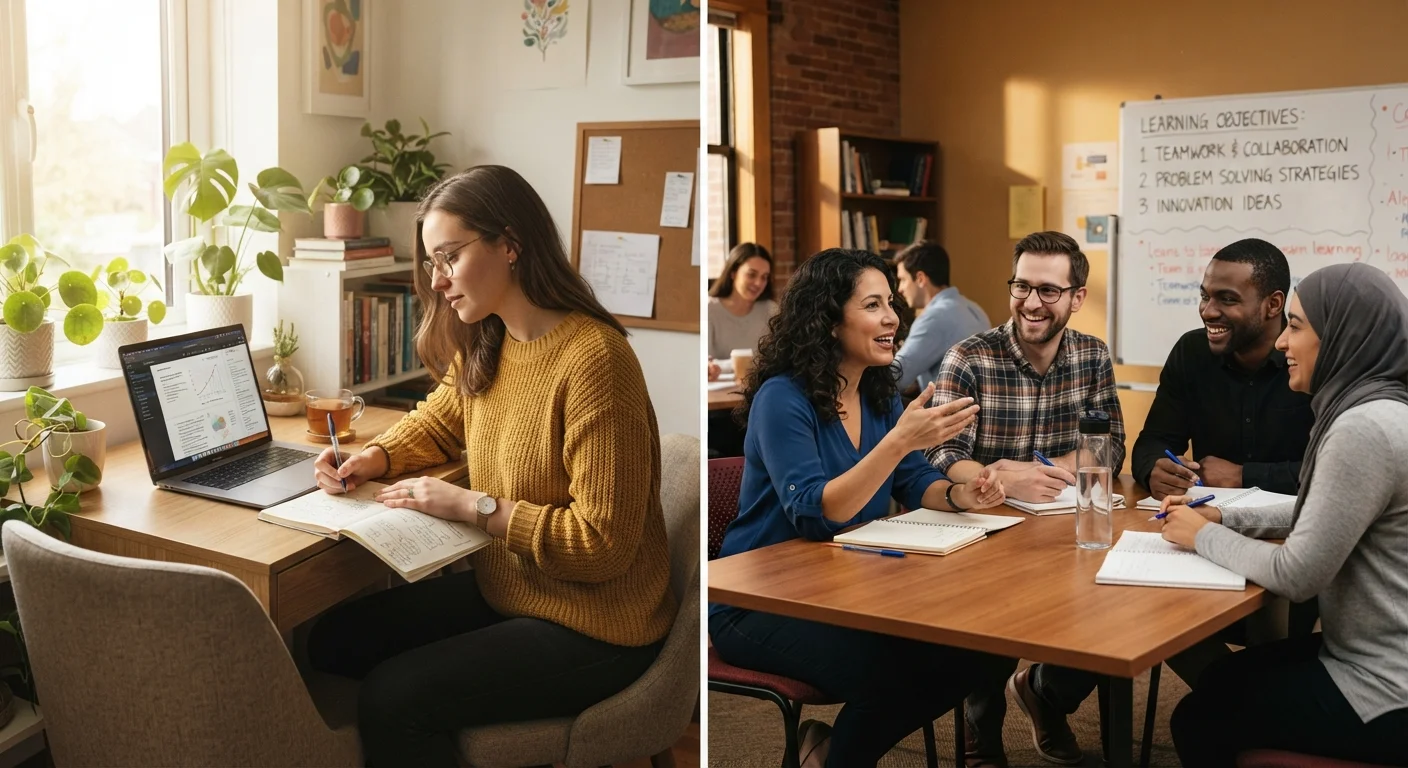
Key Takeaways
Study on your own schedule, anywhere
Asynchronous online courses allow learners to complete work when it fits their life, making education accessible to people with jobs, family obligations, or nonstandard schedules.
Generally lower cost than on-campus alternatives
Without facilities overhead and with the ability to enroll larger cohorts, online programs - especially certificate and skills-based courses - often carry significantly lower fees.
Access to a wider range of subjects and instructors
Geography no longer limits your options; learners can access specialized courses taught by instructors anywhere in the country or world.
Ability to revisit recorded content
Lectures and demonstrations available on-demand let learners pause, rewatch, and review material at their own pace - a meaningful advantage for complex topics.
Lower completion rates, especially self-paced formats
Studies from institutions including MIT and Harvard have found that completion rates for open online courses can be well below 15%, largely due to reduced accountability structures.
Limited real-time feedback from instructors
When you're stuck, asynchronous formats mean you may wait hours or days for a response - a friction point that can stall progress or compound misunderstandings.
Weaker peer connection and networking
The informal relationships built in physical classrooms - study partners, professional contacts, mentors - are harder to develop through a screen.
Not suited to all skill types
Hands-on fields like healthcare, skilled trades, lab science, and performing arts require in-person practice and supervision that online formats cannot replicate.
Requires strong self-discipline to succeed
Without set class times or physical presence, learners must generate their own motivation consistently - a genuine challenge that online formats should not understate.
Our Verdict
Online learning works well for motivated, self-directed adults who need scheduling flexibility and have clear goals. In-person learning suits those who thrive on direct interaction, benefit from structured accountability, or are developing hands-on skills. Increasingly, hybrid formats split the difference - and for many learners, that middle ground is the most practical path.
Adults weighing a return to learning who want to make an informed choice before committing time, money, or both to a specific format.
Why Format Matters More Than You Might Think
Choosing between online and in-person learning isn't just a scheduling question - it shapes how you absorb information, stay motivated, and apply what you learn. The format affects everything from the pace of instruction to your access to an instructor when you're stuck.
Adults returning to education often underestimate this. They focus on subject matter and cost while treating format as an afterthought. But research on adult learning consistently shows that environment influences both engagement and completion. Understanding the trade-offs upfront saves you from enrolling in a setting that works against your natural learning habits.
For a broader look at your format options in technical fields, see our comparison of bootcamps, community colleges, and MOOCs.
Study on your own schedule, anywhere
Asynchronous online courses allow learners to complete work when it fits their life, making education accessible to people with jobs, family obligations, or nonstandard schedules.
Generally lower cost than on-campus alternatives
Without facilities overhead and with the ability to enroll larger cohorts, online programs - especially certificate and skills-based courses - often carry significantly lower fees.
Access to a wider range of subjects and instructors
Geography no longer limits your options; learners can access specialized courses taught by instructors anywhere in the country or world.
Ability to revisit recorded content
Lectures and demonstrations available on-demand let learners pause, rewatch, and review material at their own pace - a meaningful advantage for complex topics.
Where Online Learning Genuinely Shines
The flexibility of online learning is real, not just marketing language. For working adults with irregular schedules, caregiving responsibilities, or geographic constraints, the ability to study at 10 p.m. or during a lunch break is not a minor convenience - it can be the difference between pursuing education and not pursuing it at all.
Cost is another genuine advantage. Online courses - particularly MOOCs and certificate programs - tend to carry lower tuition than on-campus equivalents, in part because there are no facilities to maintain and class sizes can scale. When evaluating whether a course is worth the investment, our guide on picking an online course that's actually worth your time walks through what to look for before enrolling.
63%
Online learners citing flexibility as primary reason for enrolling
According to the National Center for Education Statistics, scheduling flexibility is consistently the most commonly cited motivation among adults who choose online formats.
<15%
Average completion rate for open online courses
Research published by MIT and Harvard examining large-scale open online courses found average completion rates typically fall well below 15% for self-paced enrollments.
Where In-Person Learning Holds the Edge
Accountability is difficult to replicate digitally. When you show up to a physical classroom at a set time, the structure does some of the motivational work for you. Instructors notice when you're confused; classmates pull you into discussions; deadlines feel more real when peers are living them alongside you.
In-person formats also matter considerably for skill types that require physical demonstration - clinical training, studio art, lab science, trades, and similar fields. No asynchronous video module fully substitutes for hands-on feedback in these contexts.
For learners weighing a full degree rather than a single course, our online degree vs. on-campus degree comparison examines how employer perception, campus resources, and the overall experience differ.
Lower completion rates, especially self-paced formats
Studies from institutions including MIT and Harvard have found that completion rates for open online courses can be well below 15%, largely due to reduced accountability structures.
Limited real-time feedback from instructors
When you're stuck, asynchronous formats mean you may wait hours or days for a response - a friction point that can stall progress or compound misunderstandings.
Weaker peer connection and networking
The informal relationships built in physical classrooms - study partners, professional contacts, mentors - are harder to develop through a screen.
Not suited to all skill types
Hands-on fields like healthcare, skilled trades, lab science, and performing arts require in-person practice and supervision that online formats cannot replicate.
Requires strong self-discipline to succeed
Without set class times or physical presence, learners must generate their own motivation consistently - a genuine challenge that online formats should not understate.
Making the Decision: A Practical Framework
Rather than defaulting to one format, consider four questions:
- How do you handle unstructured time? If you need external cues to stay on task, in-person learning provides them. If you're self-directed and goal-oriented, online formats reward that.
- What are you learning? Conceptual and knowledge-based subjects transfer well online. Skills requiring physical practice or supervised feedback generally don't.
- What's your social preference? Some learners find peer discussion energising and essential; others find it distracting. Be honest about which camp you're in.
- What does your schedule actually allow? A commitment you can't sustain beats a perfect format you can never attend.
If you're still deciding between a structured course and a more independent approach, our article on self-directed learning vs. structured courses can help clarify that layer of the decision too.
Hybrid Formats Are Expanding Your Options
Many community colleges, universities, and professional training programs now offer hybrid courses that blend online flexibility with required in-person sessions for labs, discussions, or assessments. If you find the online vs. in-person choice feels too binary, it may be worth looking specifically for hybrid options in your subject area. They won't be right for everyone, but they do offer a genuine middle ground for learners who want both structure and flexibility.