

Key Takeaways
Stackable Credentials
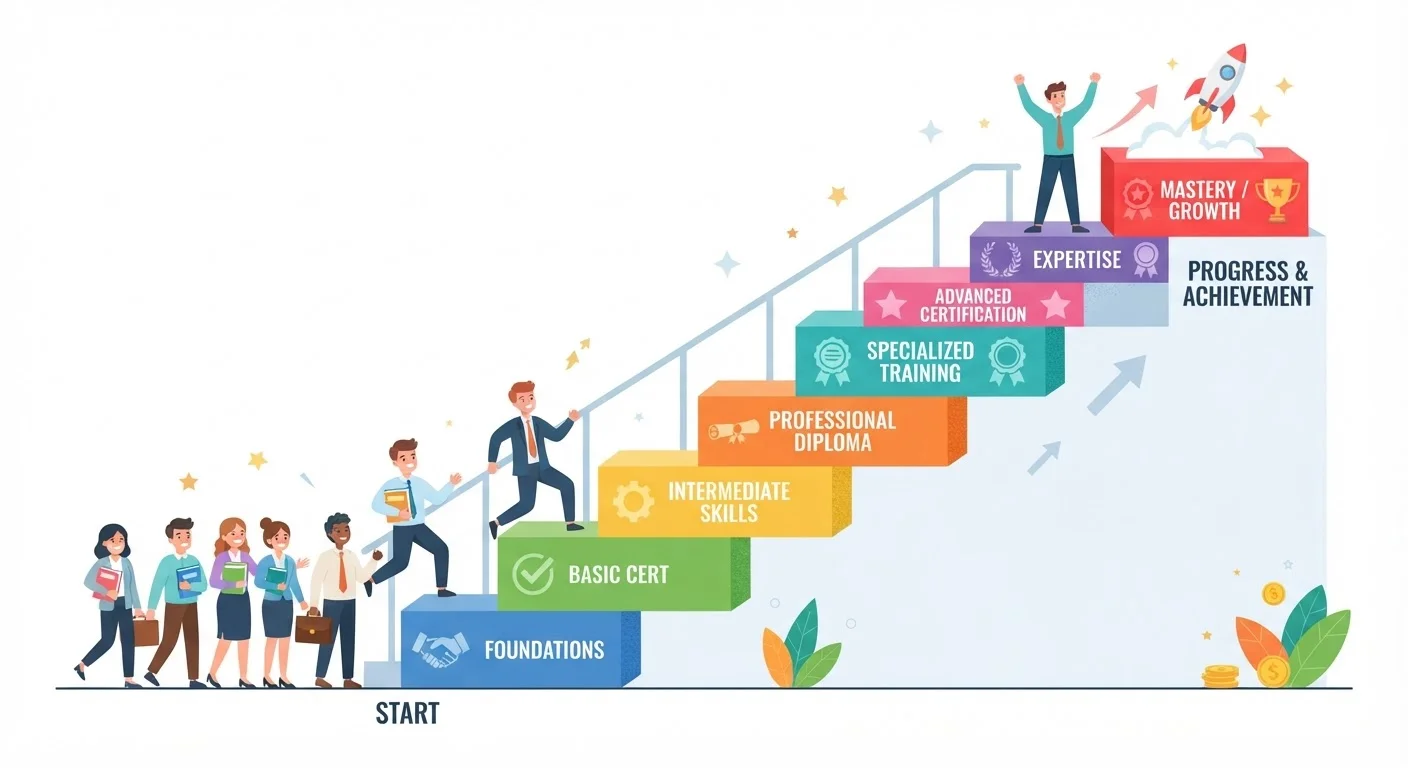
Stackable credentials are a series of smaller qualifications - such as certificates, micro-credentials, or industry certifications - that are intentionally designed to build on one another. Each credential you earn adds recognized value on its own, and together they accumulate toward a larger qualification or a more advanced career position. The idea is that you don't have to commit to a multi-year degree upfront; instead, you advance step by step at a pace that fits your life.
In formal education systems, stackable credential pathways are sometimes structured so that credits earned for a certificate count toward an associate or bachelor's degree - a feature called credit articulation.
Why the Stacking Model Works for Working Adults
Most working adults can't put their lives on hold for a four-year degree. The stackable credential model was built with that reality in mind. Rather than treating education as an all-or-nothing commitment, it breaks the journey into achievable stages - each one producing a credential you can put to use immediately.
The compounding effect is what makes the model powerful. A certificate earned this year adds to your resume right away. A year later, a second credential - built on the first - signals deeper expertise. Over time, the combination tells a coherent professional story that a single, delayed degree often can't match in real-time career value.
To understand how these qualifications fit into the broader landscape of higher education, it helps to review what each credential type actually means before choosing where to begin.
53%
Adults who cite cost as a barrier to further education
According to a Lumina Foundation survey, more than half of adults who did not pursue additional education cited cost as a primary reason - underscoring why incremental credential models matter.
2x
Wage premium for credential holders over non-credentialed peers
Research from the Georgetown Center on Education and the Workforce suggests that credential and certificate holders in high-demand fields can earn significantly more than those without post-secondary qualifications.
1 in 3
U.S. jobs now require a credential below a bachelor's degree
Georgetown CEW research indicates a substantial share of middle-skill jobs are accessible through certificates and industry credentials rather than four-year degrees.
How to Design a Pathway That Builds on Itself
The most common mistake learners make is choosing a credential in isolation - picking whatever course is convenient without asking how it connects to the next step. A true stackable path requires you to work backward from your goal.
- Define your target role or skill level. What does success look like in two to four years? A job title, a salary range, or a set of responsibilities? Start there.
- Map the skills and credentials that role requires. Talk to people in that role, review job postings, and note which certifications or degrees appear consistently.
- Identify credentials that lead into each other. Look for programs that explicitly acknowledge prior learning - where a Level 1 certificate is a prerequisite or credit source for Level 2.
- Confirm articulation agreements. If your plan involves eventually enrolling in a degree program, verify with the institution that earlier credentials will count toward it.
- Build in checkpoints. After each credential, pause and assess. Did you fill the gap you expected? Does your next step still align with your goal?
For those navigating a career change specifically, mapping skill gaps and building a realistic learning path is a practical next read.
Ask About Articulation Before You Enroll
Before starting any certificate or short-term program, contact the admissions office of any degree program you may want to enter later. Ask specifically whether credits from your target certificate will transfer or count toward their program requirements. Get the answer in writing - articulation agreements can change, and verbal assurances aren't always honored at enrollment time.
Where Stackable Credentials Are Most Established
Not every field has mature stackable systems in place, but several industries have developed clear, layered frameworks that working adults can step into with confidence.
- Healthcare: Pathways from CNA to LPN to RN - and beyond into specialty certifications - are well-documented and widely accepted by employers.
- Information Technology: CompTIA offers a sequenced certification ladder (A+, Network+, Security+) that many employers in IT support and cybersecurity recognize. Vendor-specific paths from major technology providers follow similar logic.
- Construction and Skilled Trades: Pre-apprenticeship certificates, apprenticeships, and journeyman licenses represent a classic stackable system that's been in place for decades.
- Early Childhood Education: Community colleges in many states offer Child Development Associate (CDA) credential pathways that feed into associate and bachelor's programs.
- Business and Project Management: Foundational credentials can build toward recognized designations like a Project Management Professional (PMP) certification.
For a closer look at the shortest-form credentials in these stacks, micro-credentials and why employers are paying attention to them explains the growing role of focused, bite-sized qualifications.
Making Progress Without Burning Out
Designing the pathway is only half the work. Sustaining it - across months or years, alongside a job and family - is the harder challenge. Stackable credentials help here too, because each completed credential provides a natural milestone and a motivational reset.
Practically speaking, spacing credentials thoughtfully matters more than rushing through them. Completing one credential, applying it in your work, and then enrolling in the next typically produces better learning retention than stacking courses back-to-back without pauses for application.
Time management is the most-cited barrier for working adult learners. If structuring your schedule around study time feels daunting, practical strategies for fitting skill-building into a full-time work schedule offers concrete approaches that don't require quitting your job or sleeping less.
Consistency over time is what separates those who complete a multi-year stack from those who stall after the first credential. Building lasting learning habits is a straightforward place to start if motivation and routine are your sticking points.
“The best learning plan is one you can actually stick with. A credential you finish in six months beats a degree program you abandon after a year.”
— Anthony Carnevale, Director, Georgetown University Center on Education and the Workforce