

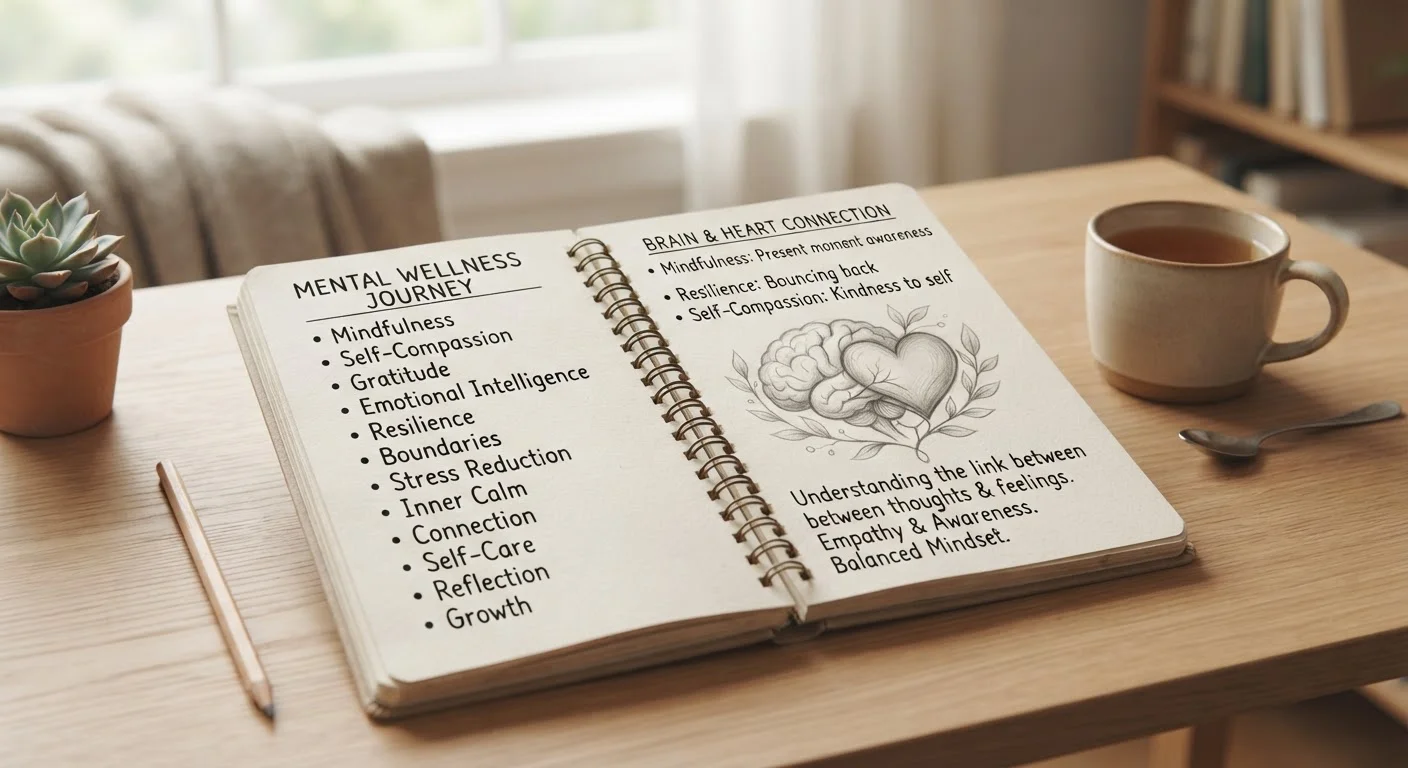
| Scope of mental wellness vocabulary | Dozens of commonly used terms span psychology, neuroscience, and everyday self-care |
| Cognitive distortions identified in research | 10+ distinct patterns documented in cognitive behavioral literature (Aaron Beck's foundational cognitive therapy research) |
| Adults reporting meaningful stress | Roughly 3 in 4 U.S. adults (American Psychological Association, Stress in America surveys) |
| Mindfulness research base | Thousands of peer-reviewed studies examining mindfulness-based programs (National Institutes of Health research database) |
| Resilience classification | Considered a dynamic, learnable process - not a fixed personality trait (American Psychological Association) |
Why a Shared Vocabulary Matters
Mental wellness discussions - in workplaces, families, and online spaces - have expanded significantly in recent years. But when terms are used loosely or interchangeably, they can cause confusion rather than clarity. Understanding what specific words actually mean helps people reflect on their own wellbeing more accurately and communicate with healthcare professionals more effectively.
This reference covers terms you are likely to encounter in everyday mental wellness conversations. It is intentionally educational, not clinical. For a useful starting point on how mental wellness differs from mental health as a concept, see what distinguishes mental wellness from mental health.
This Content Is General Information, Not Medical Advice
The definitions and concepts in this guide are provided for educational purposes only. They are not intended to diagnose any condition, guide treatment, or substitute for professional mental health support. If you have concerns about your mental health, please speak with a qualified healthcare provider.
Core Terms Defined
The following glossary covers the most frequently used terms across mental wellness contexts - from self-help reading to conversations with care providers. Each definition is written in plain language and grounded in established psychological frameworks.
Mental Wellness
A positive state in which a person can manage everyday stress, maintain meaningful relationships, and function effectively. It is distinct from the absence of mental illness - see what separates the two concepts.
Emotional Regulation
The ability to recognize, understand, and manage one's emotional responses in a healthy way. Strong emotional regulation allows people to respond thoughtfully to stressors rather than reacting impulsively.
Cognitive Distortion
An inaccurate or exaggerated thought pattern - such as all-or-nothing thinking or catastrophizing - that can negatively influence mood and behavior. Cognitive distortions are normal but can be examined and reframed with practice.
Mindfulness
Intentional, non-judgmental awareness of the present moment, including thoughts, feelings, and physical sensations. Mindfulness is a practiced skill, not a fixed trait, and is associated with reduced stress in general-population research.
Resilience
The capacity to adapt and recover from setbacks, adversity, or significant stress. Resilience is not about avoiding difficulty; it is a dynamic process that can be supported through habits and relationships.
Psychological Safety
A shared belief within a group or relationship that it is safe to speak up, share concerns, or be vulnerable without fear of punishment or ridicule. It is a key factor in healthy interpersonal environments.
Stress Response
The body's automatic physiological and psychological reaction to perceived threats or demands. The stress response - sometimes called 'fight-or-flight' - is adaptive in the short term but can be harmful when chronically activated.
Rumination
Repetitive, passive focus on distressing thoughts, feelings, or experiences without moving toward problem-solving. Rumination differs from healthy reflection and is associated with prolonged low mood.
Self-Efficacy
A person's belief in their own ability to accomplish specific tasks or navigate particular challenges. Higher self-efficacy is generally linked to greater motivation and persistence, according to established psychological research.
Coping Strategy
Any conscious effort - behavioral, cognitive, or emotional - used to manage stress or difficult situations. Strategies are generally categorized as problem-focused (addressing the source) or emotion-focused (managing feelings).
Nervous System Regulation
The process by which the body's autonomic nervous system returns to a balanced, calm state after activation. Practices such as slow breathing and physical movement are commonly associated with supporting this process.
Protective Factor
Any condition, relationship, habit, or resource that buffers against mental health challenges. Common protective factors include social connection, regular physical activity, adequate sleep, and a sense of purpose.
Once you are comfortable with this vocabulary, you may find it easier to assess your own habits. A guided approach can be found in this mental wellness self-check.
Applying These Concepts Day to Day
Knowing a term is only the first step. The practical value comes from recognizing these patterns in your own life - noticing when a thought is a cognitive distortion, identifying which coping strategies feel helpful, or understanding that rumination differs from productive reflection.
~75%
U.S. adults reporting significant stress
According to the American Psychological Association's Stress in America surveys, roughly three in four American adults experience meaningful stress levels.
10+
Distinct cognitive distortion patterns documented
Cognitive behavioral research, building on Aaron Beck's foundational work, has identified more than ten recurring inaccurate thought patterns that influence mood.
7-9 hrs
Recommended nightly sleep for most adults
The Centers for Disease Control and Prevention cites this range as generally appropriate for adult sleep needs - and sleep quality is closely tied to emotional regulation.
Research consistently highlights the role of sleep as a foundational protective factor. Poor sleep and compromised emotional regulation tend to reinforce each other - learn more about that relationship in how sleep and mental wellness shape each other.
Building small, consistent habits is generally more sustainable than overhauling your entire routine at once. The article building a daily mental wellness routine that sticks offers practical starting points grounded in these same concepts.
| Scope of mental wellness vocabulary | Dozens of commonly used terms span psychology, neuroscience, and everyday self-care |
| Cognitive distortions identified in research | 10+ distinct patterns documented in cognitive behavioral literature (Aaron Beck's foundational cognitive therapy research) |
| Adults reporting meaningful stress | Roughly 3 in 4 U.S. adults (American Psychological Association, Stress in America surveys) |
| Mindfulness research base | Thousands of peer-reviewed studies examining mindfulness-based programs (National Institutes of Health research database) |
| Resilience classification | Considered a dynamic, learnable process - not a fixed personality trait (American Psychological Association) |
This article is for general informational and educational purposes only and does not constitute medical advice. Always consult a qualified healthcare professional for guidance about your personal mental health.