

Key Takeaways
Why Balance Matters More Than Perfection
Americans are surrounded by competing nutrition claims - superfoods, elimination diets, macronutrient obsessions - yet the core findings from decades of nutrition research remain remarkably consistent. A broadly varied diet built around whole foods, adequate protein, plenty of vegetables, and limited ultra-processed options is associated with better long-term health outcomes across multiple large studies.
The goal of a balanced plate isn't perfection at every meal. It's establishing a sustainable pattern over time. Researchers from institutions including the Harvard T.H. Chan School of Public Health describe dietary quality as a cumulative habit, not a pass-or-fail daily test. That framing removes a lot of unnecessary pressure - and makes lasting change far more achievable.
If you're also working on building other healthy foundations, see our guide to building a consistent exercise routine for principles that complement good nutrition habits.
“The diet that has the most evidence behind it for long-term health is one that is predominantly plant-based, rich in whole foods, and low in ultra-processed products - but it doesn't have to be all-or-nothing.”
— Walter Willett, Professor of Epidemiology and Nutrition, Harvard T.H. Chan School of Public Health
The Core Principles: What Nutrition Science Broadly Agrees On
Despite ongoing debates in nutritional research, there is meaningful consensus around several foundational principles. These aren't tied to any single diet plan - they translate across Mediterranean, plant-forward, and omnivorous eating patterns alike.
Fill roughly half your plate with vegetables and fruits at most meals.
Vegetables and fruits are among the most nutrient-dense food categories available, delivering fiber, vitamins, minerals, and antioxidants with relatively few calories. Broad population-level research consistently links higher vegetable and fruit intake with reduced risk of several chronic conditions. Variety in color generally signals variety in micronutrient content.
Choose whole or minimally processed grains over refined versions most of the time.
Whole grains retain their bran and germ, preserving fiber, B vitamins, and minerals that refining removes. Fiber slows digestion, supports gut health, and contributes to sustained energy levels. Most dietary guidelines worldwide recommend making whole grains the majority of grain intake.
Include a quality protein source at each meal.
Protein supports muscle maintenance, immune function, and satiety. Research suggests that distributing protein intake across meals - rather than concentrating it in one - may better support muscle protein synthesis. Both animal and plant proteins can meet needs when chosen thoughtfully.
Include healthy fats rather than eliminating fat entirely.
Dietary fat is essential for absorbing fat-soluble vitamins (A, D, E, K), supporting brain function, and maintaining cell membranes. Decades of research have shifted the consensus away from blanket low-fat advice toward emphasizing fat quality - unsaturated fats from sources like olive oil, nuts, seeds, and fatty fish are associated with better cardiovascular markers than trans or highly saturated fats from ultra-processed foods.
Limit ultra-processed foods without treating them as forbidden.
Ultra-processed foods - defined by the NOVA classification system as industrially formulated products with multiple additives - tend to be lower in fiber, higher in sodium and added sugar, and more calorically dense per gram. Large epidemiological studies associate high ultra-processed food intake with less favorable health outcomes. Moderation rather than elimination is a more sustainable and evidence-consistent approach.
For a closer look at how protein fits into different eating approaches, the protein sources across eating patterns article breaks down quality and bioavailability without diet ideology.
Putting It Into Practice: Quick Wins You Can Start Today
Understanding nutrition principles is one thing; translating them into everyday meals is another. The following actions are low-effort starting points that reflect well-supported habits - no overhaul required.
90%
Americans not meeting vegetable intake recommendations
According to the CDC's analysis of dietary intake data, approximately 9 in 10 Americans fall short of federally recommended vegetable consumption.
57%
Share of calories from ultra-processed foods in average U.S. diet
A study published in BMJ Open estimated that ultra-processed foods account for more than half of daily caloric intake among American adults.
Build Your Plate Visually, Not Mathematically
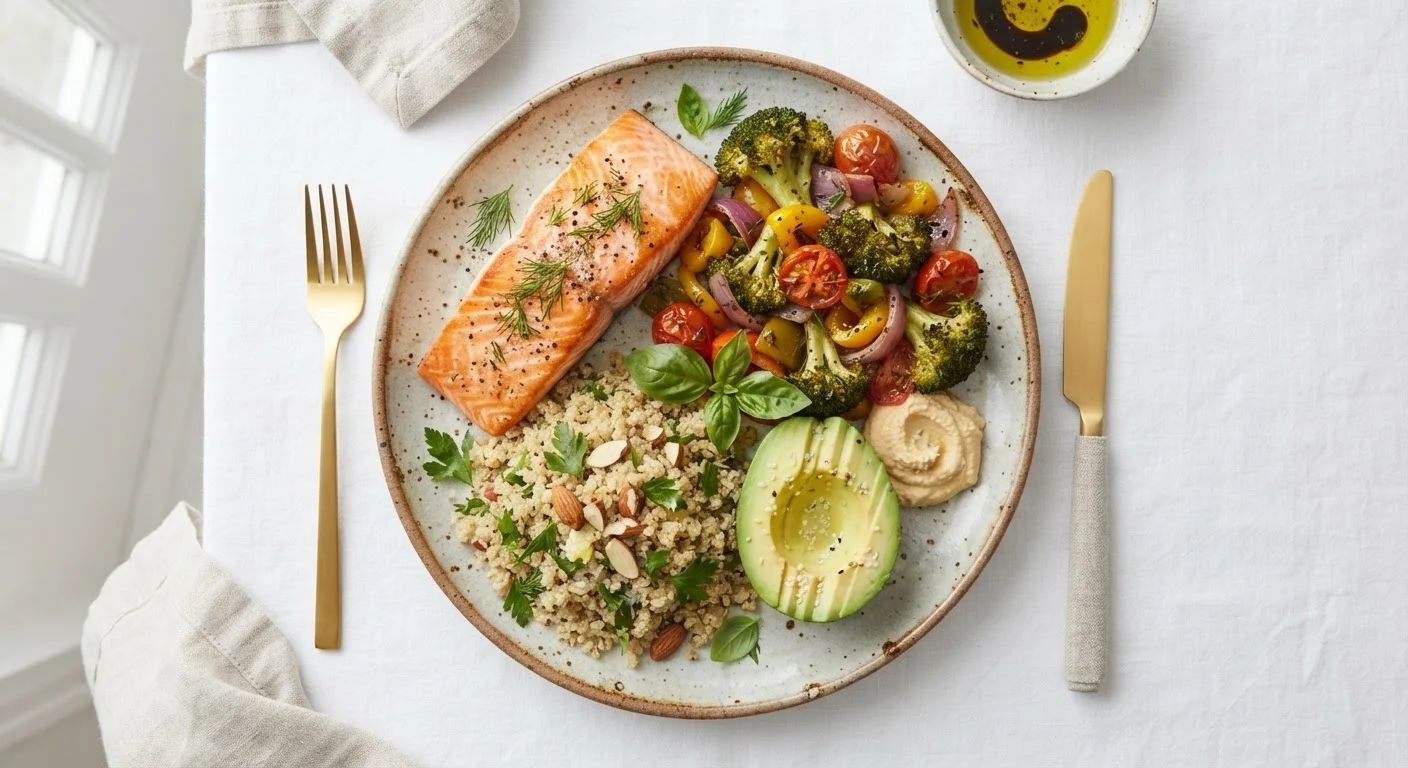
You don't need to weigh food or track every gram to eat more balanced meals. Visual portioning - such as the 'half vegetables, quarter protein, quarter whole grains' framework - is a practical, research-informed heuristic used in public health guidance worldwide. It works because it creates a consistent structure without requiring apps or scales. Start with one meal per day and build the habit from there.
This article is for general informational and educational purposes only and does not constitute medical or dietary advice. Individual nutritional needs vary. Consult a registered dietitian or qualified healthcare professional before making significant changes to your diet, especially if you have a health condition, are pregnant, or are managing a chronic illness.