

Key Takeaways
Option A
Engineered Hardwood
The moisture-resistant, versatile modern option.
Best for: Homeowners installing floors in basements, kitchens, or over radiant heat where dimensional stability matters.
Option B
Solid Hardwood
The timeless, refinishable classic.
Best for: Buyers seeking a long-term investment in above-grade rooms who want the ability to refinish floors multiple times.
If you're finishing a basement or ground-level room
Engineered Hardwood
Its multi-layer construction resists moisture and humidity fluctuation that would cause solid hardwood to warp or cup.
If longevity and repeated refinishing matter most
Solid Hardwood
A thicker wear layer allows multiple sandings over decades, potentially extending floor life well beyond 50 years.
If you have radiant floor heating
Engineered Hardwood
Engineered planks tolerate the thermal expansion and contraction cycles that radiant heat creates, reducing the risk of gaps or cracking.
If you plan to sell your home and want broad buyer appeal
Solid Hardwood
Solid hardwood is widely recognized by buyers and appraisers as a premium feature, often perceived as adding resale value.
What Sets Them Apart at the Core
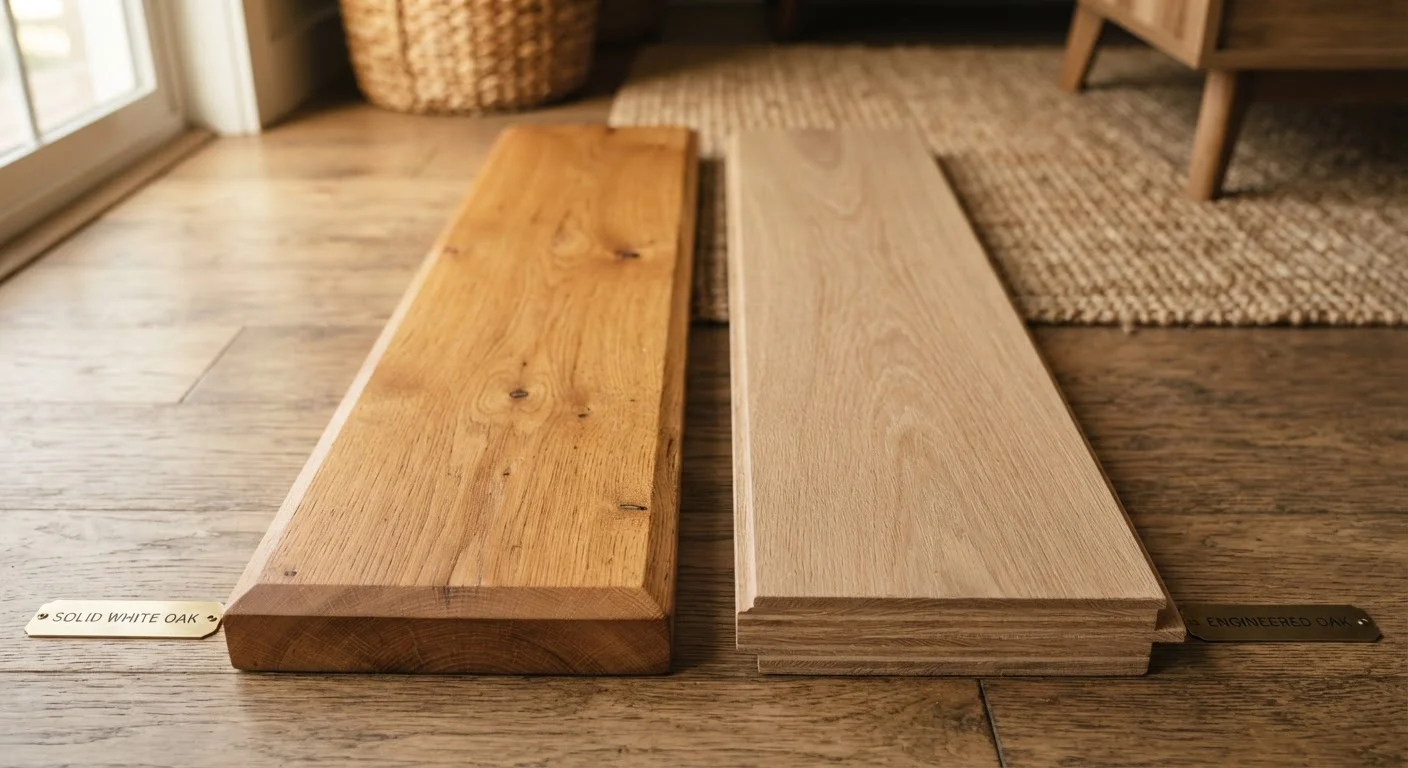
Both flooring types use real wood, but their internal construction is fundamentally different. Solid hardwood is exactly what it sounds like - a single, uniform piece of milled lumber, typically ¾ inch thick, from species like oak, maple, or hickory. Engineered hardwood is built from a thin veneer of real hardwood bonded over multiple layers of plywood or high-density fiberboard (HDF). This cross-ply construction gives engineered planks significantly greater dimensional stability.
That stability difference explains most of the performance gap between the two. Wood naturally expands and contracts as humidity and temperature change. A solid plank responds as one unit, which can cause warping, cupping, or gapping in unstable conditions. Engineered planks, with their cross-directional layers, resist this movement - a major advantage in rooms where moisture is a concern.
| Criterion | Engineered Hardwood | Solid Hardwood |
|---|---|---|
| Core construction | Veneer over plywood/HDF layers | Single solid wood plank |
| Moisture resistance | Good - stable in humid conditions | Poor - prone to warping |
| Suitable locations | Below, at, and above grade | Above grade only |
| Radiant heat compatible | Yes (most products) | Generally not recommended |
| Refinishing potential | 1-2 times (thin wear layer) | 5-8 times over lifespan |
| Installation methods | Float, glue, nail, or staple | Nail or staple to wood subfloor |
| Typical plank thickness | 3/8 - 9/16 inch | 3/4 inch |
Installation, Subfloor, and Location Considerations
Where and how you install your floor should heavily influence your choice. Solid hardwood is suitable only for above-grade installations - it should never go in basements or directly over concrete slabs due to moisture risk. It must be nailed or stapled to a wood subfloor and typically requires a period of acclimation (often 3-5 days on-site) before installation.
Engineered hardwood is far more flexible. It can be glued, nailed, stapled, or floated (installed without adhesive) depending on the product and subfloor. It works on concrete, above grade, and at grade level, and is one of the few real-wood options suitable over radiant heating systems.
Check Local Building Codes Before You Start
Some municipalities require permits for full floor replacements, particularly when work involves subfloor modifications or structural changes. Always verify local permit requirements and consult a licensed contractor if you are unsure whether your planned installation requires inspection. This is especially relevant when installing over radiant heating systems, which may have specific manufacturer and code requirements.
DIYers often find engineered floating installations more manageable as a first project. Solid hardwood nail-down installations typically require a pneumatic flooring nailer and more subfloor prep, making them better suited for experienced installers or professional contractors.
Durability, Refinishing, and Long-Term Value
Surface durability is comparable between the two - both depend on the species hardness and the finish applied. A harder species like hickory or white oak will resist dents better than a softer species like pine, regardless of whether it is solid or engineered.
Where they diverge is refinishing potential. A solid hardwood floor can usually be sanded and refinished 5-8 times over its life, depending on thickness. Engineered hardwood's wear layer is thinner (typically 2-6 mm), meaning most products can be refinished once or twice. For a floor installed in a high-traffic area that may need refreshing every 10-15 years, this matters.
2-6 mm
Engineered hardwood wear layer thickness
The thickness of the real wood veneer layer determines how many times an engineered floor can be sanded and refinished.
3/4"
Standard solid hardwood plank thickness
The greater thickness of solid hardwood planks is the primary reason they can be refinished significantly more times than engineered alternatives.
From a value standpoint, both are genuine hardwood floors and are generally treated similarly by appraisers. The idea that engineered hardwood is a lesser material is a common misconception - quality varies widely within each category, and a well-made engineered product often outperforms a low-grade solid option in real-world conditions.