

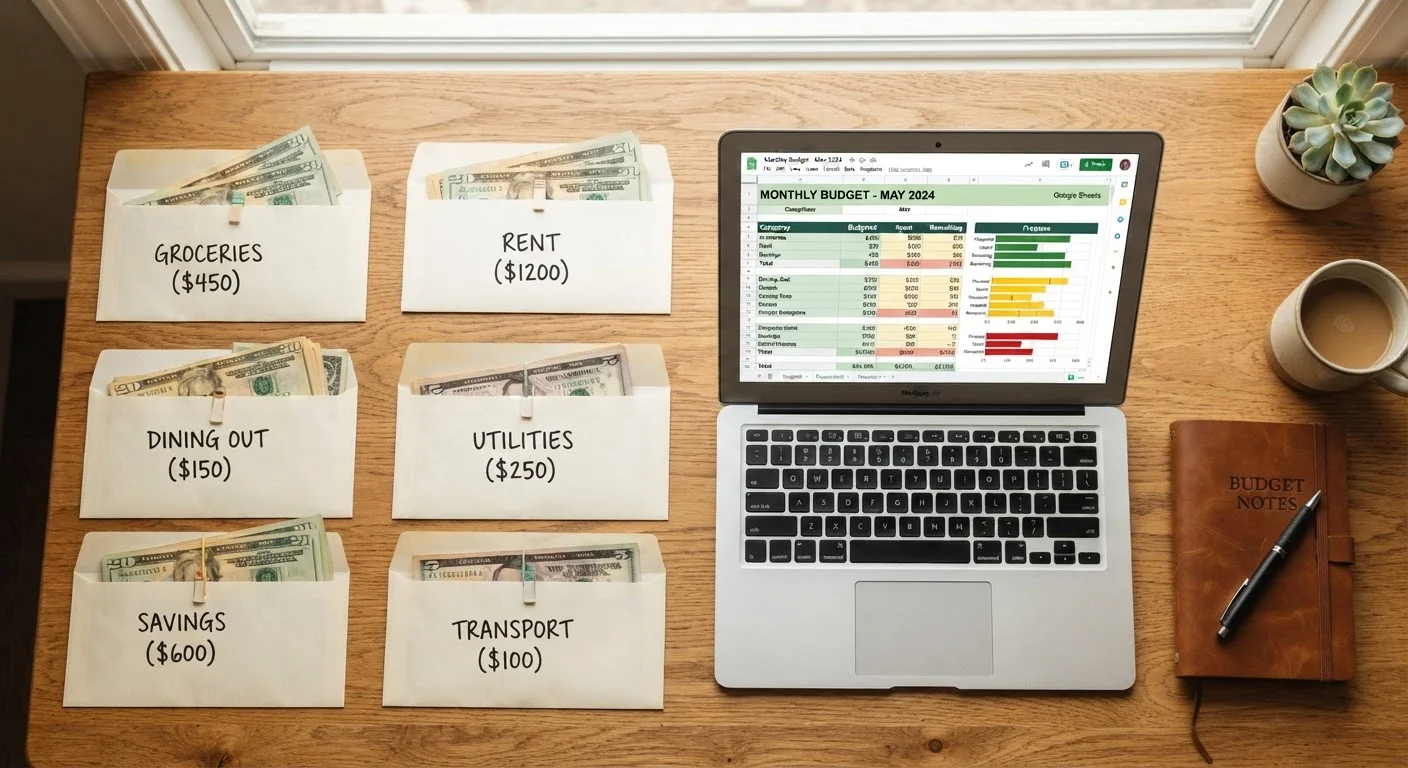
Key Takeaways
Option A
Envelope Budgeting
The tactile, cash-first method for hands-on money control.
Best for: People who overspend on discretionary categories and benefit from a physical spending limit they can see and feel.
Option B
Digital Spreadsheets
The flexible, data-driven approach for detail-oriented planners.
Best for: People who want granular visibility into their finances, prefer automation, and are comfortable working with numbers on a screen.
If you regularly overspend on dining, groceries, or entertainment
Envelope Budgeting
Physical cash limits make it structurally impossible to overspend a category once the envelope is empty, removing the temptation entirely.
If you pay most bills digitally and rarely use cash
Digital Spreadsheets
Spreadsheets handle rent, subscriptions, and card transactions seamlessly, whereas cash envelopes create friction with digital-first financial lives.
If you want to analyze spending trends over several months
Digital Spreadsheets
Spreadsheets store historical data that envelopes simply cannot, letting you spot patterns and adjust categories with evidence.
If you're new to budgeting and want a simple, no-tech starting point
Envelope Budgeting
No setup complexity - label envelopes, divide your paycheck, and spend only what's inside. The low barrier to entry helps beginners build the habit.
If you share finances with a partner and need a coordinated system
Digital Spreadsheets
A shared cloud-based spreadsheet gives both partners real-time visibility and removes the need to physically coordinate cash between two people.
How Each Method Actually Works
Envelope budgeting is straightforward: you divide your monthly take-home pay into labeled envelopes - one for groceries, one for gas, one for dining out, and so on. When an envelope is empty, spending in that category stops until next month. Popularized by debt-reduction advocates and long used by households managing tight budgets, it imposes a hard constraint that no amount of willpower alone can replicate.
Digital spreadsheets work differently. Rather than restricting money before you spend it, they record and categorize what you've already spent, comparing it against a planned budget. Whether you use a simple template in Google Sheets or a more elaborate formula-based workbook, the core function is the same: data in, insight out. The method handles direct deposits, bill payments, and card transactions that cash envelopes simply cannot.
Both approaches ultimately answer the same question - where is my money going? - but through entirely different mechanisms. Understanding that difference is what helps you choose. For a broader look at how these fit alongside other budgeting frameworks, see how different budgeting methods stack up.
| Criterion | Envelope Budgeting | Digital Spreadsheets |
|---|---|---|
| Setup effort | Low - cash and labeled envelopes | Moderate - template design and formula setup |
| Handles digital payments | Poorly - requires workarounds | Well - tracks any transaction type |
| Spending enforcement | Automatic - empty envelope = stop | Self-enforced - requires discipline |
| Historical tracking | None by default | Strong - months of data retained |
| Flexibility | Low - cash must be reallocated manually | High - adjust categories any time |
| Best for beginners? | Yes - simple and tactile | Depends on comfort with spreadsheets |
| Shared finances | Difficult to coordinate | Easy with shared cloud access |
| Cost | Free | Free (basic tools widely available) |
The Psychology Behind Spending Cash vs. Entering Numbers
One of the most meaningful distinctions between these two methods isn't logistical - it's behavioral. Studies in consumer psychology have consistently found that paying with physical cash produces a measurable "pain of payment" that digital transactions do not. When you hand over bills, the loss feels immediate and concrete. When you swipe a card or type a number into a spreadsheet, the emotional friction is significantly lower.
This is why envelope budgeting can be especially effective for people who know they overspend but struggle to stop in the moment. The envelope acts as a pre-commitment device - a concept in behavioral economics where you constrain your future choices to protect yourself from in-the-moment impulses. Once the dining envelope is empty on the 20th of the month, the decision has already been made for you.
Spreadsheets, by contrast, require you to exercise discipline after the fact: you record the purchase, see that you've exceeded your category, and resolve to do better next month. That feedback loop is valuable, but it's weaker as a guardrail. Research into why budgets fail suggests that the gap between knowing and doing is where most budget breakdowns occur.
~83%
Americans who use little or no cash weekly
Pew Research Center survey data indicates a large and growing share of Americans now go through a typical week without using cash, creating practical limitations for cash-envelope systems.
~30%
Higher spending when paying by card vs. cash
Multiple consumer behavior studies have found people tend to spend meaningfully more when using cards compared to cash, consistent with the "pain of payment" research in behavioral economics.
Practical Trade-offs: Setup, Maintenance, and Real Life
Envelope budgeting has minimal setup - you need cash, envelopes, and a clear category list. But it comes with ongoing friction: you must withdraw cash regularly, carry envelopes or a dedicated wallet, and navigate situations where cash isn't practical (online shopping, automatic bill pay, travel). These aren't dealbreakers, but they require genuine lifestyle adjustment.
Spreadsheets have a steeper initial setup if you want them to be accurate and useful. Blank templates are free and widely available, but populating one consistently takes time and attention. The payoff is significant: you can track every dollar regardless of payment method, run month-over-month comparisons, and model future scenarios like paying off a debt or saving for a goal. For guidance on building a system you'll actually maintain, this spending tracker guide walks through the process step by step.
One honest caveat: spreadsheets are only as accurate as the data you enter. Missing a week of entries and then trying to reconstruct spending from memory is a common failure mode. If you find yourself doing that regularly, the method isn't working - and it may be worth considering whether envelope budgeting's automatic enforcement suits you better. See also the pros and cons of strict budget categories for more on how rigid category systems affect behavior.
The Hybrid Approach Is Worth Considering
Many households blend both methods: they use a spreadsheet to plan and track overall finances, but apply envelope-style cash limits specifically to the categories where they most often overspend - typically dining, entertainment, or personal spending. This captures the behavioral guardrails of cash without abandoning the flexibility and visibility of digital tracking. If neither pure method feels right, a hybrid is a legitimate and widely used solution. You can also compare this approach against other structured frameworks like the 50/30/20 rule by reading 50/30/20 vs. zero-based budgeting.