

Key Takeaways
Why Dog Dental Health Is So Frequently Misunderstood
Periodontal disease - infection and inflammation of the tissues surrounding the teeth - is consistently ranked among the most prevalent health conditions diagnosed in adult dogs. Studies cited by veterinary dental organizations suggest that a significant majority of dogs show some degree of gum disease by the time they reach three years of age. Despite this, dental care routinely falls lower on most owners' priority lists than vaccination schedules or flea prevention.
The gap between how common dental disease is and how little attention it receives comes largely from persistent misconceptions. Dogs don't visibly wince from tooth pain the way humans do, which makes it easy to assume nothing is wrong. Understanding what the evidence actually says - versus what's widely repeated - is the first step toward meaningful prevention. For owners who are still settling into dog ownership broadly, our guide for first-time dog owners covers other foundational areas that often catch people off guard.
Myth
Bad breath is just normal for dogs - it's not something to worry about.
Fact
Persistent bad breath (halitosis) in dogs is a clinical sign of bacterial overgrowth and is typically associated with periodontal disease.
The idea that "dog breath" is inevitable has become so normalized that many owners never mention it to their vet. In reality, a healthy dog's mouth should not have a strong offensive odor. Halitosis signals that bacteria are accumulating in the gum pockets and on tooth surfaces - a process that, left untreated, leads to bone loss, tooth loss, and chronic pain. If your dog's breath is noticeably unpleasant, it warrants a veterinary dental examination, not an air freshener.
Myth
Dry kibble cleans a dog's teeth as they chew, so brushing isn't necessary.
Fact
Kibble provides minimal mechanical cleaning and does not substitute for toothbrushing or professional dental care.
This is one of the most pervasive myths in dog care. The reasoning seems logical - crunchy food must scrub teeth - but most dogs don't chew kibble thoroughly enough for meaningful abrasion, and kibble doesn't reach below the gumline where periodontal disease actually begins. Some veterinary dental diets are specifically formulated with fiber structure designed to encourage more surface contact, but standard dry dog food does not carry this benefit. Brushing remains irreplaceable as the primary mechanical tool for plaque removal.
Myth
Dental chews do the same job as brushing a dog's teeth.
Fact
Dental chews can reduce plaque and tartar on accessible surfaces but cannot replicate the thoroughness of brushing, particularly below the gumline.
Dental chews - especially those with a VOHC seal - have demonstrated measurable reductions in plaque and tartar in controlled studies. They are a legitimate adjunct to an oral care routine. However, they work primarily on exposed tooth surfaces and don't address subgingival (below the gumline) bacteria, which is where the most damaging disease process occurs. Treats that are excessively hard also carry a risk of tooth fracture. Think of dental chews as one useful layer in a broader strategy, not the whole strategy.
Myth
Anesthesia for a dental cleaning is too dangerous, especially in older dogs.
Fact
Modern anesthetic protocols and pre-operative screening make veterinary dental cleanings safe for the vast majority of dogs, including seniors.
Concern about anesthesia is understandable, but the risk calculus has shifted significantly with advances in monitoring and pre-anesthetic bloodwork. Anesthesia-free dental cleanings - where a dog is manually restrained for scaling - are not considered an acceptable substitute by veterinary dental specialists, because they cannot safely address subgingival disease and cause significant stress. For an older dog, the systemic effects of untreated periodontal infection - including potential links to heart, kidney, and liver stress - often represent a greater risk than a well-managed anesthetic procedure. Your veterinarian can assess individual risk based on health history.
Myth
If a dog is still eating normally, their teeth are probably fine.
Fact
Dogs will often continue eating despite significant oral pain because their survival instincts override discomfort - eating behavior is an unreliable indicator of dental health.
This myth is particularly consequential. Dogs are highly motivated to eat and will adapt their chewing patterns - favoring one side of the mouth, swallowing more whole - rather than stop eating entirely. By the time a dog visibly refuses food due to dental pain, the underlying condition is usually advanced. Regular veterinary dental examinations are the only reliable way to assess what's actually happening in a dog's mouth. Behavioral signals like dropping food, pawing at the face, or changes in chewing preference are worth reporting to a vet promptly.
What Effective Prevention Actually Looks Like
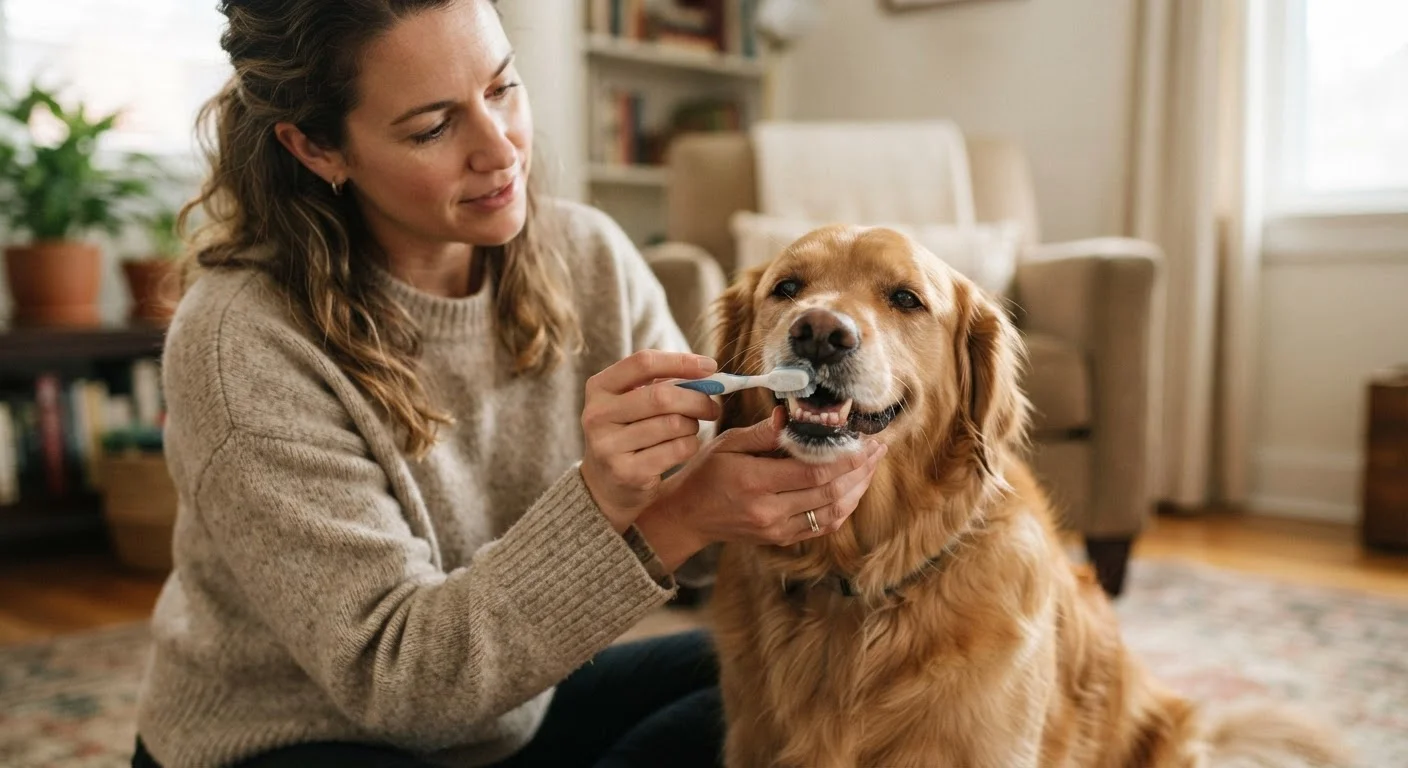
Once the myths are cleared away, a straightforward prevention picture emerges. Daily toothbrushing - using a toothbrush and toothpaste formulated specifically for dogs - is the most supported at-home intervention. Starting the habit during puppyhood makes acceptance much easier, but most adult dogs can be gradually conditioned to tolerate it with patience and positive reinforcement.
Products carrying the Veterinary Oral Health Council (VOHC) seal have met independently reviewed standards for plaque or tartar reduction, making that label a useful reference point when evaluating dental chews, water additives, or other adjunct products. These tools can contribute to oral health but should be viewed as additions to brushing rather than alternatives.
Anesthesia-Free Cleanings Are Not a Safe Alternative
Procedures marketed as "anesthesia-free" dental cleanings can remove visible surface tartar but cannot safely or thoroughly address subgingival disease - the primary driver of periodontal damage. Veterinary dental specialists, including the American Veterinary Dental College, do not consider these procedures an equivalent alternative to professional cleanings performed under anesthesia. If cost or anesthesia concern is a factor, discuss it with your veterinarian rather than substituting an unregulated procedure.
Professional cleanings performed by a veterinarian - including scaling below the gumline under anesthesia - remain essential for most adult dogs. Pre-anesthetic screening has made these procedures far safer than many owners assume, and a veterinarian can tailor the recommendation to a dog's age and health history. Because dental disease progresses silently, dogs that seem fine may still benefit from evaluation. This connects to a broader pattern worth knowing: our article on how dogs hide pain and discomfort explains why a seemingly comfortable dog may still need care.
Diet also plays a supporting role. While no feeding approach eliminates the need for mechanical cleaning, texture and consistency can influence plaque accumulation. For a deeper look at how feeding methods compare, see our breakdown of dry food, wet food, and raw diets.
~80%
Dogs with dental disease by age 3
Veterinary dental organizations estimate that around 80% of dogs show signs of periodontal disease by three years of age.
1 in 3
Dog owners who brush their pet's teeth regularly
Surveys of US pet owners consistently find that only a minority brush their dogs' teeth on a regular basis, despite it being the recommended standard.