
Iceland in Summer vs. Winter: What the Midnight Sun and Northern Lights Actually Mean for Your Trip

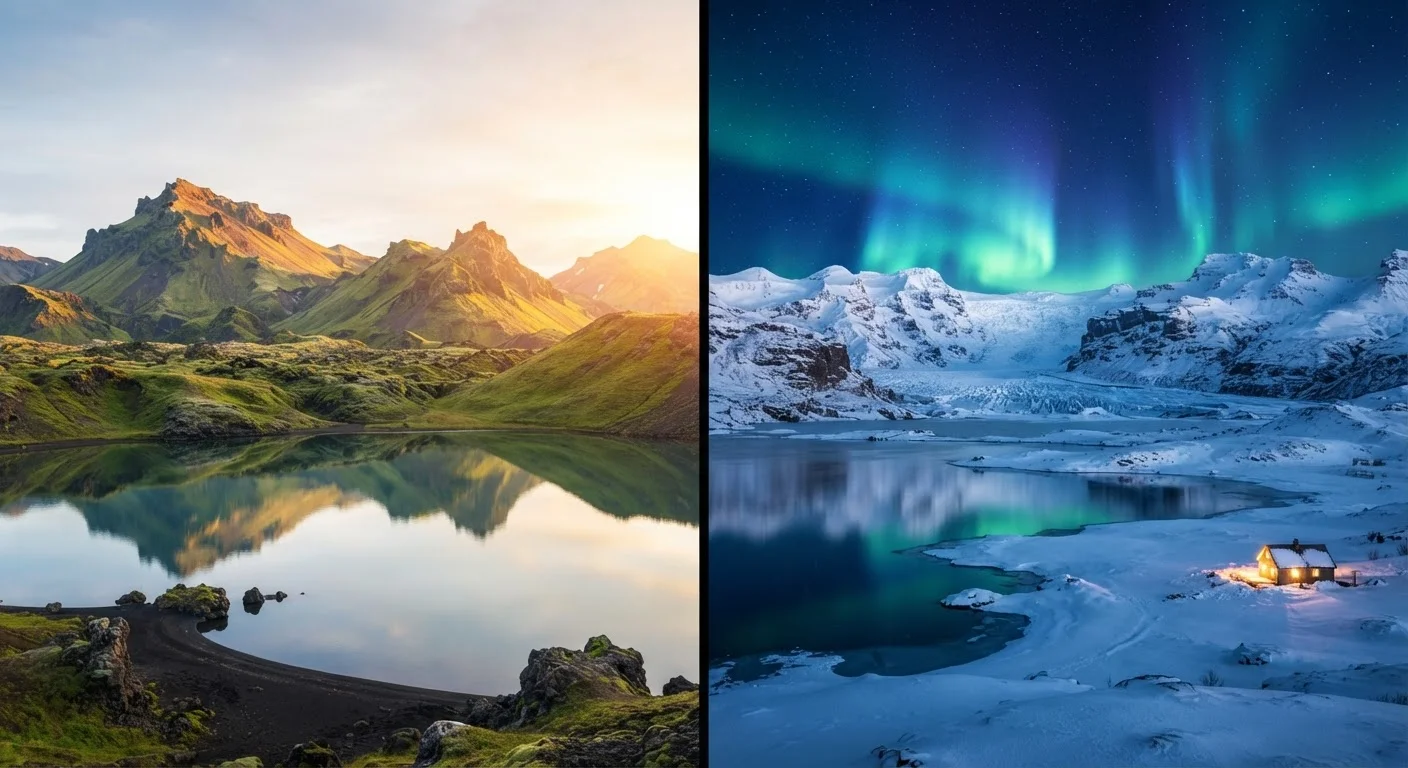
Key Takeaways
Option A
Iceland in Summer
The land of endless light and open roads.
Best for: Travelers who want maximum mobility, green landscapes, puffin sightings, and the surreal experience of a sun that never sets.
Option B
Iceland in Winter
The dramatic, aurora-chasing cold-season adventure.
Best for: Travelers drawn to northern lights, ice caves, snow-dusted lava fields, and a quieter, more atmospheric Iceland.
If you want to drive the entire Ring Road and explore the Highlands
Iceland in Summer
The Highlands (F-roads) only open between roughly June and September. Summer daylight means you can drive and hike at any hour without a headlamp.
If seeing the northern lights is your primary goal
Iceland in Winter
Dark skies from October through March give the aurora borealis its stage. You simply cannot see the lights during the near-continuous daylight of summer.
If you want to explore Vatnajökull's ice caves
Iceland in Winter
Natural ice caves are only stable and accessible from around November through March; they melt and become dangerous as temperatures rise in spring.
If you're traveling with family or prefer comfortable logistics
Iceland in Summer
Longer daylight, milder temperatures, and fully open tourist infrastructure make summer the more forgiving season for first-time visitors or families.
If you want fewer crowds and lower accommodation costs
Iceland in Winter
Outside of the holiday period, winter sees significantly fewer international visitors, and accommodation rates in Reykjavík and along the South Coast tend to be lower.
The Midnight Sun: More Than a Party Trick
From late May through mid-July, the sun barely dips below Iceland's horizon - and around the summer solstice, it doesn't set at all. This isn't just a novelty. It fundamentally rewrites how you experience travel. Hiking Landmannalaugar's rhyolite ridges at 11 p.m. in golden light, or watching Skógafoss glow amber at midnight, are moments that simply don't exist anywhere else on Earth at this scale.
But continuous daylight comes with a real practical catch: sleep. Blackout curtains in guesthouses help, but your body may rebel against the logic of going to bed at 2 a.m. with sunshine blazing through every gap. Light-blocking eye masks are not optional gear here - they're essential.
Wildlife watchers score big in summer. Atlantic puffins nest along cliffs at Látrabjarg and the Westfjords from roughly May through August. Whale watching tours out of Húsavík operate in longer weather windows. The interior Highlands - a raw, otherworldly landscape of obsidian lava and geothermal vents - only open to vehicles when snow recedes, typically between late June and early September.
| Criterion | Summer (Jun-Aug) | Winter (Nov-Feb) |
|---|---|---|
| Daylight | Up to 24 hours near solstice | 4-5 hours around solstice |
| Northern Lights | Not visible (too bright) | Possible on clear, dark nights |
| Ice Caves | Closed / unsafe | Open with guided tours |
| Highland F-Roads | Open (late Jun-early Sep) | Closed |
| Wildlife (Puffins, Whales) | Peak season | Very limited |
| Crowds | Peak - especially July | Much quieter |
| Typical Accommodation Cost | Higher (peak demand) | Generally lower |
| Driving Conditions | Mostly straightforward | Ice, snow; 4WD recommended |
The Northern Lights: What Tour Operators Don't Always Tell You
The aurora borealis is Iceland's winter calling card, and for good reason. Dark skies, relatively accessible terrain, and geomagnetic activity levels that frequently hit KP3 or higher make Iceland one of the world's most accessible aurora destinations. The viewing season runs roughly from late September through late March, when nights are long enough to offer real darkness.
Here's the honest caveat: the northern lights are a natural phenomenon, not a scheduled show. Cloud cover - Iceland's near-constant companion - can blank out an entire night. Solar activity fluctuates on its own timeline. Many visitors spend a week chasing the lights and see them clearly once; others get lucky on night one. Booking flexible accommodation and staying multiple nights dramatically improves your odds compared to a rushed two-day visit.
What winter does guarantee, regardless of aurora luck, is atmosphere. The South Coast under snow is strikingly different from its summer self - black sand beaches edged in ice, Seljalandsfoss partially frozen, and the kind of low blue light at noon that photographers chase obsessively.
~330
Aurora alerts issued per year in Iceland
The Icelandic Meteorological Office issues aurora forecasts daily; roughly 330 days per year see some level of geomagnetic activity recorded.
2.3M+
Annual international visitors to Iceland
Iceland Tourism figures indicate the majority of international arrivals cluster between June and August, heavily concentrating summer demand.
~5 hrs
Daylight hours near winter solstice
Around December 21, Reykjavík receives approximately 4-5 hours of usable daylight, dramatically limiting outdoor activity windows.
Landscapes, Road Access, and Getting Around
Summer opens Iceland up physically. The Ring Road (Route 1) is accessible year-round, but many secondary roads - including nearly all F-roads into the interior - remain closed until summer. If Þórsmörk, Landmannalaugar, or the Kjölur route are on your list, you're planning a summer trip.
Winter shrinks the map but sharpens the focus. Roads can close suddenly due to storms; the Icelandic Road and Coastal Administration website (road.is) is the traveler's bible for real-time conditions. Four-wheel drive is strongly recommended between October and April, and renting a vehicle suited to conditions isn't just practical - it's a safety matter.
Ice cave tours to Vatnajökull are a winter-only experience. Certified guides lead small groups into stunning blue-ice chambers that form each season - and that's the key word. These caves are dynamic, shifting structures; guided tours exist precisely because the terrain requires expert assessment. Never attempt to enter a glacier cave independently.
Check Road and Safety Conditions Before You Go
The Icelandic Road and Coastal Administration (road.is) provides real-time road status, including closures and hazard warnings. The Icelandic Meteorological Office (en.vedur.is) publishes both weather forecasts and aurora activity alerts. Always verify current conditions with these official sources before setting out - particularly in winter, when mountain road status can change within hours.
Both seasons reward travelers who build in flexibility. Icelandic weather can shift from sunshine to sideways sleet in under an hour at any time of year. The travelers who come away happiest tend to be those who treat the itinerary as a framework, not a contract.