

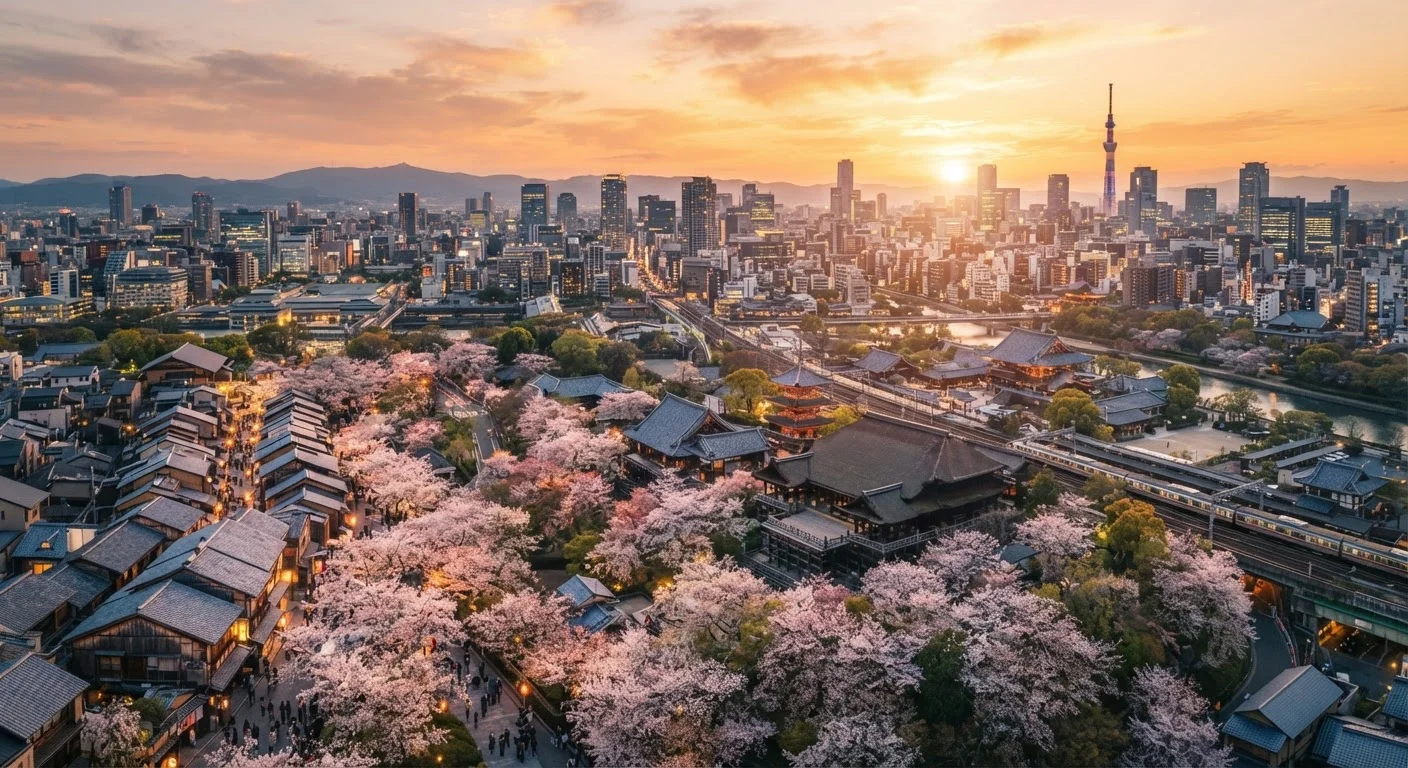
How Japan's Regions Work - and Why It Matters for Trip Planning
Japan is divided into eight main regional groupings, each containing multiple prefectures. For most first-time visitors, itineraries concentrate on Kanto (home to Tokyo) and Kansai (home to Kyoto, Osaka, and Nara) - two distinct cultural zones connected by the Shinkansen in about two and a half hours. Understanding which region holds what helps you stop treating Japan as a single blur of highlights and start building a trip with actual logic.
One useful framework: think of Kanto as Japan's forward-facing identity - commerce, innovation, pop culture - and Kansai as its inward-looking soul - imperial history, temple architecture, and a fiercely local food pride. Both are essential; neither is a substitute for the other.
Tokyo and the Kanto Region
Tokyo is so large it functions as several cities stacked together. Shinjuku delivers neon-lit nightlife and a rail hub that handles more passengers than any station on Earth. Asakusa preserves Edo-period streetscapes and the iconic Senso-ji temple. Shibuya and Harajuku broadcast youth fashion and pop culture globally. Akihabara pulses with electronics and anime.
Beyond the capital, Nikko (ornate mountain shrines, a UNESCO site) and Kamakura (coastal, with a giant bronze Buddha and Zen temples) are both reachable as day trips, making Kanto a natural base for covering a wide range of experiences without changing hotels.
Shinkansen
Japan's high-speed bullet train network connecting major cities across the country. It is the primary intercity transport backbone for travelers moving between Tokyo, Kyoto, Osaka, and other key destinations.
Torii gate
A traditional Japanese gate marking the entrance to a Shinto shrine. Torii gates signal a transition from the secular world to sacred space and are among Japan's most recognizable visual symbols.
Kansai
A regional grouping in central-western Japan encompassing Osaka, Kyoto, Nara, Kobe, and surrounding prefectures. Kansai is considered the cultural and culinary heartland of the country.
Prefecture
Japan's primary administrative division, roughly equivalent to a U.S. state. There are 47 prefectures, each with its own governor and assembly.
Ryokan
A traditional Japanese inn featuring tatami-mat rooms, futon bedding, and often multi-course kaiseki meals. Ryokan are found throughout Japan's regions and offer a culturally immersive stay distinct from Western-style hotels.
Kyoto, Osaka, and the Kansai Region
Kyoto served as Japan's imperial capital for over a millennium. Its concentration of UNESCO World Heritage sites - including Kinkaku-ji (the Golden Pavilion), Fushimi Inari's thousands of torii gates, and the Arashiyama bamboo groves - is unmatched. It rewards slow travel; trying to sprint through it in a single day is a common regret among visitors.
Osaka, 15 minutes from Kyoto by express train, offers a deliberate contrast. It's louder, cheaper to eat in, and anchored by a street-food culture centered on Dotonbori. Osaka Castle and the Osaka Aquarium Kaiyukan are crowd-pleasers, but the city's real draw is the cumulative energy of its neighborhoods.
Nara, easily reached from both cities, is compact and genuinely memorable - free-roaming deer share space with Todai-ji, home to Japan's largest bronze Buddha statue. Most visitors spend half a day here before continuing their Kansai loop.
17
UNESCO World Heritage Sites in Kyoto alone
Kyoto's Historic Monuments are listed collectively on the UNESCO World Heritage List, comprising 17 distinct properties.
3,000+
Torii gates at Fushimi Inari Shrine
The Fushimi Inari Taisha shrine in Kyoto is lined with thousands of vermilion torii gates donated by worshippers and businesses over centuries.
~500
Free-roaming deer in Nara Park
Nara Park is home to several hundred sika deer considered sacred messengers in the Shinto tradition, permitted to wander freely among visitors.
Beyond the Beaten Path: Hiroshima, Hokkaido, and the Rest
Travelers with more than a week to spare gain access to regions that reward effort with outsized payoff.
- Hiroshima and Miyajima (Chugoku region): The Peace Memorial Museum and the floating torii gate of Itsukushima Shrine together form one of Japan's most emotionally significant day-trip pairings.
- Hakone and the Fuji Five Lakes (Chubu region): The clearest views of Mt. Fuji, hot spring resorts, and open-air sculpture parks sit just 90 minutes from Tokyo.
- Hokkaido: Japan's northern island runs on a different ecological clock - lavender fields in summer, world-class powder snow in winter, and a seafood culture built around exceptional crab and sea urchin.
- Okinawa: Subtropical, historically distinct from the mainland, and home to coral reefs and a unique Ryukyuan culinary tradition.
Each of these demands at least an overnight stay to feel worthwhile. Treat them as intentional extensions rather than checklist additions.