

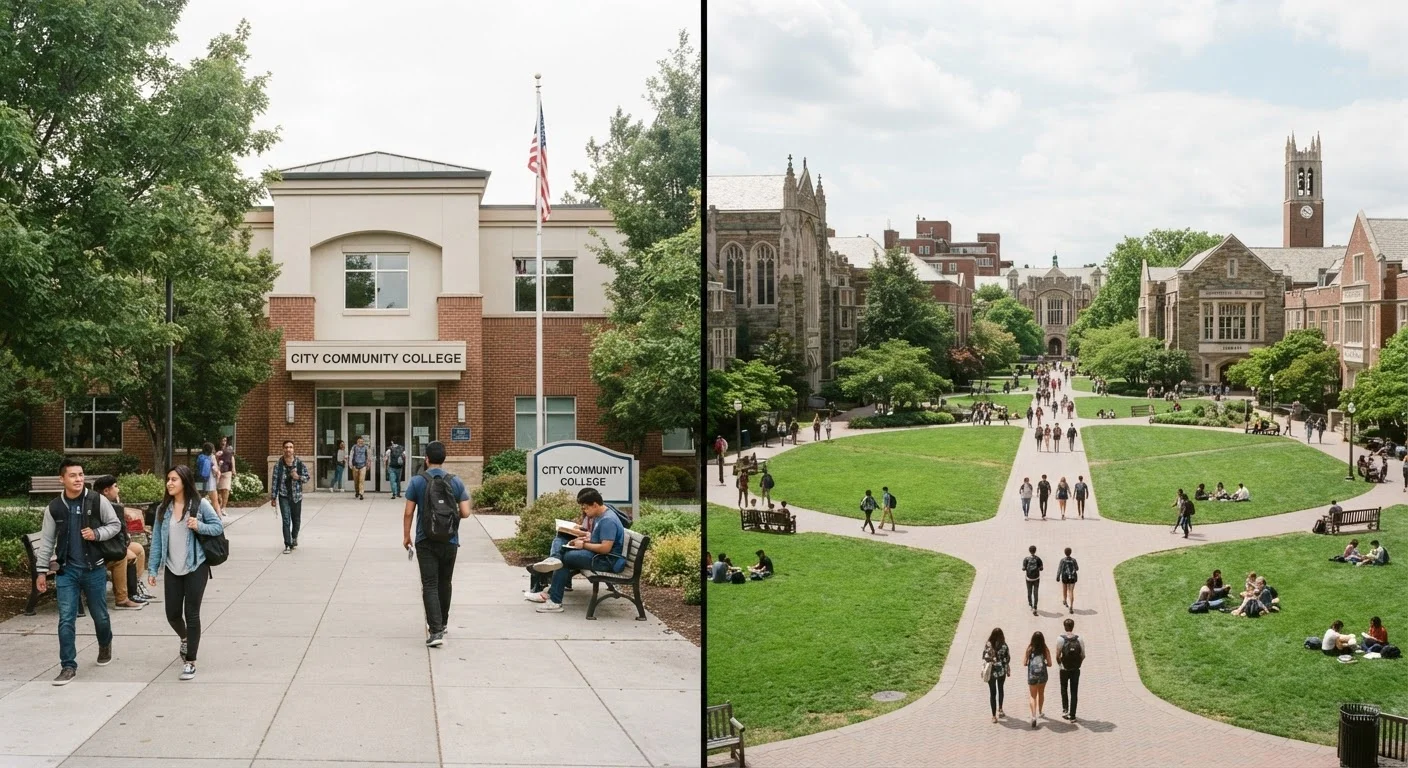
Key Takeaways
Option A
Community College
The affordable, flexible on-ramp to higher education.
Best for: Adults seeking lower costs, shorter programs, or a stepping stone toward a bachelor's degree.
Option B
Four-Year University
The comprehensive, credential-driven academic experience.
Best for: Students pursuing bachelor's or advanced degrees, broader research opportunities, and extensive campus life.
If you want to reduce education costs in the first two years
Community College
Average community college tuition is a fraction of four-year university rates, and transfer pathways mean you can still earn a bachelor's degree without paying four full years of university tuition.
If you need scheduling flexibility around work or family
Community College
Community colleges typically offer evening, weekend, and online sections designed for students who cannot attend full-time daytime classes.
If your career field requires a bachelor's degree or specialized research access
Four-Year University
Professions such as engineering, nursing, and education often require accredited four-year degrees, and universities provide direct access to research labs, internship pipelines, and alumni networks.
If you want a traditional campus experience with extracurriculars and housing
Four-Year University
Four-year universities offer residential living, varsity athletics, student organizations, and a broader social infrastructure that community colleges rarely replicate.
If you are exploring majors and are unsure of your direction
Community College
Starting at a community college lets you fulfill general education requirements at lower cost while you clarify your academic and career goals before committing to a specific university program.
Cost and Financial Commitment
Cost is the most concrete difference between the two paths. According to the College Board, average published tuition and fees at public two-year colleges run significantly lower than at public four-year institutions - and the gap widens further when comparing with private four-year universities. For many households, starting at a community college and transferring can reduce total borrowing by tens of thousands of dollars.
Financial aid is available at both institution types, including federal Pell Grants and loans. However, community college students who attend part-time - a common pattern among working adults - may receive proportionally less grant aid, so it is worth running the numbers through the FAFSA process at each school you are considering. For a broader look at how cost compares across multiple education formats, see our college vs. trade school vs. certification breakdown.
| Criterion | Community College | Four-Year University |
|---|---|---|
| Average annual tuition (public) | ~$3,900 (College Board est.) | ~$11,260 in-state (College Board est.) |
| Degree awarded | Associate degree or certificate | Bachelor's (and graduate) degree |
| Typical program length | 1-2 years | 4 years |
| Scheduling flexibility | High - evening, weekend, online | Moderate - varies by program |
| Residential housing | Rarely available | Widely available |
| Research opportunities | Limited | Broad, including graduate-level labs |
| Transfer pathway to bachelor's | Yes, via articulation agreements | N/A - degree conferred directly |
| Student population | Highly diverse ages and backgrounds | Predominantly traditional-age students |
Academics, Programs, and Transfer Pathways
Community colleges award associate degrees (typically two years) and certificates. Their general education courses cover the same foundational content - English composition, mathematics, social sciences - that students complete in the first two years of a bachelor's program. Many states have formal articulation agreements guaranteeing that credits earned at in-state community colleges transfer cleanly to public universities. California's TAG program and Florida's Statewide Articulation Agreement are well-known examples.
That said, transfer outcomes vary. Not every community college credit transfers to every program, and competitive majors such as nursing or computer science may have limited transfer seats. Before enrolling with a transfer goal in mind, confirm the specifics. Our article on how credit transfer works and where it gets complicated explains what to verify.
Four-year universities offer a full range of bachelor's programs, along with graduate schools, research centers, and specialized labs unavailable at most two-year colleges. If your target career field requires a bachelor's degree from an accredited program - engineering, architecture, many healthcare roles - a four-year institution may be the more direct route.
45%
Bachelor's graduates who started at community college
The National Student Clearinghouse Research Center has found that roughly 45% of students who completed a bachelor's degree had enrolled at a two-year institution at some point.
~$3,900
Average public community college tuition per year
The College Board's Trends in College Pricing report tracks average published tuition and fees at public two-year colleges annually.
~$11,260
Average in-state tuition at public four-year universities
Also sourced from the College Board's Trends in College Pricing, representing average published in-state tuition and fees at public four-year institutions.
Campus Life, Support Services, and Networking
Four-year universities typically offer residential housing, student organizations, varsity and intramural sports, and a robust alumni network - all of which can contribute to professional connections and personal development. For students aged 18-22 moving away from home for the first time, this environment provides structure alongside academics.
Community colleges serve a more diverse student population: recent high school graduates, working adults, career changers, and retirees often share the same classrooms. Campus life is generally less immersive - fewer residential options, smaller clubs - but student services such as tutoring, counseling, and career advising are widely available and increasingly robust. Many community colleges have strengthened employer partnerships in fields like healthcare, manufacturing, and IT.
For students weighing whether a physical campus matters to them at all, our comparison of online degrees vs. on-campus degrees covers flexibility and employer perception in detail.
Articulation Agreements Vary by State and School
A formal articulation agreement guarantees that credits earned at one institution will transfer toward a specific program at another. These agreements exist throughout the U.S. but differ significantly in scope. Some cover all general education credits; others are program-specific. Always confirm the agreement details with both the sending and receiving institutions before enrolling, and get transfer requirements in writing.
Which Path Fits Your Goals?
Neither institution type is inherently superior. A community college is a strong choice if you need to manage costs, maintain work or caregiving commitments, or want time to clarify your direction before committing to a major. A four-year university is more appropriate when your target profession requires a bachelor's degree from the start, when you want immersive campus experiences, or when graduate school is a near-term goal.
Many students combine both: two years at a community college followed by two years at a university to complete a bachelor's degree. When the transfer pathway is confirmed in advance, this hybrid approach delivers a four-year credential at materially lower total cost. For a wider-angle view of all post-secondary options - including trade schools and professional certifications - see every U.S. institution type explained.