

Key Takeaways
Our Verdict
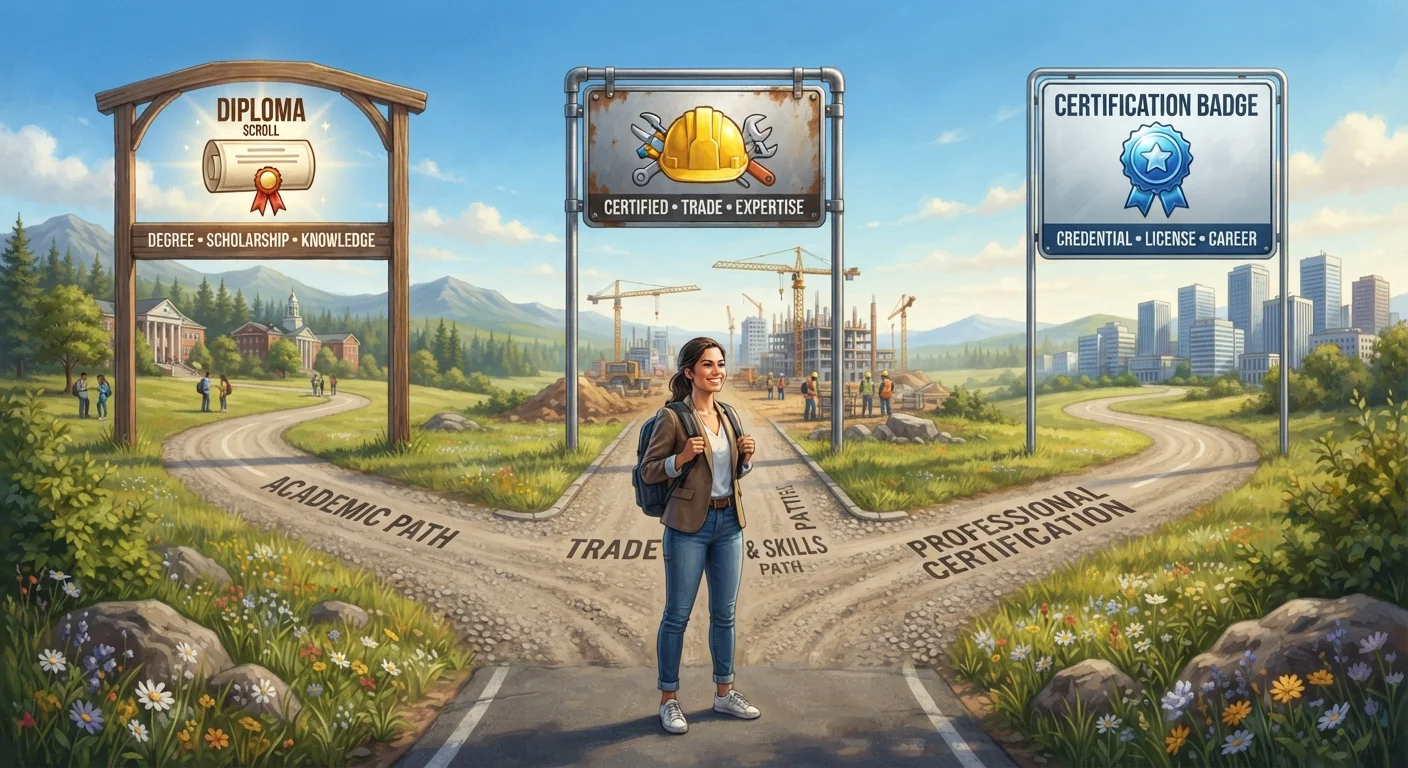
Each path serves a different set of goals, timelines, and budgets. Four-year college remains relevant for careers requiring licensure or advanced theoretical grounding. Trade school offers a direct, cost-efficient route into skilled, high-demand work. Certifications suit those pivoting careers or adding specific skills quickly. The decision should be anchored in the requirements of your target job, not assumptions about prestige.
| Best for | Recommended |
|---|---|
| Those targeting careers requiring a bachelor's degree (engineering, teaching, nursing, law) | Four-Year College |
| Those seeking hands-on, licensed trades like HVAC, electrical, or plumbing | Trade School |
| Those pivoting into IT, project management, or healthcare support roles quickly | Professional Certification |
| Those wanting to test a field before committing to a longer degree program | Professional Certification |
Why This Decision Matters More Than Ever
The phrase "you need a college degree" dominated career advice for decades. Today, employers, researchers, and workers themselves are asking harder questions about what education actually delivers-and at what cost. The U.S. Bureau of Labor Statistics projects strong growth in skilled trades, healthcare support, and technology fields, many of which do not require a four-year degree.
This comparison breaks down three main post-secondary paths-four-year college, trade school, and professional certifications-so you can match a path to your actual goals rather than assumptions. For a broader look at how different institution types fit together, see every U.S. college type explained.
| Four-Year College | Trade School | Professional Certification | |
|---|---|---|---|
| Typical Duration | 4+ years | 6 months - 2 years | Weeks to months |
| Average Cost Range | High (tens of thousands) | Moderate (thousands) | Low (hundreds to low thousands) |
| Financial Aid Eligible | Yes (federal & institutional) | Often yes (federal aid) | Rarely (some employer funding) |
| Credential Issued | Bachelor's degree | Diploma/Associate degree | Industry certificate |
| Career Entry Speed | Slower | Moderate | Fastest |
| Employer Recognition | Broad, widely required | Strong in skilled trades | Field-specific |
| Stackable Over Time | Somewhat (minors, graduate) | Limited | Highly stackable |
Four-Year College: Broad Foundation, Higher Stakes
A bachelor's degree typically takes four years of full-time study and signals a wide range of analytical and communication skills to employers. It remains a firm requirement for careers in fields like engineering, education, social work, and many healthcare roles. According to federal data, bachelor's degree holders earn meaningfully more over a lifetime than those with only a high school diploma-though the gap varies considerably by major and occupation.
The trade-off is significant. Average annual tuition at a four-year public university (in-state) runs into the tens of thousands of dollars when room and board are included, and private institutions cost far more. Student debt is a real consideration. If you're weighing a four-year university against a community college start, this side-by-side comparison covers cost, academics, and outcomes in detail. Choosing the right major also matters enormously-evidence-based major guidance can help you evaluate your options honestly.
Start With Job Postings, Not Assumptions
Before committing to any path, search current job listings for roles you genuinely want. Note whether employers list a degree as required or preferred-that single distinction can change your entire calculus. Many roles in IT, healthcare support, and skilled trades list experience and credentials as equally valid alternatives to a four-year degree.
Trade School: Faster Entry, Targeted Skills
Trade and vocational programs-covering fields like HVAC, welding, medical assisting, electrical work, cosmetology, and automotive technology-typically run between six months and two years. Tuition is substantially lower than a four-year college, and many programs qualify for federal financial aid.
Critically, skilled trades face persistent labor shortages in the U.S., which supports strong job placement for qualified graduates. Many trades also require state licensure exams, which programs prepare students to pass. If you want a realistic picture of how trade programs work, this trade school primer explains program structures, fields, and the licensure path. And if you've heard trade school dismissed as a lesser choice, this breakdown of trade school myths addresses those assumptions directly with evidence.
Professional Certifications: Fast, Focused, and Stackable
Professional certifications validate a specific skill or knowledge area recognized by an industry-think IT infrastructure, project management, medical billing, or cybersecurity. Most can be earned in weeks to months and cost hundreds, not thousands, of dollars. Some require prior experience; others are entry-level accessible.
Certifications are particularly valuable in fast-moving fields where employer demand shifts quickly and practical skills matter more than academic credentials. They are also stackable-you can add new certifications as your career evolves. For an overview of which certification categories carry weight in which industries, see professional certifications worth understanding and industry certifications by field.
One important caveat: certifications alone rarely substitute for a degree in roles where a degree is legally or contractually required. Research the actual job postings in your target field before assuming a certification will be sufficient.
Certifications Don't Replace Required Degrees
In regulated fields-nursing, engineering, teaching, social work-a professional certification rarely meets the statutory or employer requirements tied to a degree or state license. Before investing in a certification program, verify with actual job postings and state licensing boards what credentials are legally required for the role you're targeting. Assumptions here can cost significant time and money.
How to Choose: A Practical Framework
Start with the job, not the credential. Look at job postings for roles you actually want and note what education level appears in requirements versus preferences. If a license is mandatory (electrician, RN, teacher), that license will dictate your path. If postings list a degree as preferred rather than required, a certification or trade credential may still open the door.
Consider three filters when evaluating your options:
- Time: How quickly do you need to enter or re-enter the workforce? Certifications take weeks to months. Trade programs take months to two years. A bachelor's degree takes four or more years.
- Cost: What can you realistically fund without taking on unsustainable debt? Certifications are lowest cost; four-year college is highest. Bootcamps and MOOCs offer a middle ground worth exploring for technical fields.
- Career ceiling: Does your target role or industry require graduate-level credentials eventually? If so, see graduate school trade-offs before locking into a path.
Many adults also combine paths over time-earning a certification to start working, then completing a degree part-time. That flexibility is one of the most underused options available.