

Key Takeaways
Option A
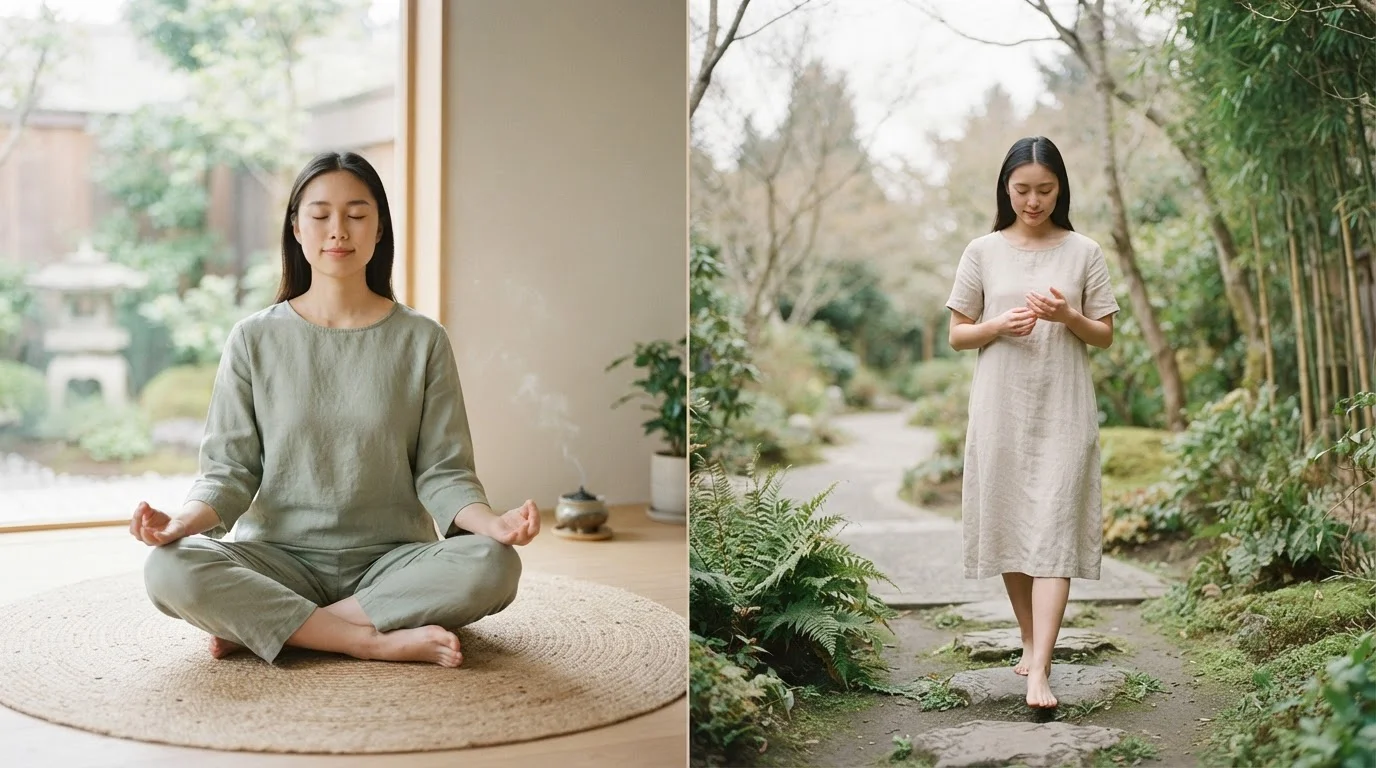
Mindfulness
An ongoing quality of awareness you can bring to any moment.
Best for: People who want to integrate present-moment awareness into everyday activities without setting aside dedicated practice time.
Option B
Meditation
A structured, intentional practice with a defined beginning and end.
Best for: People seeking a focused, repeatable technique to train attention and cultivate mental calm over time.
If you want to reduce stress without committing to a daily sitting practice
Mindfulness
Mindful awareness can be layered onto existing routines - eating, walking, or washing dishes - making it highly accessible with no extra time block needed.
If you want a structured, skill-building mental wellness habit
Meditation
Formal meditation sessions provide a consistent framework for training attention and observing thought patterns, which many people find easier to track and build on.
If you're entirely new to both and not sure where to start
Mindfulness
Starting with informal mindfulness - simply noticing your breath or surroundings for a minute - lowers the barrier to entry and builds comfort before adding formal sessions.
If you want the deepest long-term development of mental clarity
Meditation
Consistent formal practice is associated with more measurable changes in attention and emotional regulation over time, according to established research literature.
What Each Term Actually Means
Mindfulness refers to a quality of attention - the capacity to notice what is happening right now, in your thoughts, body, or environment, without immediately judging or reacting. It is not a technique you do; it is a way of being present. You can bring mindfulness to a conversation, a meal, or a commute.
Meditation, by contrast, is a deliberate practice - a set activity with a beginning, a duration, and an end. Within a meditation session you might focus on the breath, repeat a phrase silently, visualize an image, or simply observe arising thoughts. The session itself is the practice, not a background quality you carry through the day.
The confusion is understandable: many popular meditation techniques - including breath-awareness and body-scan exercises - are specifically designed to cultivate mindfulness. That makes meditation one method for building mindful awareness, not a synonym for it. Think of mindfulness as the destination and meditation as one well-mapped road to get there. As our related article explains, mental wellness encompasses far more than any single habit, and both practices fit within that broader picture.
How They Differ in Practice
The clearest way to see the distinction is to look at how each shows up during an ordinary day.
| Criterion | Mindfulness | Meditation |
|---|---|---|
| What it is | A quality of present-moment awareness | A formal, structured practice |
| When it happens | Anytime, during daily activities | During dedicated sessions |
| Time required | No extra time block needed | Typically 5-30+ minutes per session |
| Common techniques | Mindful eating, walking, breathing | Breath focus, body scan, mantra |
| Learning curve | Low - can start immediately | Moderate - benefits from guidance |
| Evidence base | Emerging; mostly informal studies | Stronger; structured program research |
| Goal | Present-moment awareness in daily life | Training attention and mental clarity |
Mindfulness asks you to notice - without stopping what you are doing. Meditation asks you to pause, sit (or lie still), and give a technique your full, uninterrupted attention. Both require some effort, but in different modes. Mindfulness is distributed throughout the day in small doses; meditation is concentrated into one deliberate block.
This also means failure looks different. With mindfulness, a lapse is simply a moment of automatic pilot - you catch it and return. With meditation, a session missed is a session missed, which is why consistency can feel harder for some people. For practical context on building any new mental wellness habit, a structured self-check can help you spot gaps in your current routine.
What the Research Broadly Suggests
A substantial body of research - including large reviews published in journals such as JAMA Internal Medicine and Psychological Bulletin - indicates that mindfulness-based programs and formal meditation practices are associated with reductions in self-reported stress, anxiety, and rumination. However, researchers also note that effect sizes vary, study quality is uneven, and results are not universal.
~47%
Time the mind wanders from the present task
A Harvard study published in Science found that mind-wandering occurred during roughly 47% of waking hours, highlighting why present-moment awareness is a trainable skill.
8 weeks
Duration of standard MBSR programs studied
The widely researched Mindfulness-Based Stress Reduction (MBSR) program, developed at the University of Massachusetts, uses an 8-week structured curriculum.
~0.38
Average effect size for meditation on anxiety
A 2014 meta-analysis in JAMA Internal Medicine found a moderate effect size (Cohen's d ≈ 0.38) for mindfulness meditation programs on anxiety symptoms.
It is worth noting that most clinical studies examine structured programs - such as Mindfulness-Based Stress Reduction (MBSR) - rather than informal daily mindfulness alone. That does not mean informal practice is without value, but the evidence base is stronger for structured, formal approaches. If you're exploring related tools, a side-by-side look at stress management strategies can help you see how meditation and mindfulness compare to other approaches like breathwork or progressive muscle relaxation.
This article is for general informational and educational purposes only and does not constitute medical or mental health advice. If you have concerns about your mental health, please consult a qualified healthcare professional.
Combining Both for Everyday Mental Wellness
The most practical take-home is that mindfulness and meditation are not competitors - they reinforce each other. Regular formal meditation builds the attentional muscle; everyday mindfulness keeps that muscle in use between sessions. Many practitioners find that even brief formal sessions (research often uses 10-20 minute periods) make it noticeably easier to return to present-moment awareness during a stressful afternoon.
If you're not sure how to begin, start with informal mindfulness: pick one routine activity and give it your complete attention for its duration. When that feels natural, consider adding a short, guided meditation session a few times a week. Our beginner's guide to mindfulness walks through simple starting points that require no prior experience. You might also notice parallels with how people approach learning - just as short daily lessons and intensive deep study sessions serve different purposes, brief mindful moments and longer meditation sessions each have a distinct role.
Mindfulness Is Not the Same as Relaxation
A common misconception is that mindfulness and meditation are simply relaxation techniques. While they may produce a calmer state, their primary aim is cultivated awareness - not necessarily relaxation. In fact, some meditation practices deliberately engage with uncomfortable thoughts or sensations rather than avoiding them. If relaxation is your primary goal, techniques like progressive muscle relaxation or controlled breathwork may be more directly suited - see our overview of breathwork techniques for a balanced look at that approach.