

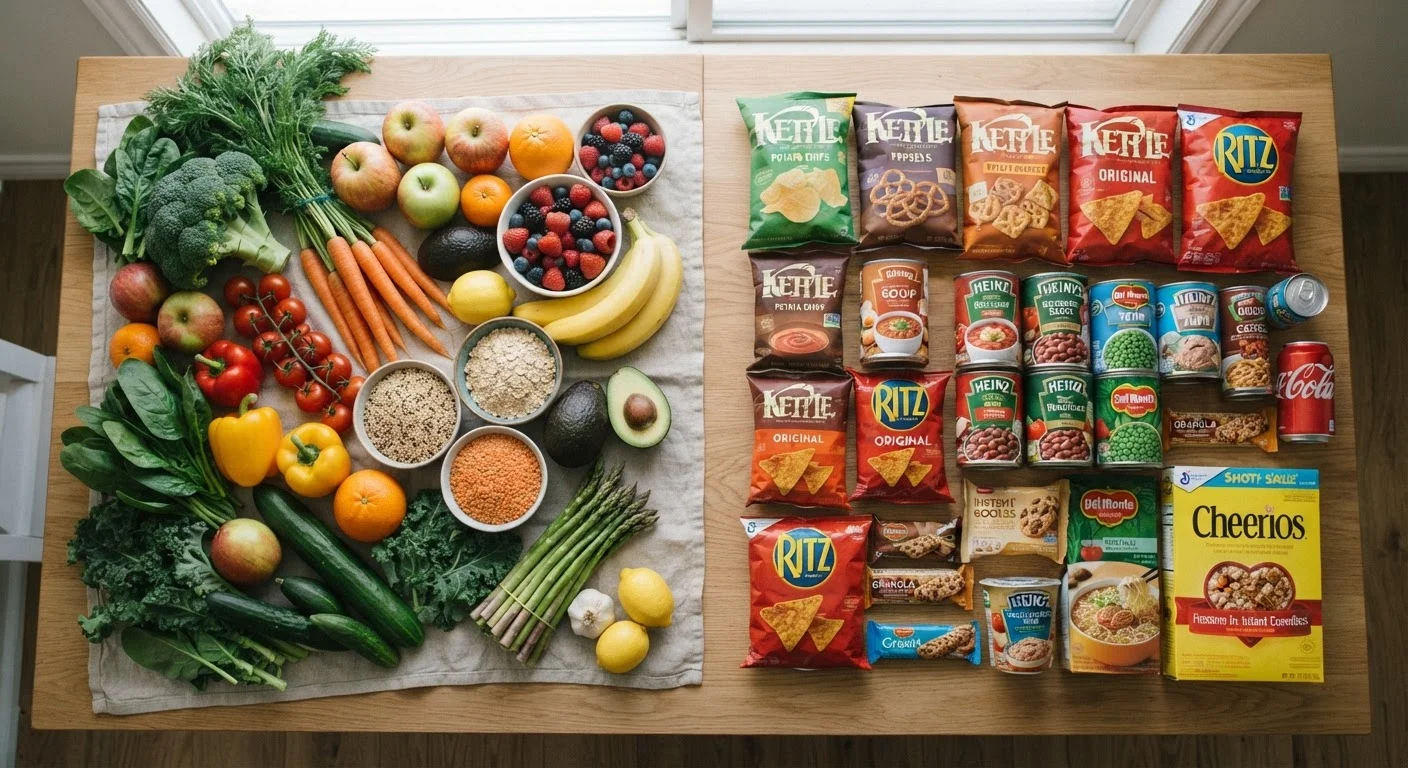
Key Takeaways
Option A
Whole Foods
The minimally altered, nutrient-dense baseline.
Best for: People looking to maximize nutrient density and reduce additives in their everyday diet.
Option B
Processed Foods
A broad spectrum from lightly modified to heavily engineered.
Best for: People who need convenience, shelf stability, or affordability without abandoning nutrition entirely.
If you want to maximize nutrient density with every meal
Whole Foods
Whole foods retain the full complement of fiber, micronutrients, and phytonutrients that processing can diminish. They form the nutritional backbone most dietary guidance frameworks recommend.
If convenience and shelf life are non-negotiable in your household
Processed Foods
Minimally processed items like canned legumes, frozen produce, and fortified whole-grain cereals can anchor a nutritious diet while fitting demanding schedules and tighter budgets.
If you are trying to reduce added sugar, sodium, and refined fats
Whole Foods
Whole foods naturally contain little to no added sugars or sodium. Shifting toward them is one of the most straightforward ways to reduce intake of these commonly over-consumed nutrients.
If you are building a realistic, sustainable everyday eating pattern
Processed Foods
A pragmatic approach includes both whole and selectively processed foods. Rigidly avoiding all processing is often unnecessary and can make healthy eating feel unattainable.
Defining the Terms: More Than a Simple Binary
The phrase "processed food" conjures images of neon-colored snacks and fast food, but the reality is more layered. The NOVA classification system, developed by nutrition researchers at the University of São Paulo, organizes foods into four groups based on the extent and purpose of processing - from unprocessed or minimally processed foods all the way to ultra-processed formulations designed primarily for palatability and shelf life.
Whole foods are those closest to their natural state: fresh or frozen vegetables, fruits, legumes, eggs, unground nuts, and whole grains. Processed foods span a vast middle ground - canned tomatoes, pasteurized milk, and smoked fish sit in the same broad category as packaged cookies and reconstituted meat products, even though their nutritional profiles are worlds apart.
Understanding where a food falls on this spectrum - rather than applying a binary label - is what makes the comparison genuinely useful. Knowing how to read packaging is part of that skill; the guide to food label claims covers regulated terms versus marketing language in depth.
| Criterion | Whole Foods | Processed Foods |
|---|---|---|
| Definition | Unaltered or minimally modified from natural state | Altered by any industrial process or additive |
| Fiber retention | Generally high and intact | Often reduced; varies by processing level |
| Added sugars & sodium | Naturally low to none | Frequently elevated in ultra-processed products |
| Micronutrient density | Typically higher per calorie | Variable; fortification can offset losses |
| Shelf life & convenience | Often short; requires fresh sourcing | Extended; easier to store and prepare quickly |
| Cost accessibility | Can be higher, especially out of season | Often lower; canned/frozen options are affordable |
| Additives & preservatives | None | Common in packaged and ultra-processed items |
Nutritional Trade-Offs Across the Spectrum
Whole foods tend to preserve the structural integrity of nutrients. Fiber in a whole apple, for instance, slows glucose absorption in a way that apple juice - even 100% juice - does not replicate. Minimally processed foods like steel-cut oats retain most of this benefit, while instant oats lose some texture and have a higher glycemic index due to additional milling.
Heavy processing often introduces what nutrition researchers call "energy-dense, nutrient-poor" characteristics. Ultra-processed products frequently derive a large share of calories from refined starches, added sugars, and saturated or trans fats, while displacing fiber and micronutrients. Sodium levels also climb significantly in many packaged products compared to home-prepared equivalents.
57%
Share of U.S. calories from ultra-processed foods
Research published in BMJ Open found that ultra-processed foods account for roughly 57% of total caloric intake in the average American diet.
~2x
Added sugar in ultra-processed vs. minimally processed foods
Studies analyzing NOVA-classified diets consistently show ultra-processed foods contribute disproportionately to added sugar consumption compared to minimally processed alternatives.
Top source
Ultra-processed foods as sodium contributors
The U.S. Dietary Guidelines Advisory Committee identifies packaged and ultra-processed foods as the primary source of excess sodium in American diets.
That said, processing can genuinely enhance nutrition in some cases. Fortification adds iron and B vitamins to refined grain products that would otherwise be stripped during milling. Pasteurization eliminates pathogens from dairy and juice. Fermentation creates beneficial compounds in yogurt and kefir. These examples illustrate why the conversation needs to move beyond "processed = bad."
Protein quality is another dimension worth examining across food forms. How protein completeness and bioavailability vary across whole and processed sources offers a useful companion perspective.
Practicality, Access, and the Real-World Picture
Nutrition science does not exist in a vacuum. Cost, geography, time, and cultural context all shape what ends up on a plate. Fresh produce in food deserts can be scarce or prohibitively expensive, while canned and frozen options - often equally nutritious - remain accessible year-round at lower price points. Frozen vegetables are typically harvested at peak ripeness and flash-frozen, which locks in micronutrients effectively.
A practical approach treats whole foods as the preferred foundation while using minimally processed options strategically. Checking what's already in your kitchen against nutritional goals is a useful habit; a weekly grocery audit can help identify gaps across food groups without requiring a complete dietary overhaul.
The key distinction most nutrition professionals draw is between minimally processed foods - which preserve most of their original nutrients - and ultra-processed products, which are engineered for hyper-palatability and offer limited nutritional return. Navigating that distinction consistently, rather than pursuing an all-or-nothing whole-foods ideal, tends to be both more achievable and more sustainable for most people.
This article is for general informational and educational purposes only and is not a substitute for personalized dietary or medical advice. Consult a qualified healthcare professional or registered dietitian for guidance specific to your health needs.