
Food Labels and Health Claims: What Terms Like 'Natural' and 'Low-Fat' Actually Mean

| Regulator of food label claims (U.S.) | U.S. Food and Drug Administration (FDA) (FDA.gov, current labeling regulations) |
| "Low-fat" FDA threshold | 3g or less of fat per serving (FDA nutrient content claim definitions) |
| "Low-sodium" FDA threshold | 140mg or less of sodium per serving (FDA nutrient content claim definitions) |
| "Calorie-free" FDA threshold | Fewer than 5 calories per serving (FDA nutrient content claim definitions) |
| "Natural" - regulatory status | No formal FDA rule; informal guidance only (FDA.gov, "Use of the Term Natural") |
| "High in" nutrient claim threshold | 20% or more of Daily Value per serving (FDA nutrient content claim definitions) |
Why Front-of-Package Language Is Often Confusing
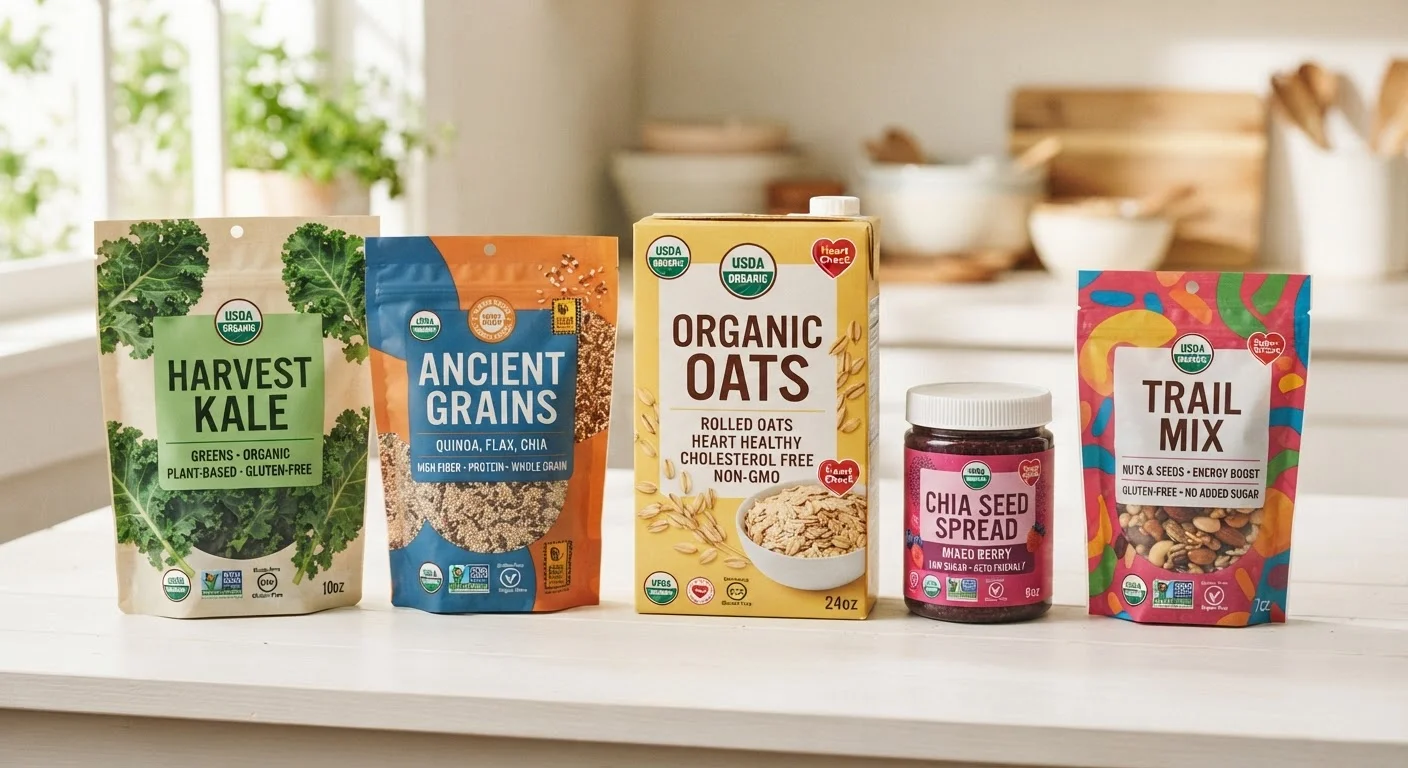
Walk through any grocery store aisle and you'll encounter a barrage of terms designed to catch your eye: "natural," "low-fat," "multigrain," "clean," "wholesome." These phrases feel meaningful, but their actual significance varies dramatically depending on whether a regulatory body defines them, whether enforcement exists, and what trade-offs may be hidden inside the package.
The U.S. Food and Drug Administration (FDA) regulates some nutrient content claims with precise definitions. Other terms on front-of-package labels carry no legal definition at all and are essentially marketing language. Understanding which is which is one of the most practical nutrition skills you can develop. For a deeper look at what's inside the package itself, see how to read a Nutrition Facts label.
| Regulator of food label claims (U.S.) | U.S. Food and Drug Administration (FDA) (FDA.gov, current labeling regulations) |
| "Low-fat" FDA threshold | 3g or less of fat per serving (FDA nutrient content claim definitions) |
| "Low-sodium" FDA threshold | 140mg or less of sodium per serving (FDA nutrient content claim definitions) |
| "Calorie-free" FDA threshold | Fewer than 5 calories per serving (FDA nutrient content claim definitions) |
| "Natural" - regulatory status | No formal FDA rule; informal guidance only (FDA.gov, "Use of the Term Natural") |
| "High in" nutrient claim threshold | 20% or more of Daily Value per serving (FDA nutrient content claim definitions) |
Terms the FDA Has Defined - and What They Require
Several common label terms have specific, legally enforced meanings under FDA rules. Manufacturers must meet numerical thresholds to use them.
Nutrient Content Claim
A label statement that characterizes the level of a nutrient in a food, such as "low fat" or "high fiber." The FDA defines specific numerical thresholds that must be met before these terms can be used.
Low-Fat
An FDA-defined term meaning the product contains 3 grams or less of total fat per serving. It says nothing about calorie content, sugar levels, or overall nutritional quality.
Reduced / Less
FDA-regulated terms indicating the product contains at least 25% less of a given nutrient compared to a reference food. The comparison product must be identified on the label.
Light (Lite)
An FDA-regulated term meaning the product contains at least one-third fewer calories or 50% less fat than a reference food, or 50% less sodium in certain low-calorie, low-fat foods.
Health Claim
A label statement describing a relationship between a food, nutrient, or dietary substance and a disease or health condition. Health claims require FDA authorization based on scientific evidence.
Structure/Function Claim
A label statement describing how a nutrient affects normal body structure or function (e.g., "supports immune health"). These do not require FDA pre-approval and cannot imply disease treatment.
Importantly, these regulated terms describe specific nutrients, not overall healthfulness. A product labeled "fat-free" may still be high in added sugars. A "low-sodium" food can be calorie-dense. The claim tells you one thing about one nutrient - nothing more. To understand how added sugars factor in, learn where added sugars hide and what they do.
One Claim Doesn't Tell the Whole Story
Regulated nutrient content claims are accurate but narrow. A product certified "low-fat" has met that specific threshold - but the Nutrition Facts panel may still show high sodium, added sugars, or low fiber. No single front-of-package claim captures a food's overall nutritional profile. Always cross-reference with the full label on the back or side of the package.
Unregulated Terms: Marketing Language With No Legal Threshold
Several popular front-of-package phrases are not defined by FDA regulation, meaning any manufacturer can apply them without meeting a specific standard.
- Natural: The FDA has informally described "natural" as meaning no artificial or synthetic ingredients have been added, but this is not a formal rule with enforcement teeth. A product can contain heavily processed ingredients and still use the term.
- Clean: Has no regulatory meaning in food labeling. It is purely a marketing construct.
- Wholesome: Similarly undefined and unregulated.
- Multigrain: Means multiple grain types are present - but those grains may be refined, not whole. Compare this to "whole grain," which has an FDA-recognized definition tied to grain composition.
When you see these terms, the back-of-package Nutrition Facts panel and ingredient list are your most reliable tools. The distinction between minimally and heavily processed foods is also worth understanding - explore how whole foods and processed foods actually compare.
~80%
Shoppers influenced by front-of-pack claims
Research published in the journal Appetite has found that a large majority of consumers report front-of-package claims influence their purchasing decisions, even when contradicted by back-panel information.
0
Legal nutrient thresholds required to use 'natural'
The FDA has no formal regulatory definition for 'natural' on food labels, meaning the term carries no enforceable nutritional standard as of current U.S. labeling rules.
Health Claims vs. Structure/Function Claims
Beyond nutrient content terms, two other claim types appear on packaging and deserve attention.
Health claims describe a relationship between a food or nutrient and a disease or health condition (e.g., "diets low in sodium may reduce the risk of high blood pressure"). These are FDA-authorized and backed by scientific agreement or at minimum a qualified level of evidence - the label must reflect which applies.
Structure/function claims describe how a nutrient affects normal body structure or function (e.g., "calcium builds strong bones"). These do not require FDA pre-approval, though manufacturers must notify the FDA and the claim cannot imply treatment of disease.
Knowing which type of claim you're reading helps calibrate how much scientific weight it carries. Many nutrition myths grow from misreading structure/function language as disease-prevention evidence - see how evidence holds up against popular nutrition beliefs.
This article is for general informational and educational purposes only and does not constitute medical or dietary advice. Consult a qualified healthcare professional or registered dietitian for guidance specific to your health needs.