

Key Takeaways
Why Small-Space Upgrades Pay Off Disproportionately
A cramped room doesn't necessarily need more square footage - it needs better decisions. Small spaces are acutely sensitive to light, clutter, and proportion, which means targeted upgrades create outsized results. A single afternoon's work on lighting or wall color can shift how a room registers emotionally, even when nothing structural has changed.
These upgrades are also budget-realistic. Unlike full renovations - where hidden costs and scope creep can derail even careful plans (see our guide on what new homeowners get wrong about renovation budgets) - most small-space improvements can be approached incrementally and independently. Whether you own or rent, the upgrades below are calibrated to deliver genuine change without requiring permits or contractors.
Reposition Your Light Sources
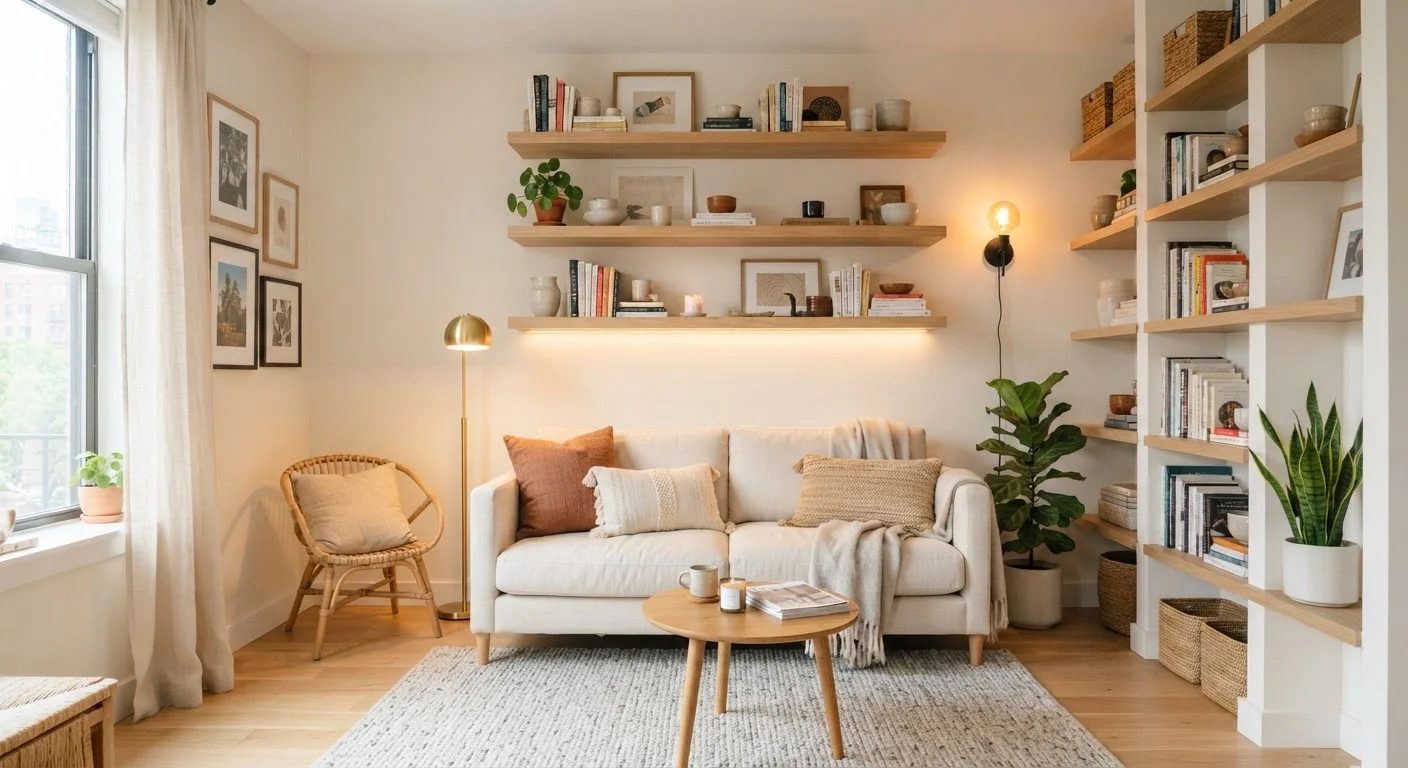
Overhead lighting flattens a room. Replacing a single ceiling fixture with a combination of floor lamps, sconces, or plug-in pendants creates depth and draws the eye across multiple planes. Warm-toned bulbs (around 2700K) add visual softness, while placing light sources at varying heights prevents the boxed-in feeling that overhead-only lighting creates.
For renters, plug-in sconces and battery-operated puck lights require no electrical work and can be installed and removed cleanly. The goal is to eliminate dark corners - corners that recede visually make a room feel smaller than it is.
Overhead lighting flattens a room; layered sources at varying heights create depth and perceived space.
Go Vertical with Storage
Floor space is finite. Wall space - especially above eye level - is almost always underused. Floating shelves, tall bookcases, and wall-mounted cabinetry shift storage upward, freeing the floor and drawing the eye toward the ceiling, which makes a room read as taller.
A practical rule: keep lower shelves functional and lightly styled; reserve upper shelves for lighter items and occasional display. Overfilled shelves at every level create visual noise that works against the openness you're trying to achieve. If your kitchen is the constrained room, cabinet refacing can refresh storage appearance without the footprint of a full remodel.
Shifting storage vertically frees floor area and draws the eye upward, making rooms read as taller.
Use Paint to Manipulate Proportion
Paint is one of the highest-leverage tools in a small room. A ceiling painted the same color as the walls - or slightly lighter - blurs the boundary between the two surfaces and creates a softer, more continuous feel. Conversely, painting a single accent wall in a deeper tone can push that wall visually backward, adding apparent depth.
Matte finishes absorb light and reduce the visual emphasis on imperfections; eggshell finishes reflect slightly more light and are easier to clean. Neither is universally better - choose based on the room's natural light levels and how much you rely on artificial lighting.
Painting the ceiling the same tone as walls blurs boundaries and softens the feeling of confinement.
Add or Upgrade Trim Details
Baseboards, door casings, and window trim are the visual skeleton of a room. Thin or missing trim makes walls look unfinished and arbitrary; wider trim with a simple profile gives walls a grounded, intentional quality that reads as spaciousness even in a compact room.
This upgrade is more straightforward than it appears - standard trim profiles are available pre-primed at most home improvement stores, and installation typically requires only a miter saw, finishing nails, and caulk. The transformation is subtle but cumulative: rooms with well-fitted trim consistently feel more considered and complete.
Well-fitted baseboards and casings give walls a grounded quality that reads as spaciousness and care.
Introduce a Large-Format Mirror Strategically
A single large mirror placed opposite or adjacent to a natural light source effectively doubles the perceived brightness of a room and extends sightlines. The key word is strategic: a mirror that reflects a cluttered corner or a blank wall offers little benefit. Position it to reflect the most appealing part of the room - a window, a well-lit shelf arrangement, or an outdoor view if available.
Leaning a large mirror against a wall rather than hanging it keeps the installation reversible and avoids wall damage. Framed mirrors with thin profiles feel contemporary; wider ornate frames work better in rooms with traditional or maximalist styling.
A large mirror placed opposite a light source doubles perceived brightness and extends a room's sightlines.
Replace Hardware and Fixtures
Cabinet pulls, door handles, faucet fixtures, and light switch plates are touched dozens of times a day - and their condition registers subconsciously. Swapping dated or mismatched hardware for a consistent finish (brushed nickel, matte black, or aged brass are currently common) creates a cohesive visual language without touching a single wall.
This is one of the fastest upgrades in terms of time-to-impact ratio. Most hardware swaps require only a screwdriver and take under an hour per room. Because the change is distributed across multiple small elements rather than concentrated in one area, the overall effect feels more like a room that has been carefully curated than one that has been renovated.
Consistent hardware finishes throughout a room create a cohesive feel that registers as quality and intention.
Putting It All Together Without Overspending
None of these changes require demolition, and most can be reversed if your situation changes. The key is sequencing: start with lighting and paint, since those set the baseline for everything else. Then layer in storage and trim details as budget and time allow.
Sequence Upgrades for Maximum Impact
Start with lighting and paint before investing in storage or trim - these set the visual baseline for everything else. Once the light and color feel right, storage and hardware upgrades will read more clearly. Doing it in reverse often means re-evaluating earlier choices after the fact, which costs both time and money.
For renters, it's worth confirming with your landlord before making any paint or fixture changes - many are open to upgrades that improve the unit's value. If you're also weighing larger projects like a bathroom overhaul, understanding the real scope of a bathroom renovation first can help you prioritize where smaller interventions still make sense. Small-space thinking isn't a consolation prize - it's often the most efficient form of home improvement there is.