

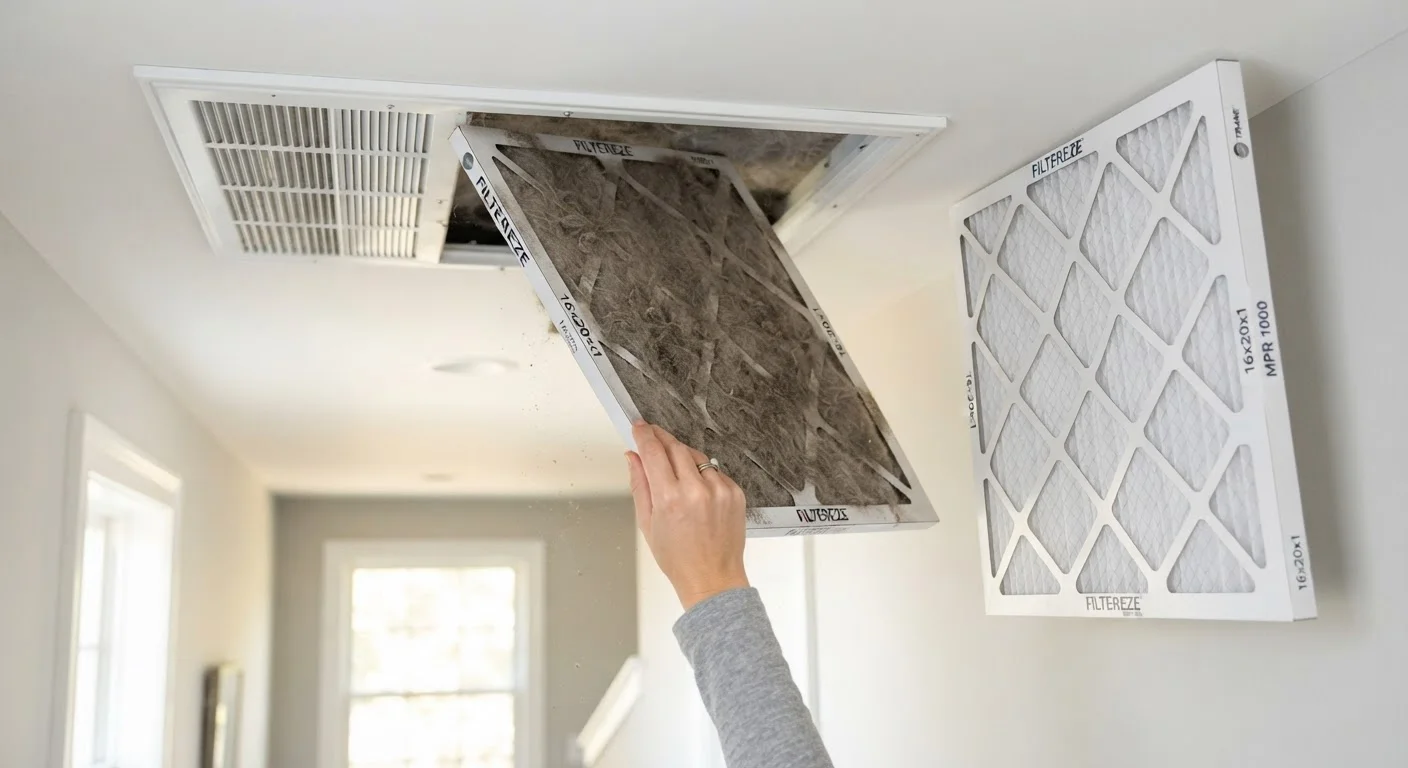
Key Takeaways
HVAC Air Filter
An HVAC air filter is a replaceable screen installed inside your heating and cooling system that traps dust, pollen, pet dander, and other airborne particles before they enter the equipment or recirculate through your home. It protects both the mechanical components of your system and the quality of air you breathe indoors. Filters vary by material and filtration efficiency, and they require regular replacement to stay effective.
Filter efficiency is rated on the MERV scale (Minimum Efficiency Reporting Value), ranging from 1 to 16 for residential use - higher numbers capture smaller particles but can restrict airflow if the system isn't designed for them.
Why Filter Changes Get Skipped - And Why That's Costly
Changing an HVAC filter is genuinely easy: locate the return vent or filter slot, slide out the old filter, insert a new one, and you're done. The task takes less time than making a cup of coffee. Yet surveys consistently show a large share of homeowners go six months or more without doing it.
The reason is simple: filters are out of sight. Unlike a leaking faucet or a flickering light, a clogged filter gives no obvious signal until damage is already underway. Your system keeps running - it just runs harder, hotter, and less efficiently with each passing week.
That hidden strain has real financial consequences. When airflow is restricted, your HVAC system's blower motor draws more electricity trying to compensate. Your thermostat still calls for the target temperature, but the system can't deliver - so it runs in longer cycles. The result shows up on your utility bill before you ever notice a comfort problem.
5-15%
Potential energy waste from a clogged filter
The U.S. Department of Energy notes that replacing a dirty, clogged filter can lower your air conditioner's energy consumption by 5-15%.
$5,000-$12,000
Typical HVAC system replacement cost
Industry estimates for full residential HVAC system replacement commonly fall in this range, underscoring why preventive maintenance matters.
40%
Of HVAC service calls linked to poor maintenance
HVAC industry professionals frequently cite lack of basic maintenance - including filter changes - as the leading cause of preventable equipment failures.
Filter neglect also ranks among the leading causes of preventable HVAC service calls. Technicians frequently find frozen evaporator coils or overheated blower motors that trace directly to airflow restriction from a clogged filter - problems that a $10 replacement could have prevented. This fits a broader pattern explored in our look at home maintenance myths that cost homeowners money: small, easy tasks skipped today become expensive emergencies later.
How Often Your Filter Actually Needs Changing
The standard advice - change your filter every three months - is a reasonable baseline, but it's not a universal rule. The right interval depends on several factors specific to your home.
- Standard 1-inch pleated filter, average household: every 60-90 days
- Households with one dog or cat: every 30-60 days
- Multiple pets or allergy sufferers in the home: every 20-45 days
- Vacation home or single occupant, no pets: up to 6 months
- Thick media filters (4-5 inches): every 6-12 months per manufacturer specs
If you live in a dusty region, are running a renovation project, or have recently had work done on your home (drywall, sanding, demolition), check your filter weekly during and immediately after the project - construction dust will saturate a filter within days.
Set a Phone Reminder - It's That Simple
Pick a recurring date - the first of every month, or every time you pay a utility bill - and set a phone reminder to check your filter. Keeping a two-pack of the correct size on a shelf near the unit removes any friction. If it looks gray and dense when you pull it out, swap it immediately rather than estimating how many days it has left.
The simplest habit is to check the filter visually every month. Hold it up to a light source: if you can't see light passing through, it's time to replace it regardless of how recently you installed it. Filter changes fit naturally into a broader seasonal maintenance rhythm - see our seasonal home maintenance calendar for a complete schedule.
What Happens Inside Your System When You Neglect the Filter
Understanding the mechanics makes the stakes concrete. Your HVAC system moves air in a continuous loop: air from your living spaces is pulled through the return duct, passed across the filter, then over the evaporator coil (for cooling) or the heat exchanger (for heating), and pushed back out through supply vents.
When the filter clogs, that airflow slows. On the cooling side, reduced airflow causes the evaporator coil to drop below freezing - moisture in the air freezes on the coil surface, forming ice. A frozen coil can't transfer heat, so the system either shuts down on a safety switch or runs continuously without cooling your home. Thawing and restarting the system doesn't fix the underlying problem.
On the heating side, restricted airflow causes the heat exchanger to overheat. Modern furnaces have high-limit switches that shut the system down for safety, but repeated cycling from overheating stresses components and shortens their service life considerably.
Signs Your System May Already Be Struggling
Watch for these indicators that a clogged filter may be affecting your system: reduced airflow from supply vents, rooms that won't reach the set temperature, ice visible on refrigerant lines or the indoor unit, or a musty smell when the system runs. If any of these appear, check the filter first - and if symptoms persist after replacement, contact a qualified HVAC technician to inspect the equipment.
In the worst cases - typically when a filter has gone unchanged for many months - debris bypasses the saturated filter entirely and coats the blower wheel and evaporator coil. Cleaning a coil clogged with dust and pet hair requires a professional service call and can cost several hundred dollars. This is the kind of overlooked area, much like the spaces discussed in our guide to crawl spaces and attics, where neglect quietly compounds into significant repair bills.
Choosing the Right Replacement Filter
Not all filters are interchangeable, and picking the wrong one can create problems even if you change it diligently. Before purchasing, identify two things: the correct physical size (printed on the edge of your current filter, such as 16x25x1) and the appropriate MERV rating for your system.
For most residential systems, MERV 8-11 strikes the best balance between particle capture and airflow. This range filters out dust mites, mold spores, pollen, and pet dander - the most common indoor air quality concerns - without imposing the airflow restriction of higher-rated filters designed for commercial environments.
If someone in your household has asthma or severe allergies, a MERV 11 filter is generally a sound choice. Before going higher, consult your HVAC system's documentation or a qualified technician to confirm the equipment can handle the added resistance. Using a filter the system isn't designed for can cause the same airflow problems as a dirty filter.
Fiberglass filters at MERV 1-4 are inexpensive but capture relatively little - they protect the equipment but do minimal work for air quality. Pleated filters in the MERV 8-11 range offer meaningfully better filtration at a modest price increase and are the practical choice for most homes.