

Key Takeaways
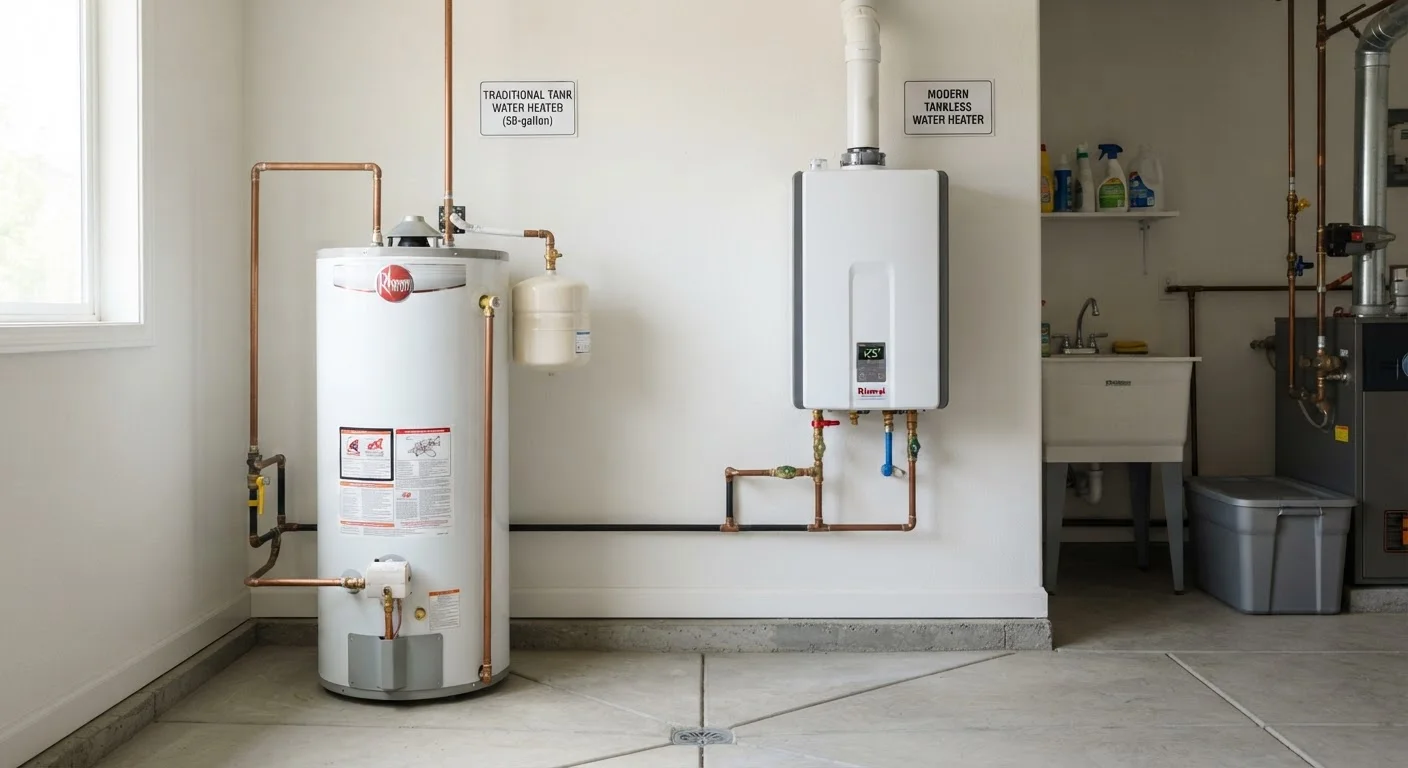
Option A
Tankless Water Heater
The compact, on-demand option with a longer potential lifespan.
Best for: Homeowners willing to invest in periodic descaling and professional servicing to maximize efficiency and longevity.
Option B
Traditional Tank Water Heater
The familiar, widely serviced workhorse of American homes.
Best for: Homeowners who prefer straightforward, widely understood maintenance tasks and lower upfront complexity.
If you want simpler, DIY-friendly annual upkeep
Traditional Tank Water Heater
Tank heater maintenance - flushing sediment and replacing the anode rod - is well-documented and achievable for most homeowners with basic tools.
If you prioritize a longer equipment lifespan
Tankless Water Heater
With consistent descaling and annual servicing, tankless units can operate for 15-20 years, significantly outlasting a standard tank heater.
If you live in a hard-water area and want low maintenance burden
Traditional Tank Water Heater
Tankless units are more sensitive to mineral scale buildup, requiring more frequent intervention in high-hardness water regions.
If you want to minimize long-term replacement costs
Tankless Water Heater
Longer lifespan and replaceable components mean fewer full-unit replacements over a 20-year homeownership period, though upfront and service costs are higher.
The Core Maintenance Difference: What Each System Demands
Both water heater types share one common enemy: sediment. Dissolved minerals - particularly calcium and magnesium in hard water - accumulate over time and degrade performance. However, the way each system is affected, and what you need to do about it, differs meaningfully.
Traditional tank heaters accumulate sediment at the bottom of the storage tank. This layer insulates the water from the heating element, forcing the unit to work harder and consuming more energy. An annual flush - attaching a garden hose to the drain valve and clearing the tank - removes this buildup. Equally important is the anode rod, a sacrificial metal rod (usually magnesium or aluminum) that attracts corrosive minerals and protects the tank lining. Without it, the steel tank rusts from the inside out. Anode rods typically need inspection every 2-3 years and replacement every 3-5 years.
Tankless water heaters have no storage tank, so sediment doesn't pool - but scale still accumulates on the heat exchanger, the component that rapidly heats water on demand. In hard-water regions, this scale can restrict flow and reduce efficiency within months. Descaling (also called flushing with a vinegar or food-grade descaling solution) is the primary maintenance task. Annual descaling is a general guideline, but homes with very hard water may need it every 6 months. Inlet filters also require periodic cleaning to prevent debris from entering the unit.
| Criterion | Tankless Water Heater | Traditional Tank Water Heater |
|---|---|---|
| Average lifespan | 15-20 years | 8-12 years |
| Primary maintenance task | Descaling heat exchanger | Flushing sediment from tank |
| Anode rod required | No | Yes, every 3-5 years |
| Flushing frequency | Annually (every 6 mo. in hard water) | Annually |
| DIY maintenance difficulty | Moderate to high | Low to moderate |
| Component replaceability | High - many parts replaceable | Low - corroded tank means replacement |
| Hard water sensitivity | High | Moderate |
| Safety valve check needed | Yes - pressure relief valve | Yes - pressure relief valve |
Lifespan, Failure Points, and What Neglect Actually Costs
Maintenance consistency has a direct impact on how long either unit lasts. Traditional tank heaters have an average service life of 8-12 years. A corroded tank cannot be repaired - it requires full replacement. The anode rod is the single most important component to monitor; a depleted rod left unchecked allows tank corrosion to begin within a year or two. Pressure relief valves - a critical safety component - should also be tested annually to ensure they open and close correctly.
Tankless units, by contrast, have a potential lifespan of 15-20 years when properly maintained. Their components - heat exchangers, flow sensors, ignition assemblies - can often be replaced individually, which means a single failed part doesn't always mean scrapping the whole unit. However, professional servicing is more involved and typically costs more per visit than tank heater maintenance.
8-12 yrs
Typical tank water heater lifespan
The U.S. Department of Energy notes that traditional storage water heaters generally last between 10 and 15 years with regular maintenance.
20 yrs
Potential tankless unit lifespan
The U.S. Department of Energy cites up to 20 years as a realistic lifespan for tankless water heaters when properly serviced.
~40%
Share of US homes with hard water
The U.S. Geological Survey estimates that roughly 85% of American homes have hard or moderately hard water, increasing scale-related maintenance needs.
Deferred maintenance compounds costs on both systems. Sediment-clogged tanks and scaled heat exchangers both reduce efficiency, raising monthly energy bills before the unit ever fails outright. As outlined in our guide to the hidden cost of deferred maintenance, postponing small upkeep tasks reliably leads to larger, more expensive problems. For broader scheduling context, see our seasonal home maintenance guide - water heater flushing fits naturally into a fall or early spring routine.
One often-overlooked myth: many homeowners believe a water heater only needs attention when something goes wrong. Reactive-only maintenance is one of the costlier misconceptions homeowners carry, and water heaters are a prime example of where prevention pays off clearly.