

Key Takeaways
Option A
The 50/30/20 Rule
The flexible, low-maintenance framework for everyday budgeters.
Best for: People who want broad guardrails without tracking every dollar - especially those new to budgeting.
Option B
Zero-Based Budgeting
The precision-focused method that assigns every dollar a specific job.
Best for: People who want granular control over spending, are paying down debt aggressively, or have variable income.
If you're just starting out with budgeting
The 50/30/20 Rule
Its simplicity makes it easy to adopt without feeling overwhelmed. Three categories are far less intimidating than a detailed line-by-line budget.
If you're aggressively paying down debt or building an emergency fund
Zero-Based Budgeting
Assigning every dollar a purpose ensures no money quietly disappears into untracked spending, which accelerates debt payoff and savings goals.
If your income changes month to month
Zero-Based Budgeting
Rebuilding the budget from scratch each month means you're always working with your actual income rather than a fixed percentage of a hoped-for figure.
If you prefer low time commitment and dislike detailed tracking
The 50/30/20 Rule
Checking whether your spending roughly fits three buckets takes minutes per week, not hours. It rewards consistency over precision.
If you want maximum visibility into your spending habits
Zero-Based Budgeting
Categorizing every expense reveals patterns - like recurring subscriptions or dining creep - that percentage-based budgets can obscure.
How Each Method Works
Both methods aim to give you intentional control over your money, but they take different paths to get there.
The 50/30/20 rule, popularized by Senator Elizabeth Warren and her daughter Amelia Warren Tyagi in their book All Your Worth, divides your after-tax income into three categories: roughly 50% toward needs (rent, utilities, groceries, insurance), 30% toward wants (dining out, streaming services, hobbies), and 20% toward savings and debt repayment beyond minimums. The percentages are guidelines, not hard rules - many financial educators adjust them to fit higher cost-of-living areas or aggressive savings goals.
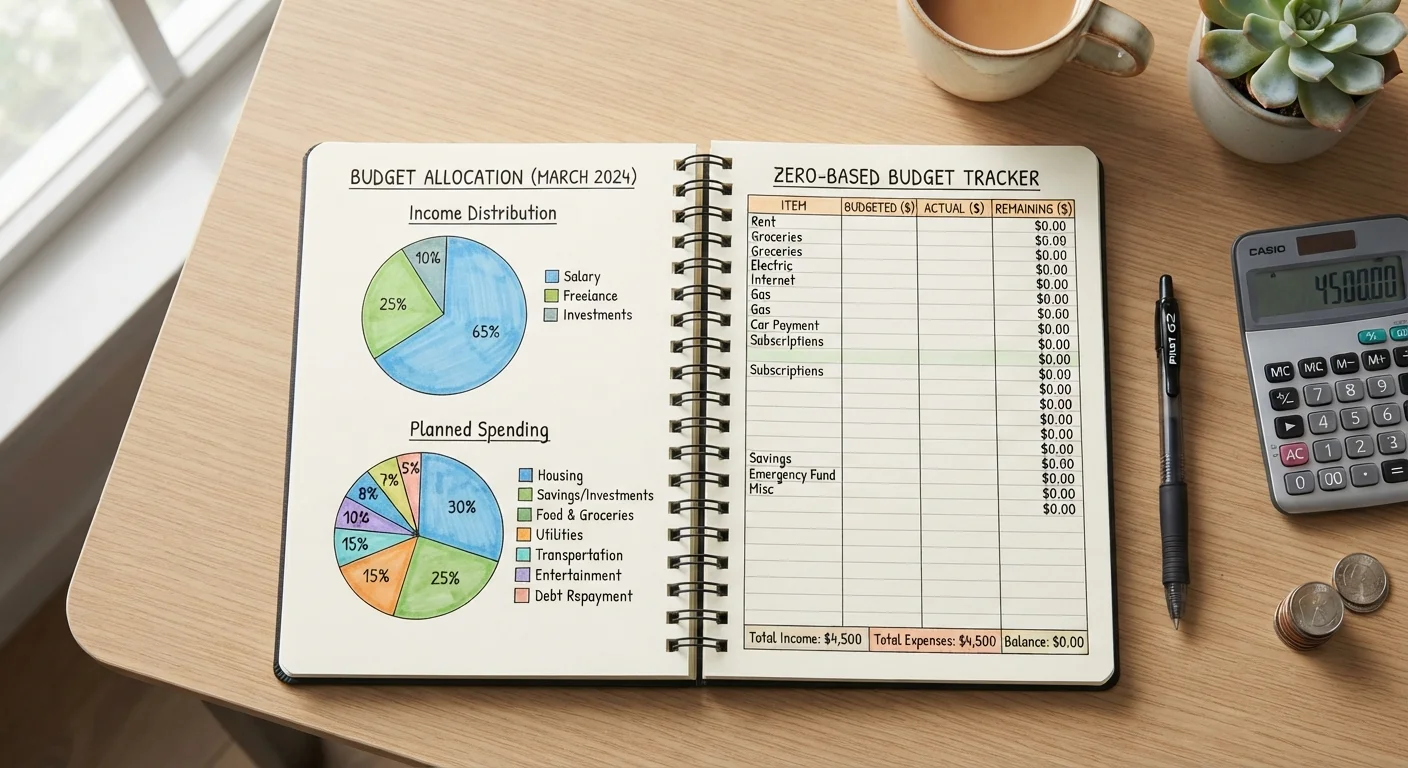
Zero-based budgeting (ZBB) takes a different approach: you start each month with your expected income and allocate every dollar to a specific category - housing, food, transportation, savings, entertainment - until you reach zero. That doesn't mean spending everything; it means every dollar has a deliberate assignment, including savings and investments. The method gained wide recognition in personal finance circles through tools like YNAB (You Need a Budget) and the teachings of financial author Dave Ramsey.
If you're newer to either approach, our practical monthly budgeting guide walks through setting up a simple framework from scratch.
| Criterion | 50/30/20 Rule | Zero-Based Budgeting |
|---|---|---|
| Setup time | Low - three categories to fill | High - every expense line itemized |
| Ongoing effort | Minimal - monthly check-in | Moderate to high - monthly rebuild |
| Spending visibility | Broad; category-level only | Granular; line-by-line clarity |
| Best income type | Stable, predictable income | Any income, especially variable |
| Debt payoff focus | General 20% savings/debt bucket | Specific dollar amounts assigned |
| Flexibility | High - percentages can shift | Moderate - requires intentional reallocation |
| Learning curve | Gentle - beginner-friendly | Steeper - requires category discipline |
Where Each Method Shines - and Struggles
The 50/30/20 rule's greatest strength is its accessibility. You don't need to track individual transactions or categorize every coffee purchase. A quick monthly review of whether your spending broadly fits the three buckets is often enough. This makes it a natural starting point and a sustainable long-term framework for people with relatively stable incomes and no acute financial crisis to navigate.
Its weakness is the same as its strength: broad categories can mask problem spending. If your "wants" bucket is consistently overflowing, the 50/30/20 rule won't automatically show you where the leak is. Strict budget categories offer more visibility, but at a cost in time and mental overhead.
Zero-based budgeting shines when circumstances demand precision. People managing debt payoff plans, irregular freelance or gig income, or a tight household cash flow often find ZBB more effective because it forces a monthly reckoning with actual numbers. Research on budgeting behavior consistently suggests that awareness of where money goes - not just how much - tends to produce better financial outcomes.
ZBB's challenge is the time investment. Building a detailed monthly budget and reconciling it mid-month requires sustained effort. Motivation can fade after the novelty wears off, which is one reason budgets fail even when the method is sound.
~74%
Americans who live paycheck to paycheck
A 2023 LendingClub report found that approximately 74% of U.S. consumers reported living paycheck to paycheck, underscoring the importance of choosing a budgeting method you'll actually use.
1 in 3
Adults with no written budget
Multiple surveys from financial research organizations have found that roughly one-third of American adults do not follow any formal budget, regardless of income level.
20%
Savings and debt repayment target
The 50/30/20 rule designates 20% of after-tax income for savings and debt repayment - a threshold many financial planners cite as a reasonable long-term baseline.
Choosing the Right Fit - or Combining Both
The honest answer is that neither method is objectively better. The right choice depends on your income stability, financial goals, personality, and how much time you're willing to spend. A useful rule of thumb: if you're in a maintenance phase - income is steady, no urgent debt, savings are on track - the 50/30/20 rule is probably sufficient. If you're in a change phase - new job, reducing debt, building your first emergency fund - zero-based budgeting's precision pays off.
Many people land on a hybrid: they use the 50/30/20 framework for high-level category targets but do a zero-based pass during months when cash is tight or a big expense is coming. This approach lets you calibrate intensity without committing to one method permanently.
For a broader look at how these two methods compare to others like pay-yourself-first or envelope budgeting, see how different budgeting methods stack up. And if you're weighing how you'll actually track your spending once you pick a method, envelope budgeting vs. digital spreadsheets covers the practical tools side of the equation.
Percentages Aren't One-Size-Fits-All
The 50/30/20 split was designed around a median U.S. income and average cost-of-living. In high-cost cities like New York or San Francisco, housing alone can exceed 50% of take-home pay for many households. If the percentages don't reflect your reality, adjust them - what matters is the habit of intentional allocation, not rigid adherence to specific numbers.
This article is for general informational purposes only and does not constitute personalized financial advice. Consider consulting a licensed financial professional for guidance tailored to your individual circumstances.