
A Realistic Monthly Budget Template for Saving and Debt Repayment at the Same Time

Key Takeaways
Why Trying to Do Both at Once Actually Works
The conventional advice - "pay off all debt before you save" - sounds logical but breaks down in practice. If you carry no emergency fund while aggressively repaying debt, a single unexpected expense can push you back into borrowing, often at a higher interest rate than the debt you were paying down. Research from financial behavior experts suggests that households with even a small savings buffer are more likely to stay on track with debt repayment over the long term.
At the same time, saving without any debt strategy means interest charges quietly erode your progress. The solution isn't to pick one goal - it's to build a framework that explicitly funds both, even if the amounts seem modest at first. For a foundational overview of how savings and debt interact, see the Personal Finance From Scratch guide.
This Is Education, Not Personal Financial Advice
The framework presented here is general financial education intended to illustrate common budgeting approaches. It is not personalized financial, tax, or legal advice. Every household's situation is different. Consult a licensed financial professional before making significant decisions about debt repayment or savings strategies.
What You'll Need Before You Start
Before setting up your budget template, gather a few key inputs. Working from real numbers - not estimates - is the single most important factor in building a budget you'll actually follow.
What you will need
Spreadsheet application (e.g., Google Sheets or Excel)
Build and update your monthly budget template with formulas that auto-calculate totals and remaining balance.
Bank or credit card statements (last 2-3 months)
Provide accurate data for estimating your real variable spending categories.
A dedicated savings account
Hold your emergency fund separately from everyday checking to reduce the temptation to spend it.
Debt payoff tracker or notepad
Record each debt's current balance, interest rate, and minimum payment to prioritize repayment order.
How to Build Your Budget, Step by Step
The steps below walk you through setting up a template designed specifically to fund both an emergency savings goal and accelerated debt repayment within a single monthly plan. If you're completely new to budgeting, the first monthly budget guide is a helpful starting point before working through this framework.
Calculate Your True Monthly Take-Home Income
Start with your actual net income - what hits your bank account after federal and state taxes, Social Security, Medicare, and any employer benefit deductions. If your income varies month to month, use a conservative average based on your three lowest-earning months in the past year.
Include all income sources: primary job, side income, freelance work, or any recurring benefits. Write this number down as your monthly starting point.
List All Fixed and Variable Expenses
Divide your spending into two columns. Fixed expenses are amounts that don't change month to month: rent or mortgage, car payment, insurance premiums, and minimum debt payments. Variable expenses fluctuate: groceries, gas, dining out, clothing, and entertainment.
Pull your last two or three bank and credit card statements to find realistic averages for each variable category. Don't estimate from memory - actual data almost always reveals spending that surprises people.
Apply a Savings and Debt Split Before Discretionary Spending
Once you know your income and essential expenses, calculate what remains. Rather than letting this remainder get absorbed by discretionary spending, deliberately allocate it before anything else.
A common starting framework is to direct roughly 70-80% of your available remainder toward accelerated debt repayment (on top of minimums) and 20-30% toward savings. This ratio should shift as high-interest debt is eliminated. If you have no emergency savings at all, consider temporarily reversing this - prioritize building a $500-$1,000 cushion first, then shift momentum toward debt.
Rank Your Debts and Define Your Payoff Target
List every debt you carry: credit cards, personal loans, student loans, medical bills. For each one, record the current balance, the interest rate (APR), and the minimum monthly payment.
Two widely referenced approaches for choosing which debt to pay first are the avalanche method (targeting the highest-interest debt first, which minimizes total interest paid) and the snowball method (targeting the smallest balance first, which provides faster psychological wins). Neither is universally correct - choose the one you're most likely to stick with. Direct your extra debt payment dollars to whichever debt you've ranked first.
Build Your Monthly Budget Template
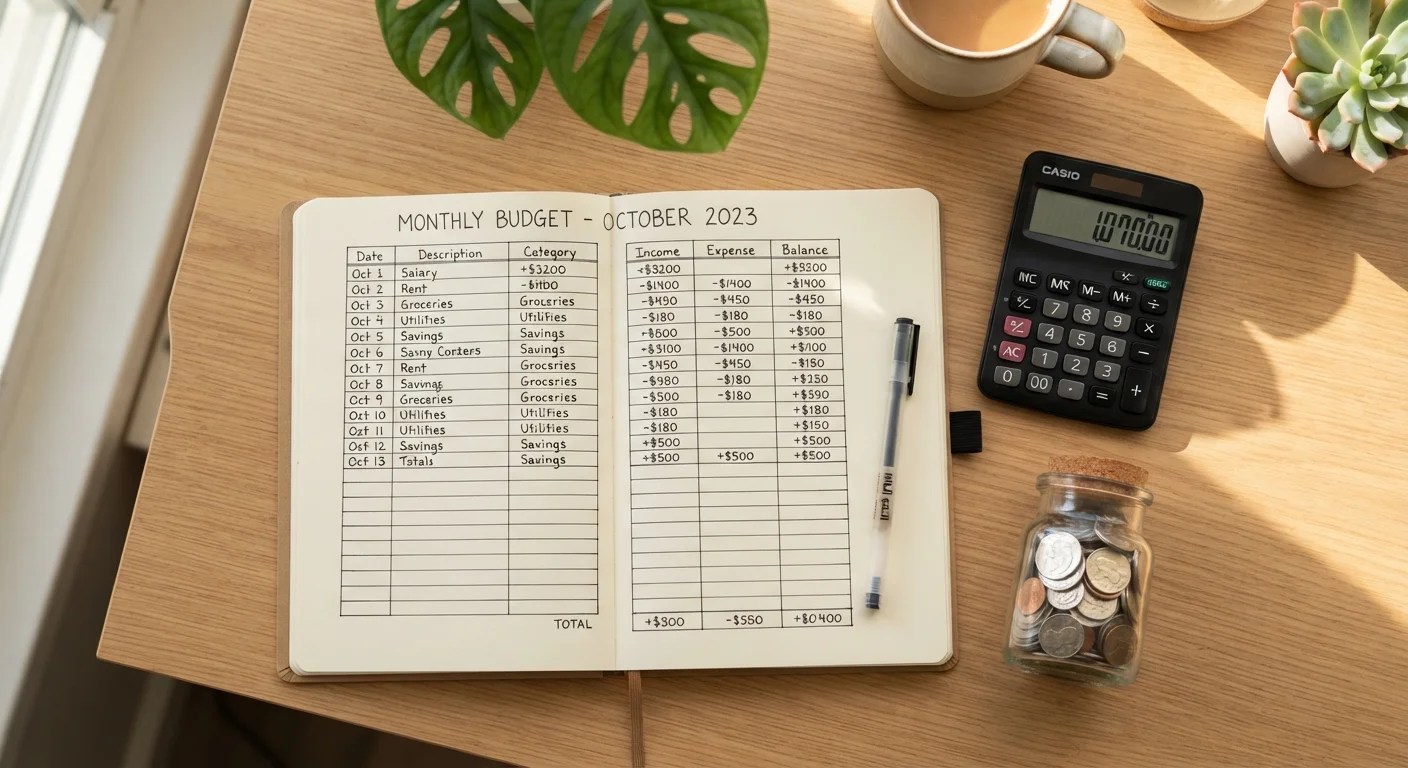
Organize your budget into a simple table with four sections:
- Income: Total take-home pay
- Essential fixed expenses: Rent, utilities, insurance, minimum debt payments
- Savings allocation: Your predetermined monthly savings contribution
- Extra debt payment: Your accelerated repayment amount above minimums
- Variable discretionary spending: Everything else, with category caps
The final row should always subtract all outflows from income. If the result is negative, you need to reduce variable spending or revisit your split percentages. If it's positive, consider directing that surplus to either savings or debt - don't leave it unassigned.
Review and Adjust Monthly
At the end of each month, compare your planned budget to actual spending in every category. Note where you overspent and why. Small, honest adjustments each month compound into significantly better habits over time.
As debts get paid off, redirect those freed-up minimum payments into your savings or toward the next debt on your list. This "payment recycling" is one of the most powerful levers in a simultaneous save-and-repay strategy.
Automate Before You Can Spend It
Set up automatic transfers to your savings account and automatic minimum payments on all debts on the day after your paycheck arrives. When money moves before you see it, spending temptation drops significantly and consistency improves without relying on willpower.
Common Pitfalls and How to Avoid Them
Even a well-designed budget breaks down without a few safeguards in place.
Don't Skip Your Emergency Fund Entirely
Focusing 100% of extra cash on debt repayment can leave you financially exposed. Without any cushion, a single unexpected expense - a car repair, a medical bill - may force you back into higher-interest borrowing. Even a small monthly contribution to savings reduces this risk meaningfully.
Ignoring irregular expenses is one of the most common budget-busting mistakes. Car maintenance, annual insurance premiums, and seasonal spending all need a monthly home in your budget even when the bill isn't due yet. Divide the annual cost by 12 and treat it as a fixed line item.
Setting unrealistic spending caps causes budget fatigue fast. If you've been spending $600 a month on groceries, cutting to $200 overnight is a recipe for abandonment. Make gradual reductions - 10 to 15 percent at a time - and give yourself a few months to adapt.
For a broader look at financial stability strategies, including how this budget template fits into a longer-term plan, the complete savings and debt repayment guide covers the full journey from first cushion to debt freedom.
This article is for general informational and educational purposes only and does not constitute personalized financial, investment, tax, or legal advice. Consult a qualified, licensed financial professional for guidance specific to your situation.