

Key Takeaways
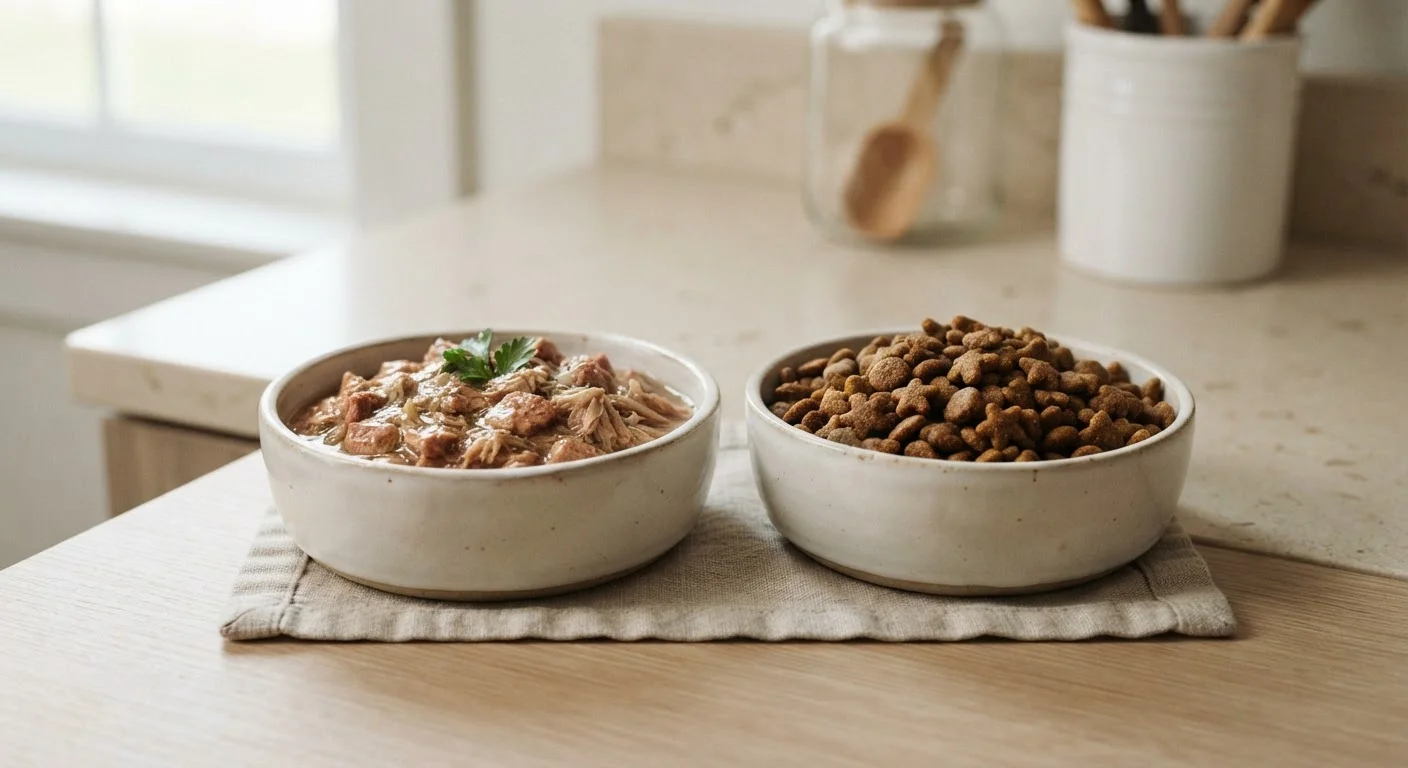
Option A
Wet Cat Food
The moisture-rich, protein-forward option.
Best for: Cats prone to urinary issues, seniors with reduced thirst drive, or picky eaters who need palatability.
Option B
Dry Cat Food
The convenient, shelf-stable everyday staple.
Best for: Multi-cat households prioritizing cost efficiency, free-feeding schedules, and dental abrasion benefits.
If your cat has a history of urinary tract issues or kidney disease
Wet Cat Food
The high moisture content - typically 70-80% water - helps maintain urine dilution, which is a key factor in managing and preventing urinary crystals and stones.
If you're managing feeding costs across multiple cats
Dry Cat Food
Kibble carries a lower cost per calorie and can be left in a bowl without spoiling, making it a practical choice for households with several cats.
If your cat is a senior over age 10 with reduced appetite
Wet Cat Food
Wet food is more aromatic and palatable, which helps entice older cats whose sense of smell and appetite may decline with age.
If convenience and free-feeding flexibility are your priority
Dry Cat Food
Kibble stays fresh in a bowl for hours, supports timed or puzzle feeders, and requires no refrigeration after opening.
If you want to optimize nutrition without committing to one format
Wet Cat Food
A mixed approach using wet food as the primary meal and dry kibble as a supplement can balance hydration, cost, and variety - consult your vet for the right ratio.
The Core Nutritional Differences
At the species level, cats evolved from desert-dwelling predators who obtained most of their water through prey, not from a water bowl. This biological history is central to the wet-versus-dry debate. Understanding what each format actually delivers nutritionally helps owners make a more grounded choice.
Wet food typically contains 70-80% moisture, making it the closest commercially available analog to a cat's ancestral diet. It tends to be higher in animal protein and lower in carbohydrates, though formulations vary widely by brand and product line.
Dry food (kibble) contains roughly 6-10% moisture and is calorie-dense - meaning cats eat smaller volumes for the same energy intake. Most kibble formulations include a higher proportion of carbohydrates compared to wet food, used as binders during processing. This isn't inherently harmful, but cats have limited ability to use carbohydrates as a primary energy source.
For a deeper look at how to read and interpret pet food labels, see our guide to cat nutrition.
| Criterion | Wet Food | Dry Food |
|---|---|---|
| Moisture content | 70-80% | 6-10% |
| Protein density | Generally higher | Moderate; varies by formula |
| Carbohydrate content | Lower | Higher (used as binders) |
| Urinary health support | Strong (high hydration) | Limited without extra water |
| Cost per serving | Higher | Lower |
| Shelf life after opening | 2-4 hours unrefrigerated | Several hours in bowl |
| Palatability | Higher aroma; preferred by many cats | Variable; some cats strongly prefer it |
| Dental abrasion | Minimal | Mild; not a substitute for brushing |
| Free-feeding suitability | Not recommended | Common practice |
Hydration, Urinary Health, and Weight Management
One of the most clinically significant differences between the two formats is their impact on hydration. Cats fed exclusively dry food typically consume less total water than those eating wet food, even when a water bowl is available. This matters because chronic low-level dehydration is associated with urinary tract disease and kidney stress over time.
70-80%
Moisture in typical wet cat food
Compared to roughly 6-10% in dry kibble, this difference meaningfully affects a cat's total daily water intake.
~50%
Estimated share of cats fed dry food exclusively
Many cats in the US are fed dry food as their sole diet, despite cats' low natural thirst drive, according to veterinary nutrition discussions.
3x
Water intake increase with wet food diet
Research has indicated that cats eating wet food can consume up to three times more total water daily than those eating only kibble.
Cats prone to struvite or calcium oxalate crystals, chronic kidney disease (CKD), or idiopathic cystitis often benefit from switching to or increasing wet food in their diet. Veterinary nutrition guidance in these cases frequently prioritizes increasing moisture intake as a first-line dietary adjustment.
Weight management is more nuanced. Wet food's higher moisture content creates greater meal volume per calorie, which can help cats feel fuller. However, calorie-dense dry food that's carefully portioned can also support a healthy weight - the format alone doesn't determine outcomes. Free-feeding kibble without portion control is more commonly associated with feline obesity.
If your cat spends time outdoors, activity level and seasonal hydration needs are also factors - our comparison of indoor versus outdoor cat care explores how lifestyle affects nutritional priorities.
Dental Health, Cost, and Practicality
Dry food is sometimes credited with supporting dental health through the mechanical abrasion of chewing. This claim has some basis - kibble does create mild friction on tooth surfaces - but the benefit is often overstated. Most cats don't chew kibble long enough or thoroughly enough to produce meaningful plaque reduction, and the American Veterinary Dental College has noted that standard kibble is not an effective substitute for active dental care such as tooth brushing.
Dental Care Requires More Than Kibble
While dry food creates some surface friction during chewing, it should not be relied upon as a dental health strategy. Veterinary dental organizations recommend regular tooth brushing and professional cleanings as the most effective approaches to managing feline periodontal disease. Dental treats or water additives may offer supplemental support but are not replacements for brushing.
From a cost and convenience standpoint, dry food holds clear advantages. It stores well, doesn't spoil within hours of serving, and generally costs less per feeding than comparable wet formulations. Wet food requires refrigeration after opening and uneaten portions should be discarded within a few hours to prevent spoilage - a real consideration in households with cats that graze.
A mixed feeding strategy - sometimes called combo feeding - is increasingly discussed among veterinary nutritionists as a practical middle ground. It allows owners to leverage wet food's hydration benefits while keeping some of the cost efficiency and convenience of kibble. Portion balance and total calorie intake should be monitored carefully if you go this route.
Feeding approaches for dogs follow a similar logic; see how dog feeding formats compare if you have a multi-species household.
Making the Right Call for Your Cat
There is no universally correct answer. The right format depends on your cat's age, health history, activity level, and your household's practical constraints. Kittens, adults, and seniors each have different caloric and hydration needs - senior cats in particular often benefit from a diet adjustment as their kidney function and appetite change after age 10.
The most important step is an honest conversation with your veterinarian. They can assess your cat's bloodwork, body condition score, and medical history to give format-specific guidance. Switching foods should be done gradually over 7-10 days to avoid digestive upset.
Whatever format you choose, the quality of the ingredient profile - adequate named animal protein, presence of taurine, and minimal artificial additives - matters more than the format itself. Both wet and dry food can support a healthy cat when chosen thoughtfully. For a broader perspective on what cats truly need across their lives, explore our overview of responsible cat ownership.
This article is for general informational purposes only and does not constitute veterinary or medical advice. Always consult a licensed veterinarian before making significant changes to your cat's diet, especially if your cat has an existing health condition.