

Travel & Trips

Preparing for a Multi-Country European Trip Without Losing Your Mind

Share
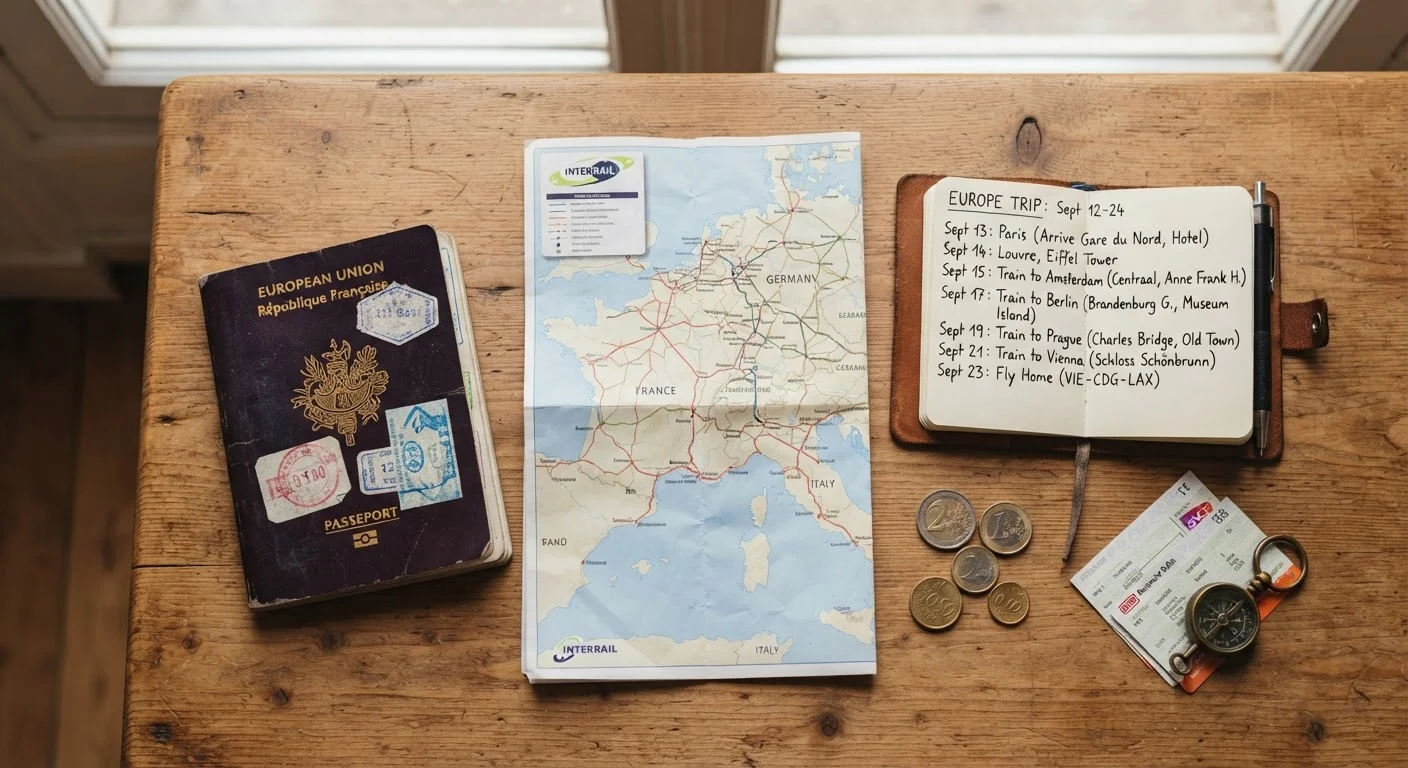
Passport, rail map, travel notebook, and euro coins arranged on a wooden table for trip planning

Key Takeaways

Americans visiting most of Europe need no visa for stays under 90 days within the Schengen Area, but rules vary — always verify before booking.
A rail pass can save money and headaches, but seat reservations are often still required on top of the pass.
Notify your bank and check your card's foreign transaction fees before you leave home.
Packing light with one carry-on dramatically simplifies movement between countries.
Travel insurance that covers medical evacuation is especially important for multi-country trips.
45–90 min

Summary

24 items · 45–90 minutes

Why Multi-Country European Trips Demand More Prep

A single-city European escape is manageable to wing. A five-country, three-week adventure across different currencies, languages, entry rules, and rail systems? That's a different beast entirely — and a deeply rewarding one if you approach it with a plan.

Unlike a domestic US trip where your phone works everywhere and your health insurance follows you, crossing European borders introduces real logistical layers: Schengen day limits, plug adapter requirements, split rail booking systems, and health coverage gaps that can turn a minor mishap into a costly ordeal. The good news is that nearly all of these variables are manageable with a focused pre-departure checklist. For a broader foundation, our pre-trip planning checklist covers the universal steps every American traveler should run through before booking.

This checklist is built specifically for the multi-country European context — organized by category so you can work through it methodically rather than in a panic the week before departure.

Required

US State Department STEP Program

Register your international trip so the US Embassy can contact you in an emergency or security situation.

Required

Seat61.com

Independent resource for researching and planning train routes across Europe, including booking guidance for individual countries.

Optional

XE Currency App

Track real-time exchange rates across multiple currencies so you always know what you're actually spending.

Required

Google Maps Offline

Download city maps for offline use so you can navigate without mobile data after arrival.

Optional

Rome2rio

Compare transport options (train, bus, ferry, flight) between any two European points to find the most practical route.

Working Through the Checklist

Start with documents and entry requirements — these have the longest lead times and the least flexibility. Passport renewal, for example, can take weeks. Entry rule research should happen before you finalize your itinerary, not after. If you're traveling with others, our guide to group travel planning covers how to align logistics when multiple people are involved.

Your US Health Insurance Likely Won't Work Abroad

Most standard US health insurance plans, including many employer plans and Medicare, provide little to no coverage outside the United States. Emergency medical care in Europe can be expensive, and evacuation back to the US for a serious medical situation can cost tens of thousands of dollars. Purchasing travel insurance with medical and evacuation coverage before you depart is strongly recommended. Review any policy carefully to understand what is and isn't covered.

Transportation planning is where most multi-country trips get into trouble. The assumption that a rail pass covers everything is one of the most common — and frustrating — surprises American travelers encounter. Book high-demand legs early and always verify whether your specific train requires a seat reservation on top of any pass you hold.

Schengen Days Add Up Fast

The Schengen Area treats all member countries as one zone — meaning your 90-day limit applies collectively, not per country. If you spend three weeks in France and two in Italy, those days count together toward your 90-day allowance within any 180-day period. Plan your itinerary carefully and track your days; overstaying carries serious legal and immigration consequences. Always verify the current rules with official EU or US State Department sources before travel.

Rail Pass ≠ Free Boarding

Many travelers arrive at a European train station expecting to hop on with their rail pass and discover they also need a paid seat reservation — especially on TGV, Thalys, Eurostar, and Frecciarossa services. These reservations must be booked in advance and sometimes carry a surcharge. Factor this into your budget and timeline or you may find yourself scrambling at a ticket window with a packed train departing in ten minutes.

For packing, the single most impactful decision you'll make is committing to one bag. Moving through Paris Gare du Nord, Rome Termini, or Barcelona Sants with a rolling suitcase on cobblestones and narrow staircases is exhausting. Our guide on what experienced travelers actually pack digs into the reasoning behind minimalist packing choices worth reading before you decide what to bring.

Documents & Entry Requirements

Verify your US passport is valid for at least six months beyond your planned return date — many European countries require this. Must
Confirm entry requirements for every country on your itinerary, including any that fall outside the Schengen Area (e.g., Croatia is Schengen; the UK and Ireland are not). Must
Check the US State Department travel advisories for each destination and register your trip with the STEP (Smart Traveler Enrollment Program) program. Must
Make two copies of your passport data page — one stored separately from your passport, one emailed to yourself. Must
Research the EU's ETIAS travel authorization, which is expected to become operational for US citizens; verify current status before your trip. Should

Money & Banking

Notify every bank and credit card issuer of your travel dates and destination countries before departing. Must
Identify which of your cards charge no foreign transaction fees and plan to use those as your primary payment cards. Must
Arrive with a small amount of local currency (euros or otherwise) for taxis, tips, or small vendors that don't accept cards. Should
Research ATM availability and withdrawal fees for each country on your itinerary, especially smaller towns. Should

Transportation Planning

Decide early whether a Eurail or Interrail pass makes sense for your route, factoring in that most high-speed trains still require separate seat reservations. Must
Book overnight sleeper trains or high-speed rail legs (Paris–Barcelona, Rome–Paris, etc.) as early as possible — these sell out months ahead. Must
Map your airport-to-city-center transit options for each arrival city to avoid expensive last-minute taxi decisions. Should
Download offline maps for every city on Google Maps or a similar app before you leave home. Should

Health & Insurance

Purchase travel insurance that includes emergency medical coverage and medical evacuation — your US health insurance is unlikely to cover you abroad. Must
Visit your doctor or a travel medicine clinic at least four to six weeks before departure to discuss any recommended vaccines or health precautions. Must
Pack a sufficient supply of any prescription medications in original labeled containers, plus a signed letter from your prescribing physician. Must
Assemble a basic travel health kit: adhesive bandages, pain reliever, antidiarrheal medication, and any personal medical items. Should

Packing

Aim to fit everything into a single carry-on or small checked bag — moving through train stations and cobblestone streets with bulky luggage is miserable. Must
Pack a universal plug adapter and a portable power bank; European outlets use Type C, E, F, and G plugs depending on the country. Must
Bring a combination lock for hostel lockers or luggage storage if you plan to use shared accommodation. Should
Include a packable rain layer — Western European weather is reliably unpredictable regardless of season. Should

Connectivity & Digital Prep

Research international SIM options or international plans from your US carrier; an unlocked phone with a local European SIM is often the most affordable approach. Must
Save key confirmation numbers, hotel addresses, and emergency contacts in an offline-accessible note on your phone. Must
Enable two-factor authentication on your most important accounts and make sure recovery options are accessible while abroad. Should

On digital security: public Wi-Fi at European airports and train stations carries real risk. Our device and data safety guide outlines practical habits worth adopting before you leave home.

This article provides general travel planning information for educational purposes. Entry requirements, health recommendations, and transit rules change frequently — always verify current requirements with official government sources, your healthcare provider, and relevant transport operators before traveling.

Travel & Trips Editorial Team is the collective byline for our editorial team and contributor network. Articles published under this byline or an editorial pen name are researched, written, and reviewed according to our editorial standards for clarity, consistency, and independence before publication.

View all articles by Travel & Trips Editorial Team →
Disclaimer: The content provided on our blog site traverses numerous categories, offering readers valuable and practical information. Readers can use the editorial team’s research and data to gain more insights into their topics of interest. However, they are requested not to treat the articles as conclusive. The website team cannot be held responsible for differences in data or inaccuracies found across other platforms. Please also note that the site might also miss out on various schemes and offers available that the readers may find more beneficial than the ones we cover.