

Key Takeaways
Why Experienced Travelers Pack Differently
There's a real pattern that emerges after a few trips: the more you've traveled, the less you tend to pack. It sounds counterintuitive - more destinations, more needs, right? But experienced travelers learn something early: a heavy bag doesn't make a trip better. It makes every airport, train station, cobblestone street, and hotel staircase harder.
The shift from first-timer packing to seasoned packing isn't about sacrificing comfort. It's about applying a ruthless question to every item: will I actually use this, or am I packing for anxiety? Most overpacking is driven by "what if" thinking - scenarios that rarely materialize on the road.
If you're weighing your luggage strategy, understanding the carry-on vs. checked bag decision is a smart first step before you even start choosing what goes in. And if you're planning something ambitious like a multi-country itinerary, the pre-departure framework for multi-country trips offers packing context that's hard to find elsewhere.
Below, we break down what experienced travelers consistently bring - and, just as importantly, why each item earns its spot.
Packing cubes
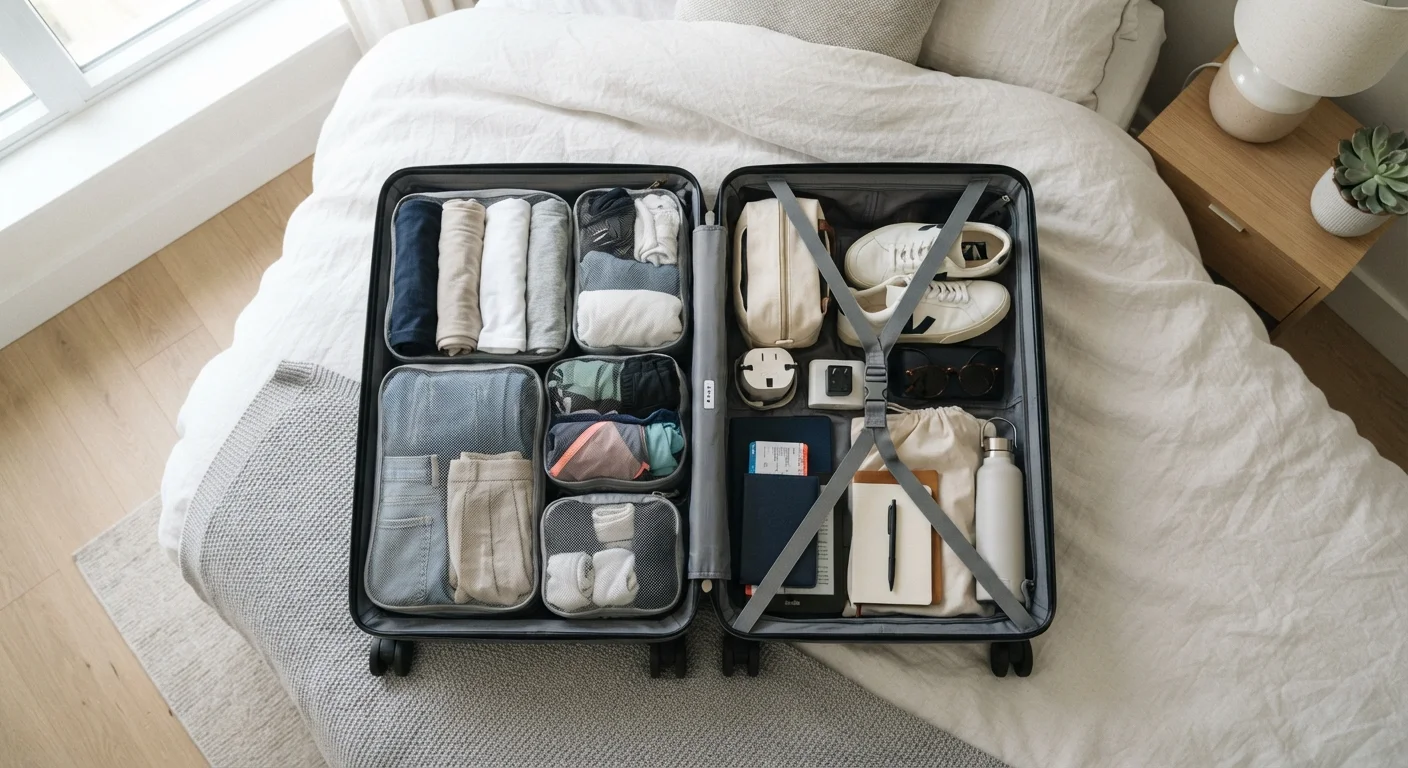
Packing cubes have moved from novelty to near-universal among frequent travelers - and for good reason. They compress clothing, keep categories separate, and make repacking at each stop dramatically faster. Instead of excavating your bag for a single shirt, everything stays organized and visible.
The real gain is behavioral: when your bag is organized, you're less likely to overpack in the first place, because you can see exactly how much space you have and make deliberate choices about what fills it.
Packing cubes don't just organize your bag - they make you pack more deliberately from the start.
A versatile, neutral-toned clothing base
Experienced travelers think in outfits, not individual pieces. A small wardrobe built around two or three neutral colors means everything mixes and matches, reducing the total count without reducing options. Dark colors travel especially well - they show wear less and photograph well in any light.
The other key move: choosing fabrics that dry quickly and resist wrinkling. Merino wool and technical synthetics pack small, odor-resist longer between washes, and bounce back from being stuffed in a bag. That means fewer items and fewer laundry stops.
Two or three neutral tones that all coordinate together can replace a bag full of single-use outfits.
A unlocked, dual-SIM or eSIM-capable phone setup
Connectivity is no longer a luxury for travelers - it's a safety and logistics tool. Experienced travelers increasingly rely on eSIM plans or physical local SIMs to avoid roaming charges and maintain reliable data access. An unlocked phone is a prerequisite for either approach.
The benefit goes beyond cost savings: real-time navigation, translation apps, accommodation check-ins, and transit apps all depend on a working data connection. Travelers who've lost connectivity mid-trip rarely make that mistake twice.
Reliable local data access isn't a luxury - it's a core logistical tool for modern travel.
A compact, powerful portable charger
Long travel days - layovers, train journeys, city walks - drain devices fast. A portable charger (commonly called a power bank) with enough capacity to fully charge a phone at least twice covers most scenarios without being bulky. Seasoned travelers treat this as non-negotiable.
If you're flying, check airline and TSA regulations for lithium battery capacity before you pack - limits apply to what can go in carry-on vs. checked baggage. Verifying this directly with your carrier and official TSA guidance before departure is always worth the two minutes it takes.
A portable charger ranked above most clothing as a trip-essential in traveler surveys - that tells you everything.
A packable, waterproof day bag
A lightweight day bag that folds into its own pouch takes up almost no space but earns its weight constantly. It handles beach days, city exploring, market runs, and day trips without requiring you to carry your main luggage. Look for water-resistant material and at least one secure zipper pocket for documents and cards.
Experienced travelers also use it as an overflow bag when returning home with purchases, keeping the main bag compliant with weight limits. That dual function alone justifies the few ounces it adds.
A packable day bag doubles as overflow space on the way home - solving the souvenir problem elegantly.
Printed and digital document backups
Digital copies of passports, travel insurance, accommodation confirmations, and emergency contacts stored in cloud storage are table stakes. Experienced travelers add a physical backup - a folded printed copy tucked in a separate pocket from the originals. When a phone dies or Wi-Fi disappears, paper still works.
This is especially relevant if you're crossing borders or navigating any destination where connectivity isn't guaranteed. The pre-trip departure checklist covers the full documents protocol if you want a complete rundown before you leave.
When technology fails, a printed document backup keeps you moving - and it weighs almost nothing.
A small, curated first-aid and medication kit
This isn't about packing a pharmacy. Experienced travelers carry a focused kit: adhesive bandages, blister treatment, pain reliever, antidiarrheal medication, and any prescription medications - enough to manage minor issues without a pharmacy run in an unfamiliar place at an inconvenient hour.
The discipline here is keeping it small. A single ziplock pouch handles most needs. If you're traveling internationally, research destination-specific health considerations and verify current vaccination and entry health requirements directly with official government and public health sources before departure - not from travel forums.
A compact first-aid kit handles most minor travel health hiccups without a stressful pharmacy search.
Pack Smart, Travel Better
The common thread running through every item on this list isn't brand or price - it's intentionality. Experienced travelers aren't packing less because they're minimalists by nature. They're packing less because they've felt the cost of packing more, and they've edited down over time.
The "Wear It Once" Test Before You Pack
Before adding any item to your bag, ask whether you'd genuinely wear or use it at least twice on the trip. If the honest answer is no, leave it. This single filter removes most of the 'just in case' items that add weight without adding value. For longer trips, planning around laundry access rather than packing more clothing almost always results in a lighter, more manageable bag.
Before your next trip, run through a pre-departure checklist to make sure the practical details - bank notifications, reservations, documents - are sorted before you zip up. And for a complete planning picture, the full trip planning guide from start to finish covers everything from research through arrival.
Whether you're prepping for a weekend domestic run or a two-week international trip, the discipline of packing with purpose is one of the most transferable travel skills you can develop.
Packing Rules Vary by Airline and Destination
Carry-on size limits, liquid restrictions, and checked baggage allowances differ between airlines and can change without much notice. Lithium battery rules for power banks are particularly important to verify before flying. Always confirm current rules directly with your airline and check official transportation authority guidance - particularly if you're connecting through multiple carriers or traveling internationally.