
Keeping Maintenance Records: Why a Paper Trail Protects Your Car and Your Wallet

Key Takeaways
Why Maintenance Records Matter More Than Most Drivers Realize
Most drivers think of maintenance records as paperwork - something to file away and forget. In practice, a well-kept service history is one of the most financially valuable documents associated with a vehicle. It protects you in disputes with mechanics, supports warranty claims, and is one of the first things a savvy used-car buyer will ask to see.
When a mechanic can review exactly what's been done - and when - diagnostic time drops. Rather than running down every possible cause of an unfamiliar noise or warning light, a technician can rule out recently serviced systems immediately. That efficiency translates directly into lower labor charges for you.
For a deeper look at how maintenance habits fit into overall vehicle ownership costs, see our guide to keeping vehicle costs under control.
Up to $500+
Potential resale premium for documented service history
Industry appraisers and automotive consumer organizations consistently note that verifiable maintenance records can add measurable value at the point of private sale or trade-in.
1 in 3
Used-car buyers who request full service records
Consumer surveys on used-vehicle purchasing behavior regularly identify service history as one of the top factors buyers consider before agreeing on a price.
What to Record: The Minimum Viable Log
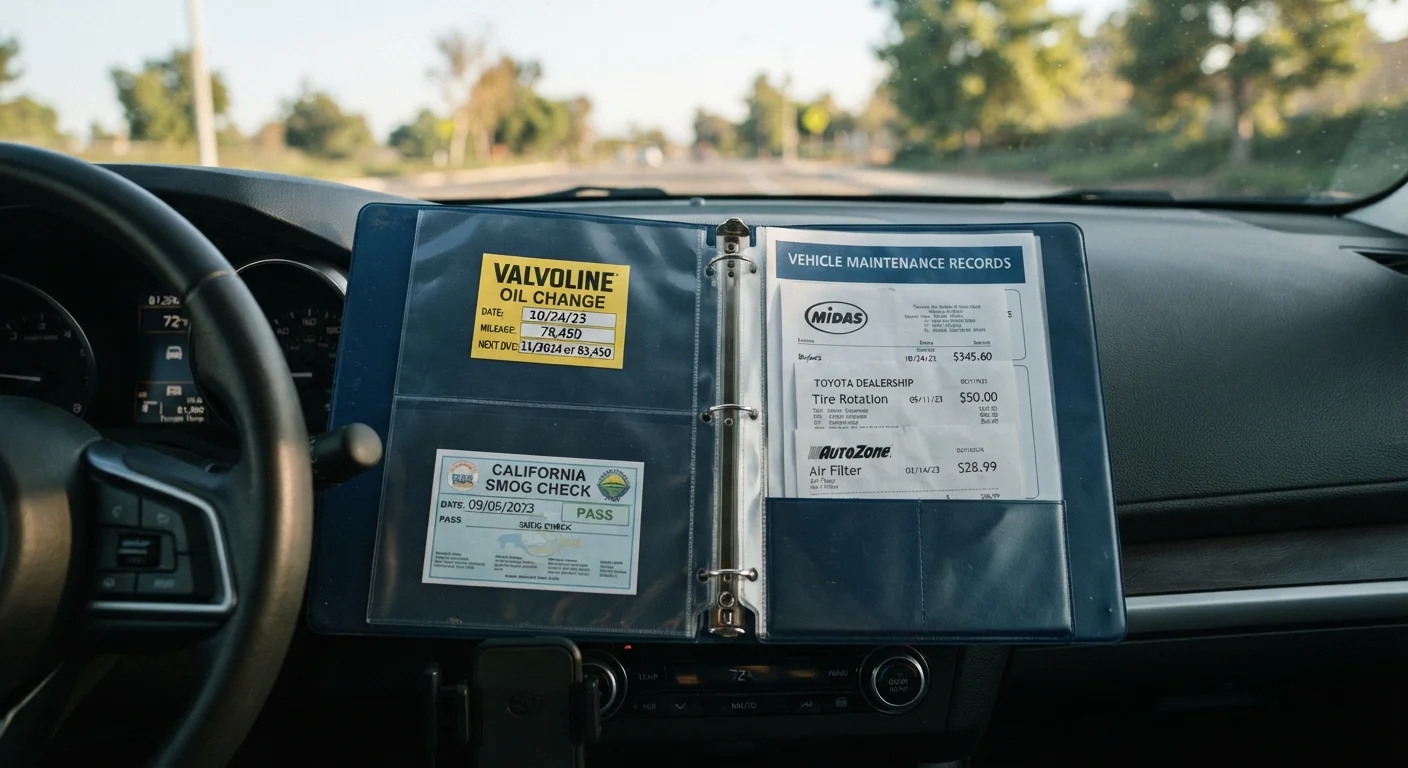
You don't need a sophisticated system to build a useful service history. Every entry should capture four pieces of information: the date, the odometer reading, a description of the work performed, and the name of the shop or person who did it. Receipts from a dealership or repair shop often contain all of this automatically - the habit is simply keeping them in one place.
Beyond routine oil changes and tire rotations, make a point of logging:
- Fluid top-offs or replacements (coolant, brake fluid, transmission fluid)
- Filter replacements (air, cabin, fuel)
- Battery, belt, and hose replacements
- Brake inspections and pad replacements
- Any recall or technical service bulletin (TSB) work performed
- Tire purchases, alignments, and rotations
If you handle any tasks yourself, note it the same way. The goal is a chronological account of your vehicle's care. For guidance on which maintenance tasks are reasonable to handle at home, see our breakdown of DIY versus professional repairs.
Keep all service receipts in a single dedicated location from day one.
Scattered records are nearly as useless as no records at all. A single folder, envelope, or digital folder ensures nothing is lost and makes the history immediately presentable to a mechanic or buyer.
Record your odometer reading with every maintenance entry.
Mileage-based intervals drive most maintenance schedules, and tracking odometer readings lets you - and your mechanic - see at a glance whether services are overdue. It also demonstrates to buyers that work was performed at appropriate intervals.
Log DIY maintenance with the same detail as shop-performed work.
Self-performed tasks count toward your service history only if documented. Without a record, you can't prove to a future buyer or a warranty administrator that the work was done.
Note any warning lights, unusual noises, or symptoms alongside the service that addressed them.
Contextual notes help future technicians understand the history of a problem, reducing diagnostic guesswork. They can also protect you if a repair fails to resolve an issue that was clearly documented.
Back up your records in at least two places.
A folder lost in a flood or a phone that fails can erase years of history. A simple digital backup - photographed receipts in cloud storage, for example - ensures the record survives.
Choosing a Format That You'll Actually Use
The best record-keeping system is whichever one you'll maintain consistently. There are three practical approaches most drivers use:
- Physical folder in the glove box: A simple accordion folder or envelope holds receipts and a handwritten log. It's always with the car and requires no technology.
- Spreadsheet or notes app: A basic spreadsheet - date, mileage, service, cost - is easy to maintain on a phone or computer and simple to share with a buyer or mechanic.
- Dedicated vehicle apps: Several mobile applications are designed specifically for logging car service. Many can store photos of receipts and send reminders when service is due based on your mileage input.
Whichever format you choose, establish a habit of updating it within 24 hours of any service - before the receipt gets lost in a bag or the glove compartment fills with unrelated clutter. Pairing your log updates with seasonal maintenance check-ins is one way to build a natural review rhythm.
Set a Mileage Reminder When You Log a Service
After recording any interval-based service - oil change, tire rotation, air filter - note the mileage at which the next service is due directly in your log. Many drivers also set a calendar reminder or use their phone's notes app to flag upcoming intervals. This small habit prevents the common situation of discovering a service is overdue only when a warning light appears.
Records at Resale: What Buyers and Dealers Look For
When the time comes to sell or trade in your vehicle, a documented service history is a concrete negotiating asset. Private buyers - particularly those who've done their homework - will pay more for a car with proof of regular oil changes and inspections than for an identical vehicle with no paper trail. Dealers also factor service history into trade-in appraisals, even if they don't always make that calculation visible.
“A vehicle with a complete, verifiable service history tells buyers that the owner cared about the car - and that confidence alone can move the price in your favor.”
— Automotive Editors, Cars & Driving, Cars & Driving Editorial Team
Equally important: if a warranty claim arises, manufacturers and extended warranty providers commonly require evidence that the vehicle was serviced according to the owner's manual schedule. A missing oil change record at the wrong moment can complicate or delay a valid claim. Good records close that gap before it opens.
New drivers building these habits from the start will find the process straightforward. Our introduction to car maintenance for new drivers covers the essential systems to monitor and the early habits that pay off over time.
This article provides general informational guidance and does not constitute professional mechanical or financial advice. Consult a qualified technician for diagnosis and repair decisions specific to your vehicle.