

Key Takeaways
Tailgating
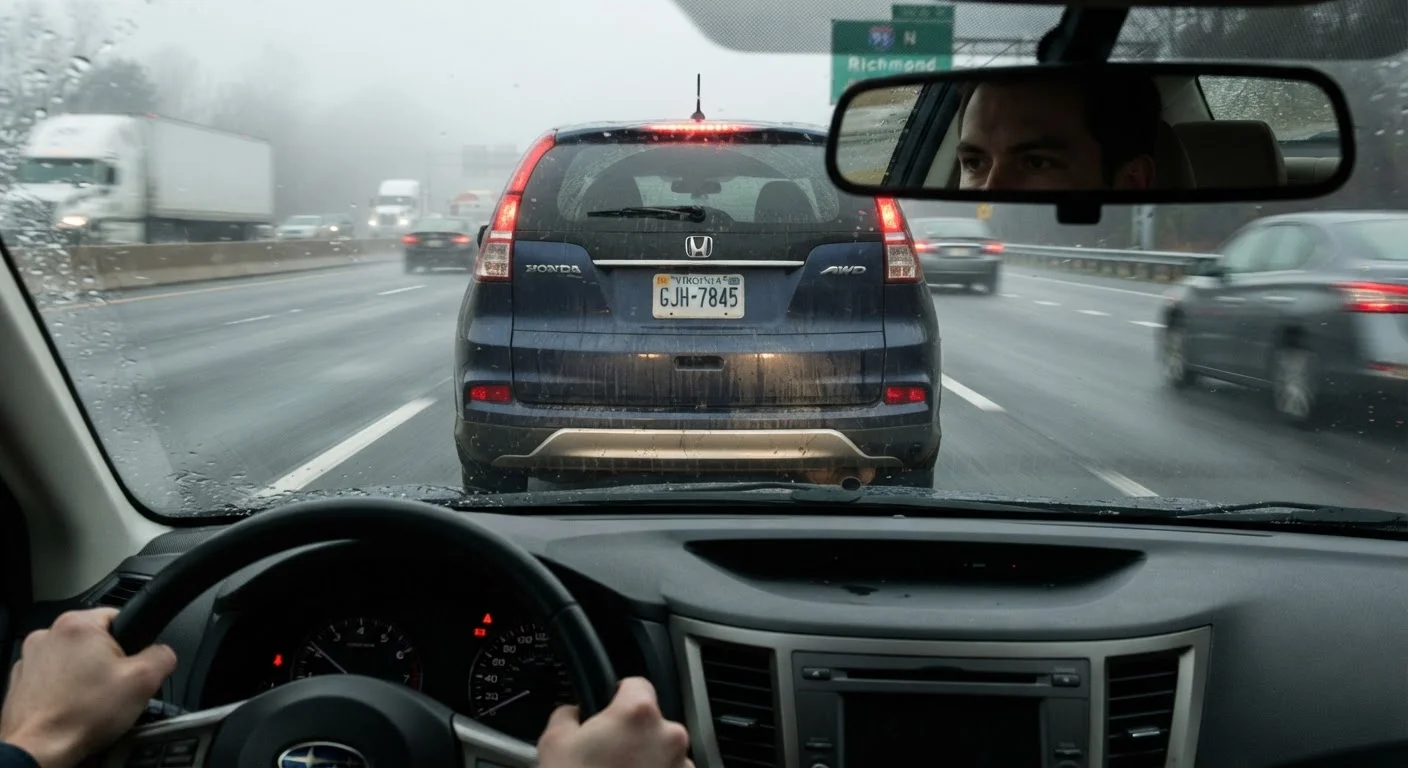
Tailgating means following another vehicle too closely - leaving less space than you would need to stop safely if the car ahead braked suddenly. It is one of the most common contributing factors in rear-end crashes on American roads. Safe following distance gives your brain time to perceive a hazard, your foot time to reach the brake, and your vehicle time to stop before impact.
The standard guidance in the U.S. is a minimum 3-second following gap under normal conditions, measured by picking a fixed roadside marker and counting the time between when the lead vehicle passes it and when yours does. Larger vehicles, bad weather, and higher speeds all call for additional distance.
Why Following Distance Is Constantly Underestimated
Most drivers who tailgate don't think of themselves as doing anything dangerous. From behind the wheel, a gap that looks comfortable often isn't - human perception of distance at speed is notoriously poor, especially on open highways where there are few reference points to anchor judgment.
The physics are unforgiving. At 60 mph, a vehicle covers 88 feet every second. Factor in the time it takes for a driver to perceive a hazard and physically move their foot to the brake - typically between 1.0 and 1.5 seconds - and you've already traveled 88 to 132 feet before braking even begins. Then add the actual braking distance, which varies by vehicle weight, tire condition, and road surface. Situational awareness - the habit of reading road conditions well ahead - can buy back some of that time, but it cannot replace physical space.
~1.5 sec
Average driver reaction time before braking
At 60 mph, this translates to roughly 132 feet traveled before the brakes are even applied, according to commonly cited traffic safety engineering data.
29%
Share of all crashes that are rear-end collisions
NHTSA data consistently shows rear-end crashes as one of the single most common crash configurations on U.S. roads.
3 seconds
Minimum recommended following distance (good conditions)
This baseline, taught in U.S. driver education programs, should be extended in rain, fog, night driving, or when towing.
The result: a driver following 1.5 seconds behind at highway speed has virtually zero margin for error if the lead vehicle brakes hard. This is not a theoretical concern - the National Highway Traffic Safety Administration (NHTSA) consistently identifies rear-end crashes as one of the most common crash configurations on U.S. roads.
The Real Cost of a Rear-End Crash
Rear-end collisions are frequently written off as minor fender-benders, but this reputation is misleading. While many are low-speed impacts in city traffic, a significant share occur at highway speeds where the forces involved are far greater. Whiplash injuries - soft-tissue damage to the neck and upper back - are among the most common outcomes even in moderate-speed crashes, and they can result in lasting pain and significant medical costs.
Beyond physical injury, the financial fallout is substantial. The at-fault driver - almost always the one following too closely - typically bears liability for vehicle repairs, medical bills, and legal costs. A citation for following too closely can also add points to a driving record, raising insurance premiums for years. Defensive driving principles are explicitly designed to prevent exactly this scenario by encouraging drivers to anticipate rather than react.
How Conditions Change the Distance You Need
The 3-second rule applies to dry pavement in good visibility - conditions that don't describe every commute. Wet roads extend stopping distance significantly; ice and snow can multiply it several times over. Rain reduces tire grip and impairs visibility simultaneously, making the gap between a safe stop and a collision far narrower than drivers tend to assume.
Adjust Your Gap for Conditions, Not Just Speed
Many drivers set their following distance based on how fast they're going, but road conditions are equally important. In rain, double your gap to at least 6 seconds. In snow or ice, even more space is warranted. If you're towing any trailer, treat your stopping distance as that of a much heavier vehicle - because it is.
Load matters too. A pickup truck carrying heavy cargo, or any driver towing a trailer, faces dramatically longer stopping distances than an unloaded passenger car - yet many drivers towing trailers maintain the same following gap they use when driving solo. Large commercial trucks operate under this reality at all times, which is why federal regulations require professional drivers to allow significantly greater following gaps than those expected of passenger vehicle drivers.
Night driving introduces another layer: reduced visibility means a hazard may not be perceptible until you're already dangerously close. Increasing following distance after dark is one of the simplest adjustments that meaningfully reduces risk.
Building the Habit: Practical Steps for Every Driver
Adjusting following distance is one of the easiest safety habits to develop because it requires no equipment and costs nothing. The 3-second count is straightforward to practice during any drive - choose a bridge, sign, or shadow line and count seconds as you pass it after the vehicle ahead. If you reach that marker before finishing your count, you're too close.
New drivers in particular benefit from making this a deliberate practice early. New drivers often underestimate gap distances - both when following and when merging - making rear-end risk higher in the first year of driving. Building the habit of counting seconds rather than estimating car lengths makes correct following distance automatic over time.
Following Distance and Traffic Flow
Maintaining proper following distance doesn't just protect you - it benefits everyone behind you. Drivers who leave adequate space can brake more gradually, reducing the cascade effect that turns a single hard stop into a multi-car chain reaction. Research in traffic engineering shows that consistent spacing by even a portion of drivers can reduce highway congestion and crash risk for the entire flow of traffic.
If your vehicle is older or due for maintenance, stopping distances can be further affected by worn brake pads or aging tires. Visit the car maintenance hub for guidance on keeping your vehicle's safety systems in working order - because following distance only helps if your brakes can do their job.