

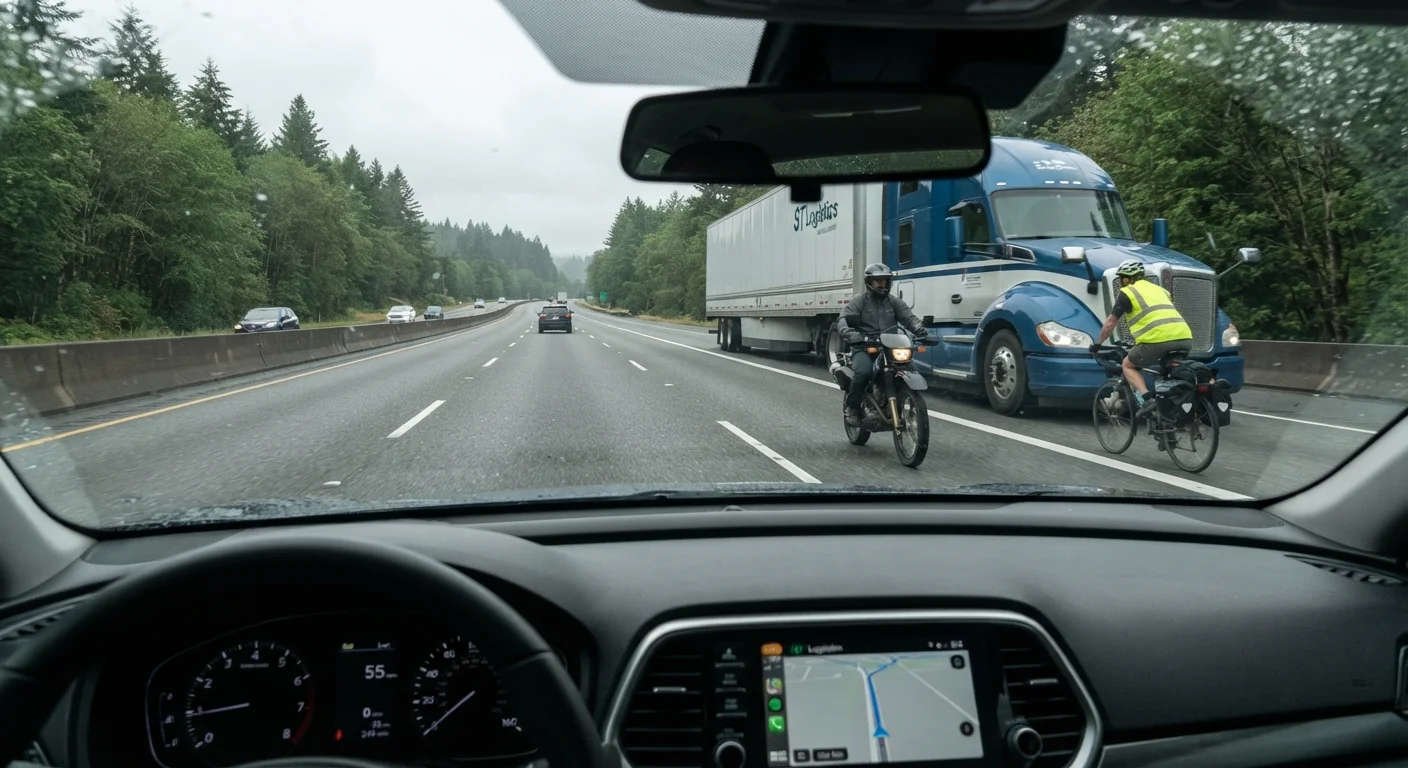
Key Takeaways
Why Sharing the Road Requires a Different Mindset
Most drivers develop habits around other cars of roughly similar size, speed, and predictability. The moment a 40-ton semi-truck, a 400-pound motorcycle, or a cyclist enters that mental model, those habits stop working reliably. Each road user type has a distinct physics profile, visibility limitation, and legal standing - and collisions often happen when drivers fail to account for those differences.
Good situational awareness - actively scanning mirrors, tracking where vehicles are positioned, and anticipating what they might do - is what separates reactive drivers from genuinely safe ones. That skill becomes even more critical when your surroundings include a 70-foot truck or a rider with no crumple zone protecting them.
Never linger in a truck's No-Zone - pass decisively or fall back
Extended time in a truck driver's blind spots means they may merge, brake, or turn with no awareness of your presence. The longer you stay invisible, the higher the collision probability. Quick, decisive passing reduces exposure time.
Give motorcycles a full lane and a four-second following gap
Motorcyclists use lateral lane position strategically to stay visible and avoid hazards. Crowding them removes their maneuvering room. A longer following gap gives both of you time to react to road surface changes that only matter to two-wheeled vehicles.
Treat every cyclist pass as a lane change with a three-foot minimum clearance
Cyclists are physically unprotected and can be knocked off balance by air turbulence alone. Legal minimums exist because unsafe passing is a leading cause of cyclist fatalities. Treating the pass formally - signal, check, move, clear - builds the habit correctly.
Check for cyclists in your mirror before opening a car door near a bike lane
Dooring crashes happen fast and leave the cyclist almost no reaction time. The driver typically doesn't see the approaching rider until after the door is already open. A two-second mirror check before opening eliminates most of this risk.
Look twice at intersections before turning left across oncoming traffic
Motorcycles and cyclists are significantly harder to detect than cars at distance. One glance that registers "clear" can miss a motorcycle traveling at speed due to its smaller visual profile. A second deliberate look specifically scanning for smaller road users dramatically reduces this error.
Sharing the Road with Large Commercial Trucks
A fully loaded tractor-trailer can weigh up to 80,000 pounds and take the length of nearly two football fields to stop at highway speeds. These are not just large cars - they behave differently in ways that demand specific driver adjustments.
Blind spots are larger than most drivers realize. Truckers commonly call them "No-Zones": directly behind the trailer, directly in front of the cab, and along both sides for much of the truck's length. If you can't see the driver's face in their side mirror, assume they cannot see you.
Avoid lingering alongside a truck, especially when it's turning or merging. Wide right turns are a known hazard - trucks often swing left before turning right, and the gap created looks like an opening to impatient drivers. It isn't. Following too closely behind a truck is particularly dangerous because it eliminates your sightline and stopping room simultaneously.
~9 car lengths
Stopping distance for a loaded semi at 65 mph
According to FMCSA guidance, a fully loaded commercial truck at highway speed needs roughly 525 feet to stop - nearly twice the distance of a passenger car.
24x
Higher fatality rate for motorcyclists vs. car occupants per mile
NHTSA data consistently shows motorcyclists face dramatically elevated fatality risk per vehicle mile traveled compared to passenger car occupants.
Sharing the Road with Motorcyclists
Motorcycles are legal, full-lane vehicles - not a subset of bicycle traffic and not a smaller car. They are entitled to the entire lane width, and experienced riders use all of it intentionally to improve their own visibility and road position.
A common driver error is misjudging a motorcycle's speed and distance, especially at intersections. The smaller visual profile creates a perceptual trick: motorcycles appear farther away and slower than they actually are. This contributes directly to left-turn crashes, one of the most common collision types involving motorcycles.
Maintain at least a four-second following gap behind a motorcycle - more in poor weather. Signal early and check your blind spots twice before changing lanes. At night, a motorcycle's single headlight can be harder to track among other light sources; increase your following distance further. Never share a lane side-by-side with a rider. If you see a motorcycle ahead wobbling or braking hard, give them maximum space - road debris or surface hazards that a car tires over can be life-threatening on two wheels.
“Motorcyclists are about 24 times more likely than passenger car occupants to die in a crash per mile traveled. Most of those crashes involve another vehicle - and in roughly two-thirds of those cases, the other driver violated the motorcyclist's right-of-way.”
— National Highway Traffic Safety Administration, U.S. federal road safety agency (NHTSA crash data)
Sharing the Road with Cyclists
In most U.S. states, cyclists have the same rights and responsibilities as other vehicle operators. Many roads legally require drivers to maintain a minimum passing distance of three feet - some states mandate more. Passing too closely at speed creates a dangerous pressure wave that can destabilize a rider.
Before passing a cyclist, treat it like a lane change: check mirrors, signal, move over as fully as traffic allows, and return to your lane only after you've cleared them. In urban areas, watch for cyclists filtering through slower traffic or occupying bike lanes adjacent to your path - especially before right turns, where cyclists in the bike lane have right-of-way over a turning vehicle.
Door-zone awareness matters too. If you're parking on a street with a bike lane, check your mirrors and the blind spot before opening your door. "Dooring" - striking a cyclist with an opening car door - causes serious injuries and is a ticketable offense in many jurisdictions.
For additional context on navigating busy intersections where cyclists, pedestrians, and vehicles interact, see our breakdown of traffic signals and right-of-way rules.
Habits That Protect Every Road User
Regardless of who you're sharing the road with, a handful of habits consistently reduce collision risk. Scan ahead 12-15 seconds rather than focusing only on the vehicle directly in front of you. This gives you time to identify a cyclist emerging from a side street, a truck braking hard on a grade, or a motorcyclist weaving to avoid debris.
Different road environments concentrate different risks: highways bring high-speed truck interactions and lane-change hazards; urban streets bring cyclist and pedestrian exposure at intersections. Adjust your scanning pattern accordingly. And avoid distracted driving - even hands-free phone use impairs hazard detection enough to miss a cyclist or a motorcycle filtering into your path.
Scan Specifically for Smaller Road Users
When scanning traffic ahead, train yourself to actively look for motorcycles and cyclists rather than relying on peripheral detection. Their smaller size and profile mean your brain may filter them out of an initial glance. Deliberate, category-specific scanning - "am I sharing this road with a bike or rider right now?" - catches what passive awareness misses.
This article provides general driver education and is not a substitute for your state's official driver's manual or a certified driving course. Traffic laws, passing distance requirements, and road rules vary by state - always verify the rules that apply in your jurisdiction.