

Key Takeaways
Option A
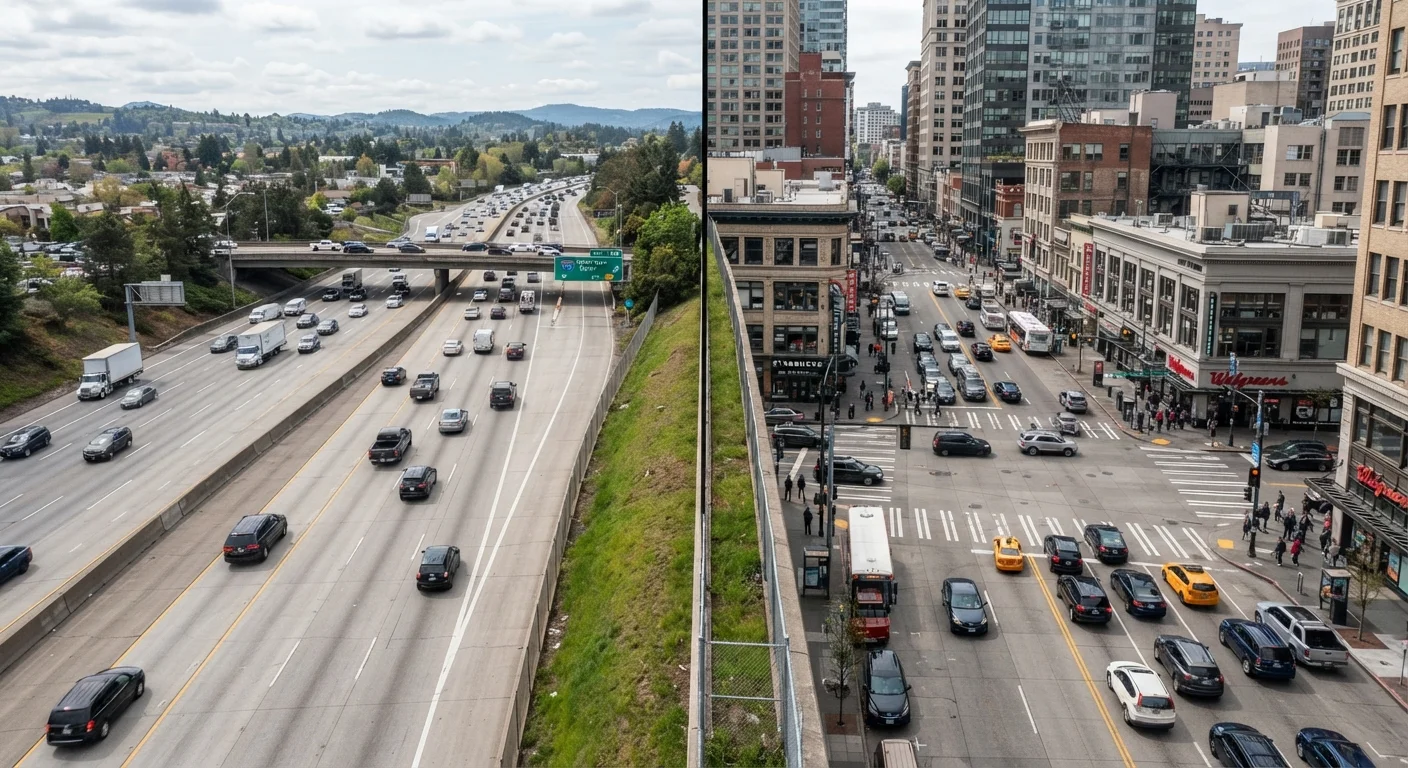
Highway Driving
High-speed, long-distance travel with structured lane discipline.
Best for: Drivers covering longer distances who need to manage speed, following distance, and fatigue at sustained high velocity.
Option B
City Driving
Stop-and-go navigation through dense, unpredictable environments.
Best for: Drivers navigating frequent intersections, pedestrians, cyclists, and tight spaces at lower but rapidly changing speeds.
If you're a new driver building foundational skills
City Driving (practice first)
Lower speeds mean more reaction time to correct mistakes, but the complexity of intersections and pedestrian traffic means new drivers should study city rules thoroughly. See what new drivers often get wrong before hitting either environment.
If your primary concern is crash severity and fatality risk
Highway Driving (approach with extra caution)
High-speed collisions carry significantly higher fatality rates. Maintaining safe following distance and avoiding distraction is critical on the highway.
If you want to reduce your total number of minor incidents
Highway Driving (once comfortable)
Highways have fewer conflict points per mile than city streets, meaning the raw frequency of close calls and minor fender-benders is considerably lower.
Understanding the Core Difference in Risk Profiles
Highway driving and city driving are not simply fast versus slow - they represent fundamentally different risk architectures. According to the National Highway Traffic Safety Administration (NHTSA), urban areas account for a disproportionate share of total crashes, while rural and highway corridors account for a disproportionate share of crash fatalities. This distinction shapes everything about how drivers should approach each environment.
On the highway, speeds above 65 mph dramatically compress the time available to react to hazards. A driver traveling at 70 mph covers roughly 103 feet per second, meaning a two-second distraction erases over 200 feet of road. In the city, average speeds may sit between 15 and 35 mph, but the hazard landscape is far more crowded - pedestrians, cyclists, delivery vehicles, and cyclists all compete for the same space, often unpredictably.
| Criterion | Highway Driving | City Driving |
|---|---|---|
| Typical Speed Range | 55-80 mph | 15-40 mph |
| Crash Frequency | Lower per mile | Higher per mile |
| Crash Severity | Higher fatality rate | Lower fatality rate |
| Primary Hazard Type | Speed, fatigue, merging | Intersections, pedestrians, cyclists |
| Reaction Time Available | Very limited at speed | Slightly more, but hazards multiply |
| Distraction Risk | High (monotony-induced) | High (sensory overload) |
| Key Skill Required | Speed management, lane discipline | Situational awareness, scanning |
Highway Hazards: Speed, Fatigue, and Merging
The three primary danger categories on American highways are high-speed collisions, driver fatigue, and merging conflicts. At highway speeds, even a well-executed emergency braking maneuver may not prevent impact - stopping distance increases exponentially with speed, not linearly. A vehicle braking from 70 mph needs roughly 315 feet to stop under ideal conditions, compared to about 75 feet from 35 mph.
Driver fatigue becomes a serious factor on long highway stretches, particularly on rural interstates with minimal visual stimulation. The monotonous environment can induce microsleep - brief involuntary sleep episodes - especially in the late afternoon or between midnight and 6 a.m. Night driving presents compounding fatigue risks that are especially pronounced at highway speeds.
Merging - both entering and exiting - is another concentrated risk zone. Drivers must judge closing speeds and gaps accurately while maintaining their current lane. Large commercial trucks are particularly challenging to merge near, given their substantial blind spots and longer braking distances.
~54%
Share of traffic fatalities on rural roads
According to NHTSA data, rural roads - which include many highway corridors - account for a disproportionate share of fatal crashes relative to vehicle miles traveled.
40%
Of fatal crashes involve intersection-related factors
The Federal Highway Administration estimates that approximately 40 percent of all crashes in the U.S. are intersection-related, with urban areas bearing the bulk of these incidents.
2-4 sec
Recommended minimum following distance on highway
Safety organizations including the National Safety Council advise a minimum two-to-four second following gap on highways, increasing in adverse weather or at higher speeds.
City Driving Hazards: Intersections, Pedestrians, and Complexity
Urban driving distributes risk across a much wider set of conflict points. Intersections represent the single most dangerous location in city driving - research from the Federal Highway Administration consistently identifies them as sites of a majority of urban crashes. Running red lights, misjudging a yield, or failing to spot a pedestrian mid-crossing can result in serious collisions even at modest speeds.
Pedestrian and cyclist exposure is another defining feature of city risk. Urban environments require constant scanning not just ahead, but to the sides and in mirrors - a skill set that newer drivers often underestimate during their first year behind the wheel. Parked vehicles can obscure pedestrians stepping into the road; delivery trucks double-parked in travel lanes force sudden lane changes.
Understanding signal timing, right-of-way rules, and yielding behavior is essential. Drivers who are unclear on these fundamentals will find city driving especially stressful. A solid grounding in traffic signals and right-of-way rules is the clearest preventive measure available.
Weather Changes the Equation Significantly
Both highway and city driving carry substantially elevated risk in rain, snow, ice, or dense fog. Wet pavement increases stopping distances, and reduced visibility compounds the challenge of scanning for hazards. The risk calculus presented here assumes normal daylight and dry conditions. Drivers should adjust their strategies - and their expectations - whenever weather deteriorates. For a full breakdown, see guidance on driving in challenging weather conditions.
Adapting Your Driving Habits to Each Environment
Skilled drivers don't apply the same habits in both settings - they calibrate. On the highway, the priority habits are: maintaining a following distance of at least three to four seconds; scanning far ahead for brake lights and lane changes; and planning fuel and rest stops to manage fatigue proactively. Weather conditions like rain, snow, or fog amplify every highway risk, and adjusting speed and following distance in bad weather is non-negotiable.
In the city, the priority shifts to heightened situational awareness at lower speeds: checking mirrors before every lane change, anticipating pedestrian crossings near bus stops and schools, and leaving extra buffer space in stop-and-go conditions to allow for sudden stops. Avoiding distraction - particularly phone use - carries outsized importance in urban environments where hazards emerge from multiple directions simultaneously.
No environment is categorically safer than the other. Highway driving concentrates its danger into severity; city driving spreads it across frequency and complexity. Recognizing which risks are active in your current environment is the foundational skill that separates reactive from proactive drivers.