

Key Takeaways
Option A
Debt Avalanche
The mathematically efficient approach to debt elimination.
Best for: People who are motivated by minimizing total interest paid and can stay the course without quick wins.
Option B
Debt Snowball
The momentum-driven approach that builds confidence fast.
Best for: People who need early victories to stay motivated and have multiple smaller debts to knock out.
If you want to pay the least interest overall
Debt Avalanche
By attacking the highest-rate debt first, the avalanche method mathematically reduces the total interest you'll pay across all balances.
If you need early motivation to stay on track
Debt Snowball
Clearing smaller balances quickly creates a sense of progress that can keep you committed through a longer payoff journey.
If your debts carry similar interest rates
Debt Snowball
When interest rates are close, the cost difference between methods shrinks - and the snowball's psychological benefits may tip the scales.
If you have one very large, high-rate balance dominating your debt
Debt Avalanche
A single high-interest account dragging on your finances is precisely the scenario where avalanche saves the most money.
How Each Method Works
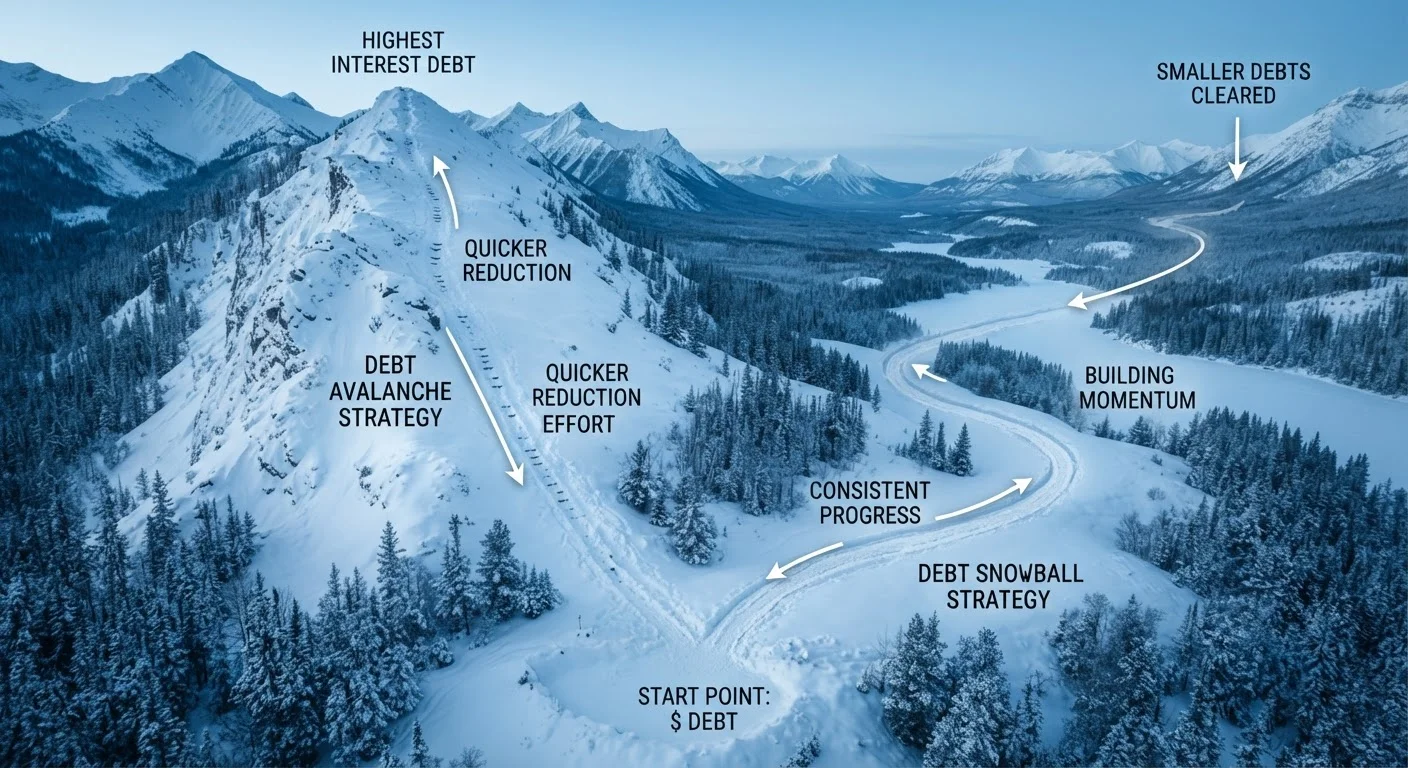
Both strategies share the same foundational rule: make the minimum payment on every debt, then direct any extra money toward one priority account. The difference is which account gets that extra attention.
Debt Avalanche: You rank your debts by interest rate, highest to lowest. Every extra dollar goes to the highest-rate balance first. Once that's paid off, you roll its payment into the next highest-rate debt, and so on. Because high-rate balances accumulate the most interest over time, eliminating them first limits the total amount you repay.
Debt Snowball: You rank debts by current balance, smallest to largest, ignoring interest rates. Extra payments go to the smallest balance first. When it's gone, you roll that payment into the next smallest. The early payoffs are psychologically rewarding - each closed account is a concrete win.
Before committing to either approach, it helps to have a clear inventory of every balance, rate, and minimum payment you carry. A personal debt audit is a practical first step.
| Criterion | Debt Avalanche | Debt Snowball |
|---|---|---|
| Priority order | Highest interest rate first | Smallest balance first |
| Total interest paid | Lower (mathematically optimal) | Typically higher |
| Speed to first payoff | Slower if high-rate debt is large | Faster - smallest balance closes first |
| Psychological reward | Delayed; satisfaction comes later | Immediate; early wins build momentum |
| Best rate-spread scenario | Wide gap between high and low rates | Rates are similar across debts |
| Complexity | Requires tracking rates carefully | Simple - just sort by balance |
The Real-World Trade-Off: Interest Saved vs. Motivation
The avalanche method's advantage is purely financial. By starving high-interest debt of extra time to compound, you can save a meaningful amount - potentially hundreds or even thousands of dollars depending on balances and rates. The trade-off is patience: if your highest-rate debt also carries a large balance, it may take many months before you see your first account closed.
The snowball method flips that trade-off. You'll likely pay more in total interest compared to the avalanche, but you get visible progress faster. Research in behavioral economics, including work published in the Journal of Marketing Research, has found that people are more likely to stay engaged with debt repayment when they can see accounts being eliminated - even if those accounts aren't the costliest ones.
~$1,000+
Potential interest saved with avalanche on typical multi-debt scenarios
The exact savings vary widely based on balances, rates, and extra payment amounts - higher-rate and larger balances amplify the difference.
35%
Americans carrying credit card debt month to month
According to the Federal Reserve's Survey of Consumer Finances, a significant share of U.S. households carry revolving credit card balances.
Neither strategy is wrong. The question is what actually keeps you paying consistently. A plan you abandon partway through costs more than a slightly less efficient plan you complete.
For context on how these methods fit into a broader financial picture, the complete guide to savings and debt repayment covers how debt elimination fits alongside saving goals.
Choosing the Right Method for Your Situation
A few practical questions can help clarify which approach suits you better:
- How many separate debts do you have? If you're juggling six or seven accounts with varying small balances, the snowball can simplify your financial life quickly. If you have two or three debts with very different rates, the avalanche's math matters more.
- How wide is the interest rate gap? A 5-percentage-point difference between your highest and lowest rates makes the avalanche considerably more valuable. A 1-point spread barely changes the outcome.
- What's your track record with financial goals? If you've started payoff plans before and stalled, the snowball's early momentum may be exactly what you need this time.
It's also worth knowing that these aren't your only options. Debt consolidation can restructure multiple balances into a single payment, sometimes at a lower rate - though it comes with its own considerations.
Hybrid Approaches Are Valid Too
Some people use a modified strategy: start with the snowball to eliminate one or two small accounts quickly, then switch to the avalanche once they've built confidence. There's no rule requiring you to commit to a single method for your entire payoff journey. What matters is that the approach is sustainable and that minimum payments are always met on time to avoid late fees and credit score impact.
If you're also trying to build savings at the same time, saving while in debt involves a separate set of trade-offs worth understanding before you lock in your plan.
This article is for general informational purposes only and does not constitute personalized financial advice. Consider consulting a licensed financial professional for guidance specific to your situation.