

Key Takeaways
Our Verdict
For most Americans carrying high-interest debt, the financially sound move is to build a minimal emergency cushion first, then redirect extra money toward debt payoff. Once high-interest balances are cleared, shifting focus to savings and investing makes strong mathematical sense. That said, capturing a full employer retirement match is rarely worth skipping - it is one of the few scenarios where saving while in debt pays off reliably.
| Best for | Recommended |
|---|---|
| Those with high-interest credit card or personal loan debt | Pay off debt first |
| Those with employer-matched retirement benefits | Save up to the match, then attack debt |
| Anyone without any emergency cushion | Build a starter emergency fund first |
| Those carrying only low-interest debt (mortgage, federal student loans) | Save and invest simultaneously |
Why This Question Doesn't Have One Universal Answer
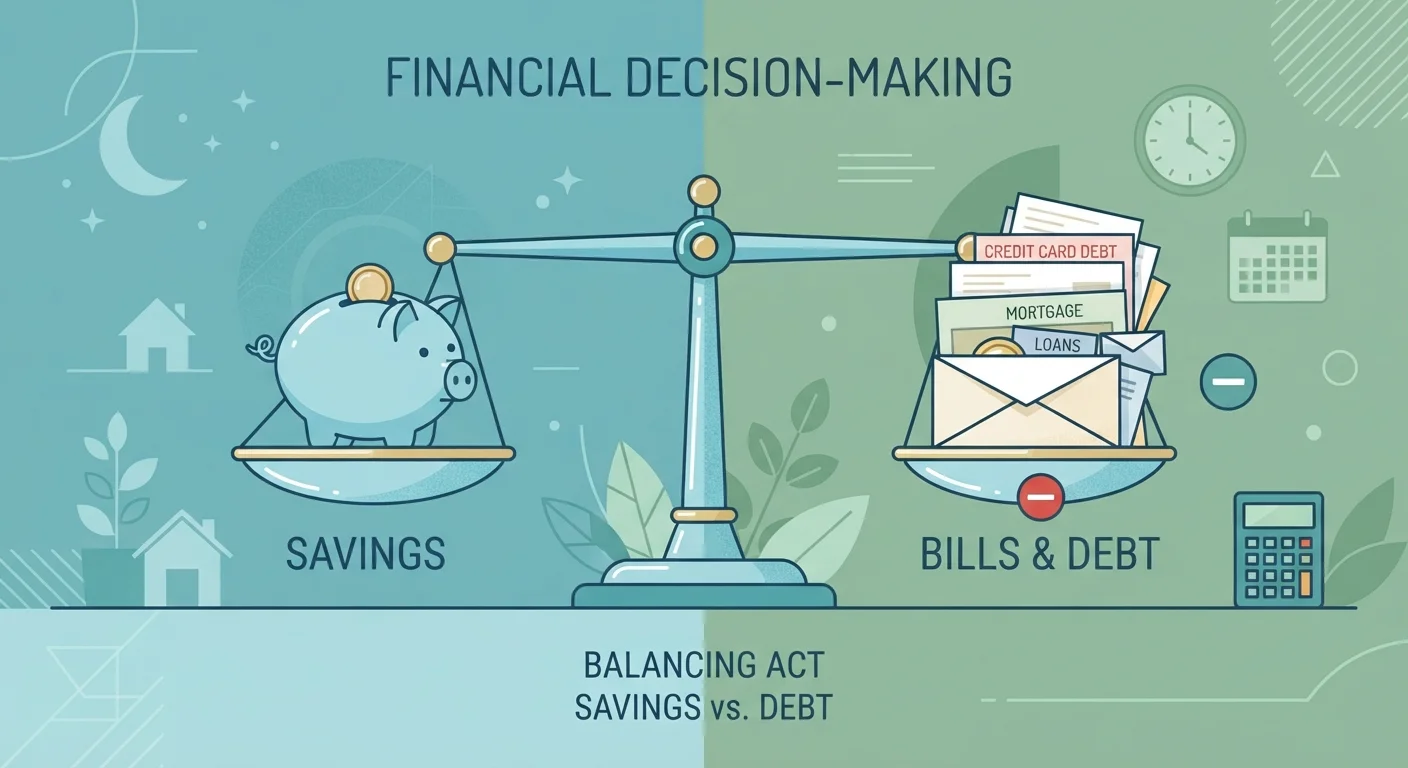
The tension between saving and paying off debt is one of the most common financial dilemmas American adults face. The instinct to eliminate debt entirely before saving anything feels responsible, but it can leave you financially exposed. The reverse - ignoring high-interest debt to build savings - often costs more in interest than the savings ever earn.
The right balance depends on three core variables: the interest rate on your debt, the return you could earn on savings or investments, and your income stability. Understanding how those interact is the foundation of a smart strategy. This article is general financial education - for decisions specific to your situation, a licensed financial adviser can help you apply these principles to your numbers.
For a broader overview of how saving and debt repayment fit together, see the complete guide to savings and debt repayment.
The Case for Paying Off Debt First
When debt carries a high interest rate - commonly 15% to 25% on credit cards - paying it down delivers a guaranteed, risk-free "return" equal to whatever rate you eliminate. No savings account or low-risk investment reliably matches that. This is the core mathematical argument for prioritizing debt repayment.
| Pay Off Debt First | Save / Invest First | Do Both Simultaneously | |
|---|---|---|---|
| Best for debt type | High-interest (credit cards, payday loans) | Low-interest (mortgage, federal student loans) | Mixed debt portfolio |
| Risk profile | Low - guaranteed interest savings | Moderate - depends on investment returns | Moderate - requires discipline |
| Emergency fund impact | Leaves you exposed without a cushion | Builds safety net | Balanced protection |
| Employer match consideration | May miss free retirement match | Captures full employer match | Can capture match while paying debt |
| Psychological benefit | Strong - eliminates debt stress | Moderate - savings growth motivating | Variable - requires tracking two goals |
| Interest rate math | Wins when debt rate > savings rate | Wins when savings rate > debt rate | Neutral - splits the difference |
Beyond the math, carrying high-interest balances compounds rapidly. A $5,000 credit card balance at 20% APR costs roughly $1,000 in interest per year if only minimum payments are made. That erosion works against any savings progress happening simultaneously.
If you're weighing different repayment approaches once you commit to paying down debt, the avalanche vs. snowball comparison walks through how each method works and which tends to suit different personalities.
Minimum Payments Are Not a Strategy
Making only minimum payments while focusing entirely on savings can cost thousands of dollars in unnecessary interest over time. High-interest debt grows faster than most savings earn. If you're only paying minimums on credit card balances while building a savings account yielding 4-5%, you are likely losing ground. Run the numbers on your specific balances and rates before deciding.
When Saving Should Come First (or Alongside Debt)
There are two situations where saving takes priority even when you carry debt.
Build a starter emergency fund first
Without any liquid savings, an unexpected expense - a car repair, a medical bill, a job gap - forces you back into debt, often at high interest. Financial educators commonly suggest a starting cushion of around $1,000 before aggressively paying down debt. Once high-interest balances are eliminated, expanding that fund to cover three to six months of essential expenses becomes the next milestone.
Capture the full employer retirement match
If your employer matches contributions to a 401(k) or similar plan, not contributing enough to get the full match is effectively leaving part of your compensation on the table. Even a 50% match on 6% of salary represents a 50% immediate return on those dollars - a rate that almost no debt's interest cost can outpace. Contributing up to the match, then directing remaining funds toward high-interest debt, is a widely recommended approach.
For guidance on where to keep your emergency fund once you start building it, see savings account vs. money market account.
Prioritize the Employer Match Before Anything Else
If your employer offers a retirement contribution match, contribute at least enough to capture every dollar of it before directing extra cash to debt payoff. A 50% or 100% match represents an immediate return no debt reduction strategy can reliably beat. Once you've secured the full match, redirect surplus funds toward high-interest balances.
Low-Interest Debt Changes the Calculus
Not all debt is equally urgent to eliminate. A fixed-rate mortgage at 3-4% or federal student loans at 5-6% occupy a different category than credit card debt. When borrowing costs are low, the expected long-term return from investing - historically averaging around 7% annually for diversified equity portfolios, though past performance does not guarantee future results - may exceed what you'd "save" by accelerating payoff.
This is why many financial planning frameworks suggest treating low-interest debt as a lower priority, continuing regular payments while directing surplus cash toward retirement accounts or other savings goals. The interest rate environment you're operating in also shapes this math. How interest rate environments affect your strategy explains how rising or falling rates shift the equation.
For a practical framework to do both simultaneously, the monthly budget template for saving and debt repayment offers a structured starting point.
~$1,000
Recommended starter emergency fund
Many personal finance educators suggest this as a minimum buffer before aggressively paying down debt to avoid re-entering debt after unexpected expenses.
3-6 months
Target emergency fund size (post-debt)
The Federal Reserve's Report on the Economic Well-Being of U.S. Households highlights that many Americans cannot cover a $400 unexpected expense without borrowing.