

Key Takeaways
Why Mental Stimulation Matters for Caged Birds
Caged birds occupy a unique position in the pet world: they are cognitively complex animals whose daily lives can be radically constrained by their living situation. In the wild, parrots, finches, and other companion species spend their days foraging, socializing, problem-solving, and navigating dynamic environments. A standard cage, even a well-maintained one, eliminates most of those demands.
The result is often what avian behaviorists call environmental deprivation - a state where insufficient stimulation produces stress-related behaviors including feather destructive behavior (sometimes called feather plucking), excessive screaming, stereotyped repetitive movements, and aggression. These are not personality flaws; they are predictable responses to unmet needs.
Thoughtful enrichment doesn't require expensive setups. It requires understanding what birds actually do in the wild and finding practical ways to replicate those experiences inside a home environment. Just as rabbit enclosures benefit from species-appropriate environmental design, bird cages need intentional enrichment built in from the start.
Enrichment Needs Vary by Species
A budgerigar's enrichment needs differ considerably from those of a cockatiel or a conure. Species-specific research matters: what engages one bird may be ignored or even stressful to another. Learn how budgerigars and cockatiels compare in temperament and care demands before designing an enrichment plan.
Core Enrichment Practices to Implement
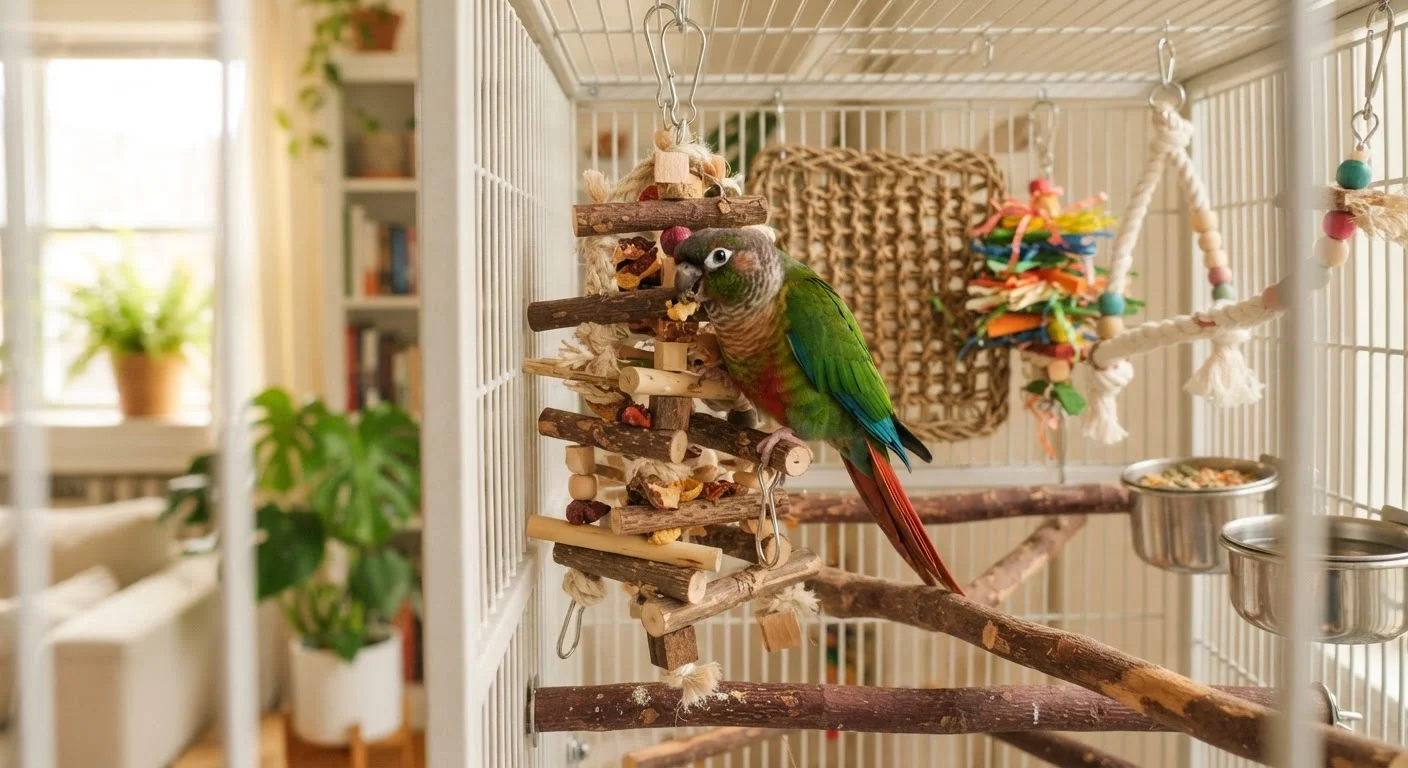
Effective enrichment spans several categories: foraging, physical variety, sensory stimulation, and social connection. The practices below address all of these dimensions and are grounded in behavioral science applied to companion birds.
Offer foraging opportunities every day rather than presenting food in open dishes.
Wild birds spend the majority of their waking hours searching for food. Presenting meals in easy-access bowls eliminates this instinct-driven activity, leaving birds with hours of unstructured time that often leads to feather-destructive behaviors or excessive vocalization. Foraging engages problem-solving circuits and provides meaningful occupation.
Rotate toys on a weekly schedule rather than leaving the same items in place indefinitely.
Birds habituate quickly to stationary objects. Once novelty fades, a toy provides little cognitive value. A rotation schedule reintroduces items with the psychological effect of novelty - even familiar objects become interesting again after a short absence.
Provide multiple perch diameters and textures rather than relying on a single dowel rod.
Uniform perches force the foot into one position repeatedly, contributing to pressure sores and muscle fatigue. Varied perches - natural wood branches, rope perches, and platform rests - exercise different muscle groups and maintain foot health, which is directly connected to comfort and engagement.
Schedule consistent, predictable social interaction outside the cage each day.
Most companion bird species are highly social in the wild and experience genuine stress when isolated for extended periods. Structured out-of-cage time with a trusted person meets the bird's need for bonding, exploration, and stimulation simultaneously. Predictability in timing also reduces anxiety.
Introduce novel, safe sounds and controlled visual stimulation periodically.
Birds are highly attuned to their auditory and visual environment. Gentle background music, nature sound recordings, or even positioning the cage to observe safe household activity provides low-intensity stimulation that prevents the monotony of a silent, unchanging environment.
“Behavioral problems in parrots are most often problems of environment, not personality. A bird that screams, plucks, or bites is frequently a bird whose cognitive needs are not being met.”
— Dr. Susan Friedman, Behavioral psychologist and applied behavior analysis researcher specializing in companion bird behavior
Recognizing When Enrichment Is Working - and When It Isn't
A well-enriched bird is generally active during daylight hours, engages with objects in its environment, vocalizes in contextually appropriate ways, and interacts willingly with familiar people. These are positive behavioral indicators, not guarantees of perfect health - physical conditions can mimic or compound behavioral signs.
Warning signs that enrichment may be insufficient include repetitive head-bobbing unrelated to social context, persistent screaming beyond normal species-typical vocalization, feather destruction, and complete disinterest in the environment. If these behaviors appear or escalate, consult an avian veterinarian to rule out medical causes before attributing the issue solely to enrichment gaps.
Before bringing a bird home, it's worth reviewing a small pet preparation checklist to ensure the environment is genuinely ready - enrichment planning belongs at that stage, not as an afterthought.
Quick Wins: Start Today
You don't need to overhaul your bird's entire setup to make a meaningful difference. The following actions can be implemented immediately with minimal cost and effort.
This article provides general educational information about bird care and is not a substitute for guidance from a qualified avian veterinarian. If your bird shows sudden behavioral changes or signs of distress, consult a professional promptly.