

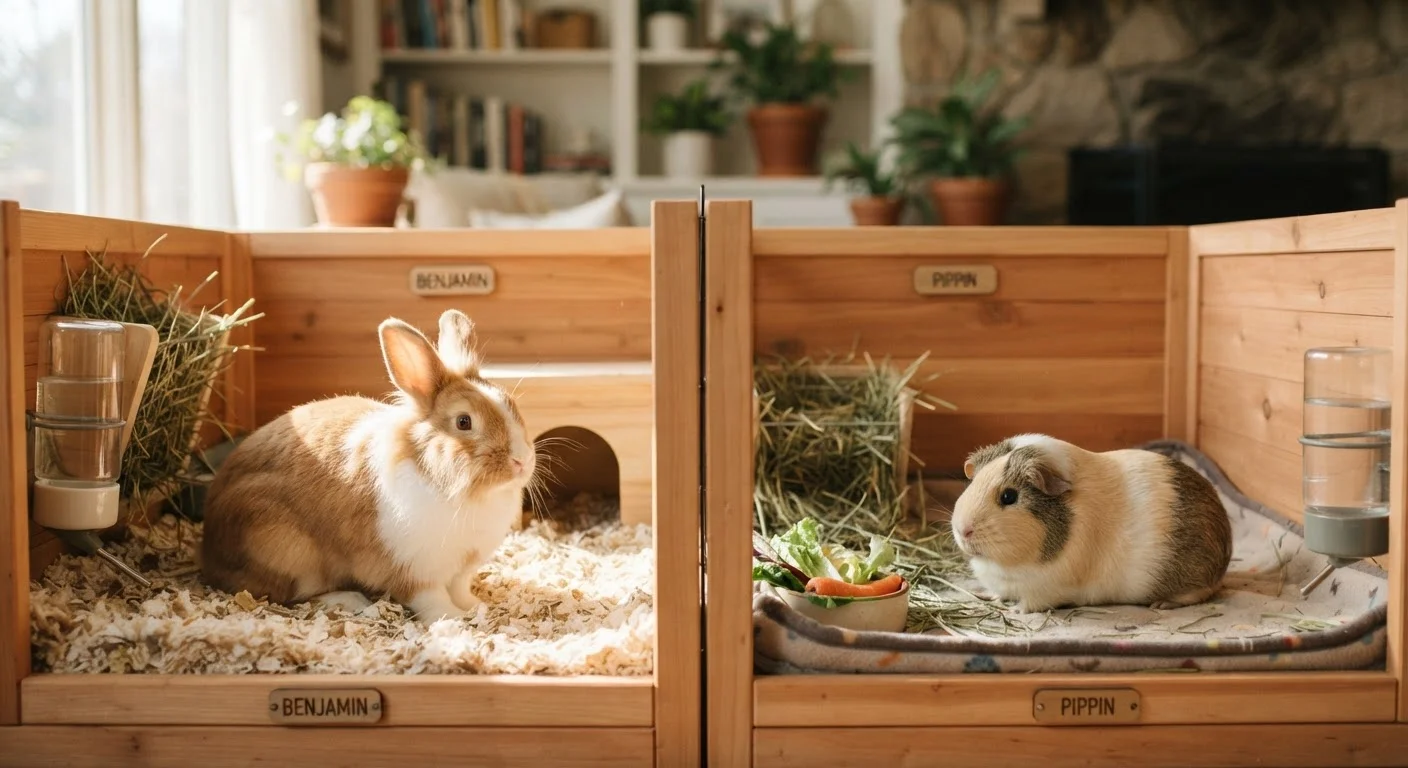
Key Takeaways
A Popular Pairing With Hidden Dangers
Guinea pigs and rabbits are two of the most popular small companion animals in American households, and it's easy to see why owners assume they'd make good roommates. They're roughly similar in size, both herbivorous, and sold in the same sections of pet stores. But that surface-level resemblance hides real incompatibilities - biological, behavioral, and nutritional - that make cohabitation genuinely hazardous for both animals.
Veterinary and small animal welfare organizations have advised against co-housing these species for decades, yet the myth that they're natural companions persists. Before setting up a shared enclosure, it's worth understanding exactly what the risks are. If you're still preparing your setup, the small pet preparation checklist is a useful starting point for getting species-specific housing right from day one.
Myth
Guinea pigs and rabbits are natural companions because they're both small, gentle herbivores.
Fact
The two species have incompatible communication styles, different nutritional needs, and a documented disease transmission risk that makes co-housing harmful to both.
Being herbivorous and roughly similar in size does not make two species compatible housemates. Guinea pigs are prey animals that rely on same-species social cues for security. Rabbits are also prey animals but operate on entirely different behavioral signals. When housed together, neither animal can fulfill its social needs, and the guinea pig - typically the more vulnerable of the two - bears the greater stress burden. Welfare organizations including the RSPCA have long recommended against this pairing for these reasons.
Myth
As long as the cage is large enough, a rabbit and guinea pig can safely share the same space.
Fact
Space does not eliminate the disease transmission, nutritional incompatibility, or physical injury risks that make co-housing unsafe regardless of enclosure size.
A larger enclosure reduces some territorial stress, but it cannot prevent a rabbit from kicking a guinea pig during normal movement, stop respiratory bacteria from circulating in shared air, or ensure a guinea pig receives adequate vitamin C if both animals are fed the same diet. The risks are structural, not spatial. No enclosure size resolves the underlying incompatibility.
Myth
Rabbits won't hurt guinea pigs - they're both too gentle.
Fact
Rabbits have powerful hind legs and can unintentionally injure or kill a guinea pig even without aggressive behavior.
A rabbit's kick is one of its primary defense mechanisms and can exert significant force. In a shared enclosure, a guinea pig may be struck during normal rabbit movement, play, or a startled response - not necessarily during a fight. Because guinea pigs are smaller and less sturdy, injuries from these incidents can be serious or fatal. Veterinarians treating small animals regularly see traumatic injuries in guinea pigs that were housed with rabbits.
Myth
Guinea pigs will get the social interaction they need from living with a rabbit.
Fact
Guinea pigs require the company of other guinea pigs to thrive; a rabbit cannot meet their social or communicative needs.
Guinea pigs are highly social animals that communicate through a rich repertoire of sounds - purring, wheeking, rumblestrutting - and physical contact with other cavies. A rabbit cannot interpret or reciprocate these signals. A guinea pig housed only with a rabbit is effectively socially isolated from its own species, which is associated with chronic stress and poorer health outcomes. The humane solution is to pair guinea pigs with other guinea pigs, and rabbits with other rabbits. See guinea pig socialization guidance for more on appropriate companionship.
Myth
Rabbits don't carry diseases that affect guinea pigs.
Fact
Rabbits can carry Bordetella bronchiseptica without showing symptoms, and this bacterium can cause severe, sometimes fatal, respiratory disease in guinea pigs.
Bordetella bronchiseptica is a well-documented respiratory pathogen in guinea pigs. Rabbits can harbor it asymptomatically - meaning a rabbit can appear completely healthy while actively shedding the bacteria. A guinea pig sharing the same enclosure (or even the same room, in close quarters) can inhale it and develop a serious respiratory infection. This is one of the strongest medical arguments against co-housing the two species, and it applies even when both animals appear outwardly healthy.
Why Separate Housing Is Non-Negotiable
The evidence against co-housing is not a matter of preference - it reflects well-documented health and welfare outcomes. Rabbits are considerably stronger than guinea pigs and can deliver powerful kicks that cause internal injuries, even during what appears to be casual movement. A rabbit that feels threatened or simply wants more space can seriously harm a guinea pig without any aggressive intent.
Bordetella Risk Is Not Visible
A rabbit can carry Bordetella bronchiseptica and appear completely healthy. Guinea pigs exposed to this bacterium - even briefly - can develop severe pneumonia. If your guinea pig shows labored breathing, nasal discharge, or lethargy after any contact with a rabbit, contact a veterinarian promptly. This is general health information, not medical advice; always consult a qualified vet for your specific animal's situation.
Nutritional incompatibility adds another layer of risk. Guinea pigs, like humans, cannot synthesize vitamin C and require it through food - typically fresh vegetables and specially formulated pellets. Rabbits have no such requirement, and a diet calibrated for a rabbit will leave a guinea pig chronically deficient, leading to conditions like scurvy. Feeding them identically is not a workable compromise.
Behavioral stress is subtler but equally serious. Guinea pigs are highly vocal and social within their own species, relying on specific vocalizations and body language to feel safe. Rabbits communicate entirely differently and may respond to guinea pig sounds with indifference, dominance displays, or chasing - all of which place the guinea pig in a state of chronic low-grade stress. Stress in small animals suppresses immune function and shortens lifespan.
For owners ready to invest in appropriate housing, rabbit enclosure requirements and guinea pig care fundamentals each deserve separate attention - because these animals genuinely thrive when their individual needs are met.
~45%
Small pet owners who house mixed species
Surveys by small animal veterinary practices suggest a significant minority of guinea pig and rabbit owners have attempted co-housing at some point, often based on pet store misinformation.
3-5 years
Average guinea pig lifespan in captivity
Chronic stress and inadequate nutrition - both common in mixed-species housing - are among the factors most associated with shortened lifespan in guinea pigs, according to small animal veterinary literature.