

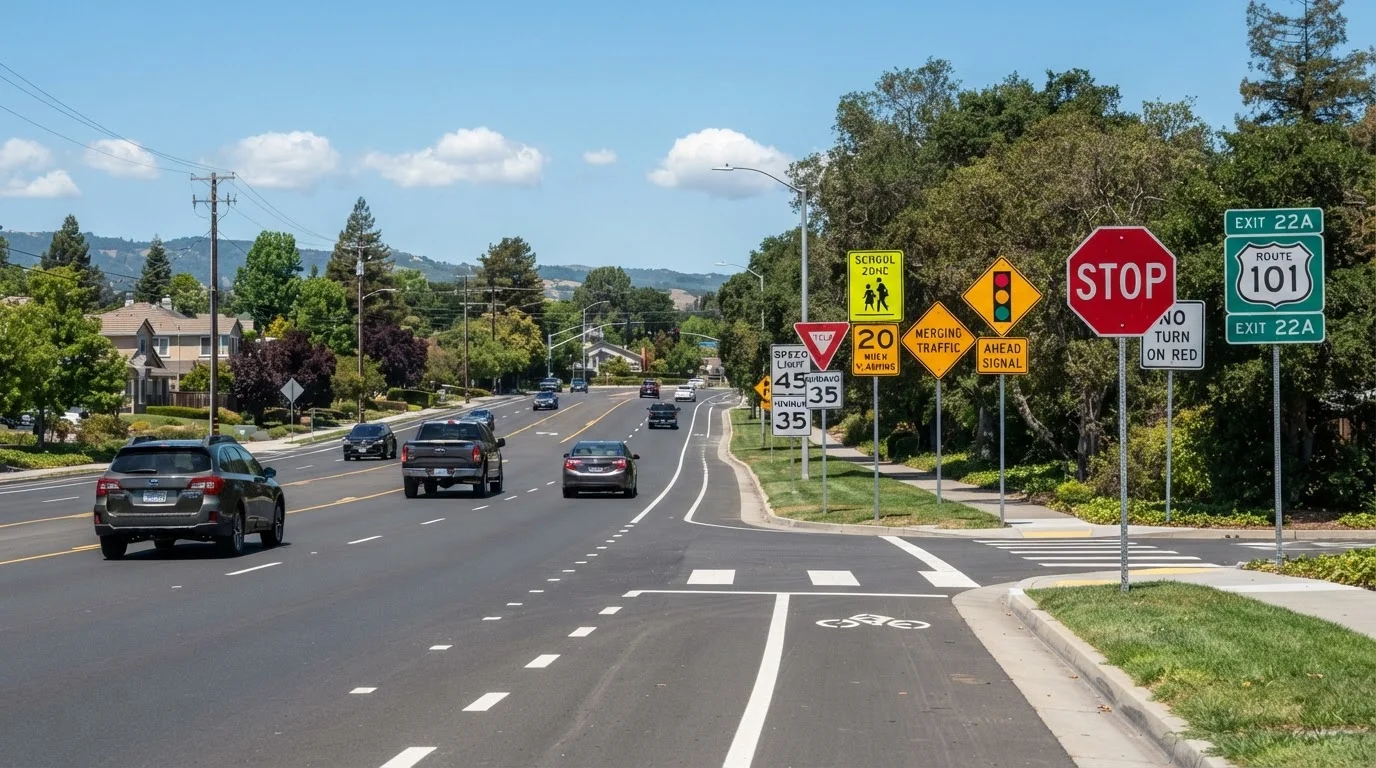
How U.S. Road Signs Are Organized
The Federal Highway Administration (FHWA) standardizes road signs across the United States through the Manual on Uniform Traffic Control Devices (MUTCD). Signs are grouped into three primary categories: regulatory, warning, and informational (guide). Each category uses a distinct shape and color system so drivers can identify sign type at a glance - even before reading the text.
This design-first approach matters because recognition speed directly affects reaction time. A driver who knows that an octagon always means stop, or that a yellow diamond always signals a hazard ahead, processes that information faster than one who has to read word-for-word. Pairing sign literacy with situational habits - like those covered in our guide to traffic signals and intersection rules - gives drivers a complete picture of how roads communicate with them.
Regulatory Signs: What the Law Requires
Regulatory signs tell drivers what they must or must not do. Ignoring them is a traffic violation. Here are the most important ones every driver should know:
- Stop (red octagon): Come to a complete stop behind the stop line. Proceed only when the intersection is clear.
- Yield (red and white downward triangle): Slow down and give right-of-way to oncoming traffic or pedestrians. Stop if necessary.
- Speed Limit (white rectangle): The maximum legal speed under ideal conditions. Adverse weather, traffic, or road conditions may require driving slower - see our guide to driving in bad weather.
- Do Not Enter / Wrong Way (red and white): Entry is prohibited. If you see a Wrong Way sign while driving, you are traveling against traffic - pull over safely and turn around.
- No Turn on Red: Unlike the general rule permitting right turns on red after stopping, this sign prohibits any turn while the light is red.
- One Way (black on white): Traffic flows in one direction only. Do not travel against the arrow.
State Variations Do Exist
While the MUTCD sets a national baseline, individual states can supplement federal standards with additional signs and specific regulations. For example, "Keep Right Except to Pass" carries legal weight in some states but is advisory in others. Always check your state's official driver handbook for local requirements. The FHWA publishes the current MUTCD on its website as a free public document.
Warning Signs: Hazards and Changes Ahead
Warning signs are typically yellow diamonds (or orange in work zones) and alert drivers to conditions that require reduced speed or heightened attention. They do not carry the same legal mandate as regulatory signs, but ignoring them is dangerous.
MUTCD
The Manual on Uniform Traffic Control Devices, published by the FHWA. It sets the national standard for all traffic signs, signals, and pavement markings used on public roads in the United States.
Regulatory Sign
A sign that legally requires or prohibits a specific driver action. Failure to comply constitutes a traffic violation.
Warning Sign
A sign that alerts drivers to road conditions, hazards, or changes ahead that require caution. These are typically yellow diamonds and do not carry direct legal penalties, but ignoring them creates serious safety risk.
Advisory Speed
A recommended (not legally mandated) speed posted below a warning sign for a specific condition, such as a curve or interchange ramp. Exceeding it in poor conditions can be grounds for a reckless driving charge.
HOV Lane
High-Occupancy Vehicle lane reserved for vehicles with a minimum number of occupants, often two or three. Rules vary by state and corridor, and violating them carries fines.
- Curve / Winding Road: Indicates sharp curves. Reduce speed before entering - not during - to maintain control.
- Pedestrian Crossing: A school or civilian crosswalk is nearby. Watch for people entering the roadway.
- Slippery When Wet: Road surface loses traction in rain or ice. Especially relevant on bridges and overpasses, which freeze before road surfaces.
- Divided Highway Begins / Ends: The road ahead splits into or merges from a divided roadway. Adjust lane position accordingly.
- Railroad Crossing (round, black on yellow): Unique circular shape signals a rail crossing ahead. Always look and listen; signals are not always active.
- Advisory Speed Plate (yellow rectangle below a warning sign): Recommends the safe speed for that specific condition, such as a ramp or sharp curve.
Many warning signs become harder to see in low-light conditions. Our night driving guide explains how to adapt visibility habits when driving after dark.
Informational and Guide Signs: Navigating the Road Network
Green, blue, and brown signs provide navigation and service information - they guide rather than regulate. Green signs indicate highway routes, exits, and distances. Blue signs mark services (fuel, food, lodging, hospitals) available at upcoming exits. Brown signs designate recreational areas, parks, and cultural landmarks.
A few high-value informational signs drivers frequently misread:
- Exit signs with mileage: The distance shown is to the exit ramp, not to the destination itself.
- Keep Right Except to Pass: On multi-lane highways, this is often regulatory in many states - not just a courtesy request.
- HOV Lane signs: High-Occupancy Vehicle lanes have occupancy and time-of-day restrictions. Violating them carries fines in most states.
Sharing the road effectively - especially around large trucks and cyclists - depends on reading signs governing lane use and merging. See our full guide to sharing the road for more.
This article provides general educational information about U.S. road sign standards. Always consult your state's driver handbook and applicable traffic laws for jurisdiction-specific requirements.