

Key Takeaways
Soil Test
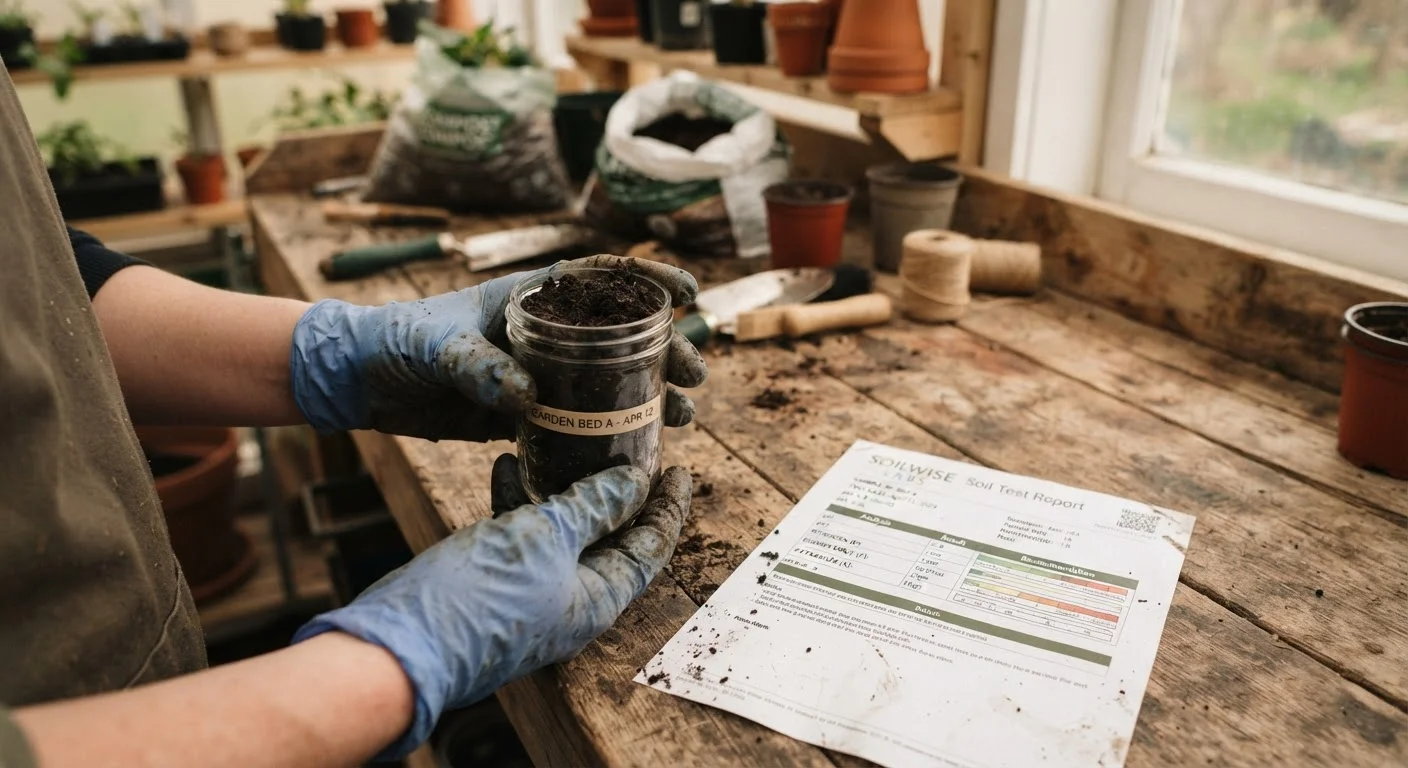
A soil test is a laboratory analysis of a sample taken from your garden or lawn that measures key properties like pH, nutrient levels, and sometimes organic matter content. The results tell you what your soil currently has, what it lacks, and how those conditions affect plant health. Most tests are conducted by university cooperative extension labs or private labs, and results are returned as a printed or digital report with amendment recommendations.
Soil pH is measured on a logarithmic scale from 0 to 14, meaning each unit represents a tenfold change in acidity or alkalinity - a soil with pH 5 is ten times more acidic than one with pH 6.
Why Bother Testing? The Case for Real Data
Gardening advice often skips straight to fertilizer recommendations without asking the most important question first: what does your soil actually contain? Adding nutrients to soil that is already well-supplied wastes money and can create imbalances that harm plants. More critically, no amount of fertilizer helps if your soil pH is off - because pH determines whether roots can absorb nutrients at all.
A soil test removes the guesswork. For a modest fee - often under $20 through your state's cooperative extension service - you receive a report that maps your starting point precisely. That makes every subsequent decision, from choosing amendments to planning what to plant, far more effective.
If you are starting a vegetable garden from scratch, testing before you plant saves you from building beds on soil that will underperform from day one.
Reading the pH Section: The Most Critical Number
pH is the first number to look at on any soil report, and for good reason. On a scale of 0 to 14, a pH of 7 is neutral. Values below 7 are acidic; values above 7 are alkaline. Most vegetables, fruits, and lawn grasses perform best in the 6.0-7.0 range, where the widest range of nutrients remains soluble and accessible to roots.
If your pH falls below 6.0, your report will likely recommend ground limestone (calcitic or dolomitic). Apply it in the fall if possible, since limestone works slowly. If pH reads above 7.5, elemental sulfur or acidifying fertilizers are typically recommended. Always follow the rate specified in your report - more is not better, and over-correction is a real risk.
Match Your Test to Your Region
Contact your state's cooperative extension service before ordering a soil test - their lab is calibrated to local soil types and will provide amendment recommendations suited to your region's materials and climate. Results from a generic national lab may not account for regional soil chemistry differences that affect how much lime or sulfur your specific soil actually needs.
Regional soils vary widely. Much of the Southeast and Pacific Northwest naturally tends toward acidity, while many Western states have alkaline soils. Your extension lab will account for your region when making recommendations.
Decoding Nutrient Levels: N, P, K and Beyond
After pH, look at your macronutrient readings. Most reports list phosphorus (P) and potassium (K) levels - often rated as low, medium, high, or given in parts per million (ppm). Nitrogen (N) is rarely listed because it moves through soil so quickly that a snapshot reading has limited value; it is addressed through ongoing fertilizer applications instead.
- Phosphorus (P): Essential for root development and flowering. Low readings suggest adding rock phosphate or a high-phosphorus fertilizer. Very high readings mean you should stop adding P entirely.
- Potassium (K): Supports overall plant vigor and disease resistance. Greensand, wood ash (in moderation), or potassium-rich fertilizers can address deficiencies.
- Secondary nutrients: Calcium, magnesium, and sulfur may also appear. Dolomitic limestone supplies both calcium and magnesium simultaneously if both are low.
6.0-7.0
Ideal pH range for most vegetables
This range is widely cited by university cooperative extension services as the target for optimal nutrient availability in food gardens.
~$15-$25
Typical cost of a cooperative extension soil test
Fees vary by state and test type; many land-grant university labs charge in this range for a standard pH-and-nutrient panel.
3-5%
Organic matter target for productive garden soil
Soil scientists generally consider 3-5% organic matter content a healthy baseline for supporting plant growth and microbial activity.
Understanding the difference between organic and synthetic options matters here - see our article on organic vs. synthetic fertilizers for a deeper look at how each type affects soil biology over time.
Organic Matter and Texture: The Context Behind the Numbers
Many soil reports also include an organic matter percentage and a texture reading (the ratio of sand, silt, and clay). Organic matter below 3-5% typically signals that the soil will benefit from regular additions of compost. Organic matter improves drainage in clay soils, boosts water retention in sandy soils, and feeds the microbial life that cycles nutrients to plant roots.
If your report shows very sandy or heavy clay texture, amending with compost is often the single most impactful thing you can do - regardless of what the nutrient numbers say. Making your own compost is a straightforward way to build a steady supply of this amendment.
Compost Improves More Than Nutrition
Adding compost does not just raise organic matter - it improves soil structure, water retention, drainage, and microbial diversity simultaneously. Even soils with adequate nutrient levels often benefit from regular compost additions. Consider compost a long-term investment in soil health rather than a quick fix for any single deficiency.
Putting It All Together: Building Your Amendment Plan
Once you have read your report, prioritize in this order: (1) correct pH, (2) address any severe nutrient deficiencies, (3) build organic matter. Trying to fix everything at once is rarely necessary and can be counterproductive.
Apply amendments according to the rates in your report, then plan to retest in 2-3 years to gauge progress. For raised beds, where you control the soil mix entirely, testing at planting and annually afterward gives you the tightest feedback loop. Our guide on raised bed gardening covers how to build a soil mix that gives you a strong baseline from the start.
Think of your soil test not as a one-time fix but as an ongoing conversation with your garden - each report tells you whether your amendments are working and what to adjust next.