

Key Takeaways
Object Knocking Behavior in Cats
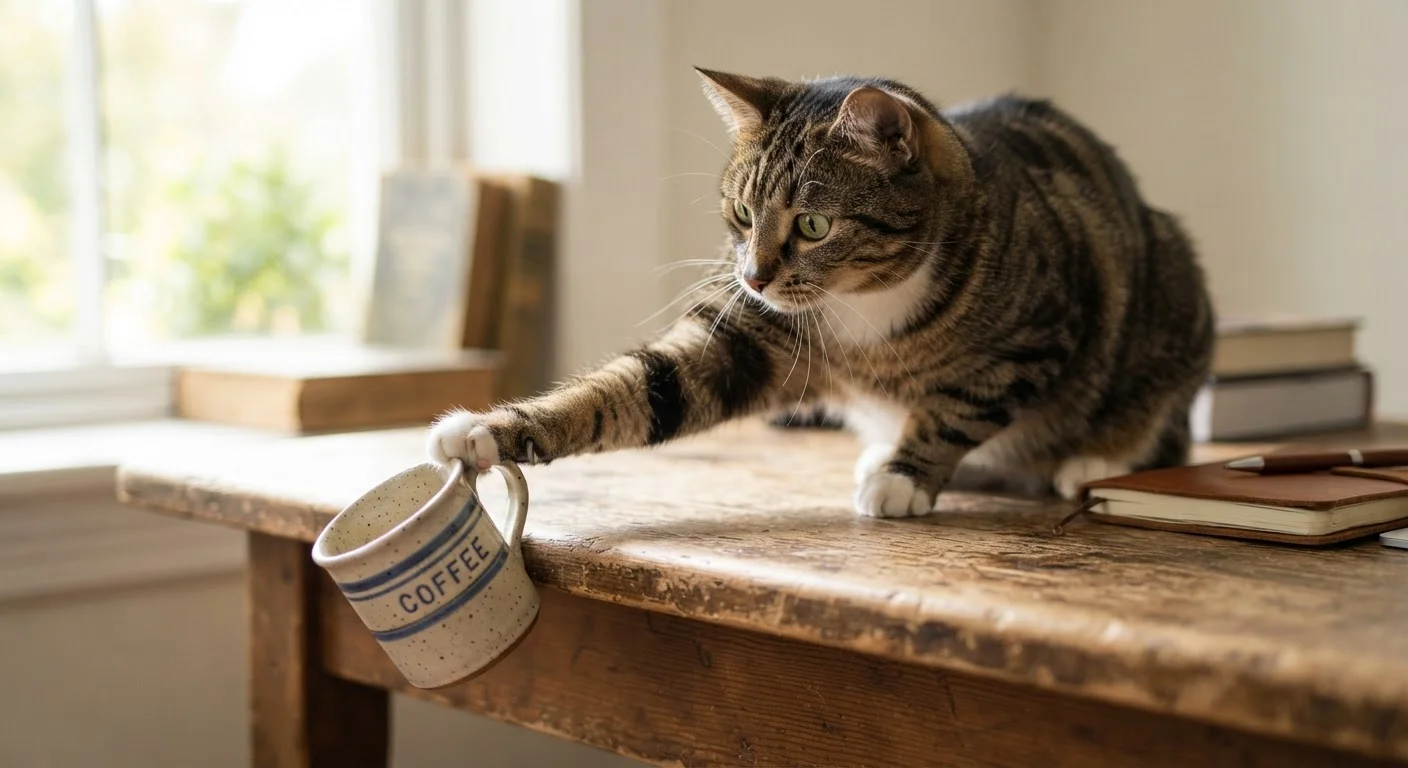
Object knocking is when a cat deliberately uses its paw to push items off elevated surfaces such as tables, shelves, or counters. Far from random mischief, this behavior is rooted in feline predatory instinct, sensory curiosity, and social communication. It is a normal part of cat behavior, not a sign of stubbornness or spite.
Behaviorists classify this under "predatory play" - cats use the same paw-batting motion to test prey movement that they employ when interacting with inanimate objects.
The Predatory Instinct Behind the Paw
Watch a cat bat a pen off a desk and you're witnessing millions of years of evolution in action. Domestic cats retain the full predatory toolkit of their wild ancestors: stalking, pouncing, swatting, and assessing prey. When a cat sees a small object resting near a ledge, its nervous system registers it much the way it would a motionless mouse - something worth investigating with a paw.
The swat serves a practical purpose in the wild: testing whether prey is alive, injured, or likely to flee. A stationary object that suddenly tumbles and bounces provides exactly the kind of unpredictable movement that triggers a cat's hunting instincts. In this sense, your water glass is a proxy for prey.
This same impulse underlies scratching behavior. As we explain in our guide to why cats scratch, behaviors that look destructive to humans are often expressions of hardwired biological programming that served cats well long before they shared our living rooms.
Channel the Instinct, Don't Fight It
Rather than trying to eliminate object-knocking entirely, redirect it to appropriate outlets. Puzzle feeders, batting toys, and crinkle balls give cats a safe, satisfying way to exercise the same paw-strike instinct. A cat with an outlet for predatory play is much less motivated to repurpose your belongings.
Curiosity, Sensation, and Environmental Mapping
Cats are tactile learners. Their paws - densely packed with mechanoreceptors - are sophisticated sensory instruments they use to gather information about their environment. Pushing an object tests its weight, surface texture, and how it responds to force. This is active, engaged learning, not aimless destruction.
Elevated surfaces matter here too. Cats naturally prefer high vantage points because height confers a survival advantage: broader sightlines and protection from ground-level threats. Tables, shelves, and countertops are prime real estate. Once a cat claims a high perch, it will explore everything on it - and that exploration often ends with objects on the floor.
Understanding this drive can inform how you set up your home environment. Indoor cats in particular benefit from vertical enrichment - cat trees, window perches, and puzzle feeders - that satisfies this need for environmental engagement without casualties to your belongings.
~63%
US households that own at least one cat
According to the American Pet Products Association's National Pet Owners Survey, cats are among the most commonly kept companion animals in the United States.
2x
Daily play sessions recommended for indoor cats
Feline behavior specialists generally recommend at least two interactive play sessions per day to meet the predatory and cognitive needs of indoor cats.
30+
Sensory nerve endings per square centimeter in cat paw pads
Research on feline anatomy shows that cat paw pads are among the most touch-sensitive areas of their body, explaining why tactile exploration is such a core behavior.
Attention-Seeking: When Cats Learn the Formula
Here's where cat behavior gets cleverly social. Cats are fast learners who track cause and effect with precision. If nudging your phone off the nightstand reliably causes you to look up, call out, or scramble across the room, your cat has discovered a highly effective attention mechanism - and it will use it.
This isn't manipulation in the human sense; it's conditioning. Your reaction - whether positive or exasperated - becomes the reward. The behavior is especially common in cats who are under-stimulated or whose daily interaction with their owners is limited. A cat that knocks things over persistently to get your attention is communicating a real need: more engagement.
Body language often signals what's driving the behavior in the moment. A cat that makes eye contact with you before batting something off a shelf is almost certainly seeking a reaction. To learn more about what your cat's posture and movements communicate, see our guide to feline body language.
What You Can Do About It
The most effective approach addresses the underlying motivation rather than trying to suppress the behavior outright. If predatory instinct is the driver, scheduled interactive play sessions with wand toys or puzzle feeders redirect that energy appropriately. Two focused play sessions daily - roughly 10-15 minutes each - can meaningfully reduce object-knocking behavior in many cats.
If attention-seeking is the main factor, the counterintuitive strategy is to reduce your reaction. Consistently ignoring safe knocking incidents removes the reward and gradually extinguishes the behavior. At the same time, proactively offering attention before your cat escalates to table-sweeping gives it a better path to connection.
For practical household management: keep genuinely fragile or irreplaceable items away from ledges your cat frequents. Provide sanctioned "knocking zones" - a low shelf with cat-safe objects or a puzzle toy that rewards batting - to give the behavior an acceptable outlet.
This article is for general informational purposes about normal feline behavior. If your cat shows sudden or dramatic behavioral changes, consult a licensed veterinarian or a certified animal behaviorist for personalized guidance.
“A cat's behavior that looks mischievous to us is almost always purposeful to the cat. Understanding what purpose it serves is the starting point for any effective response.”
— Applied Animal Behaviorist consensus, Reflected in peer-reviewed feline behavioral literature