

Key Takeaways
Dog Food Label
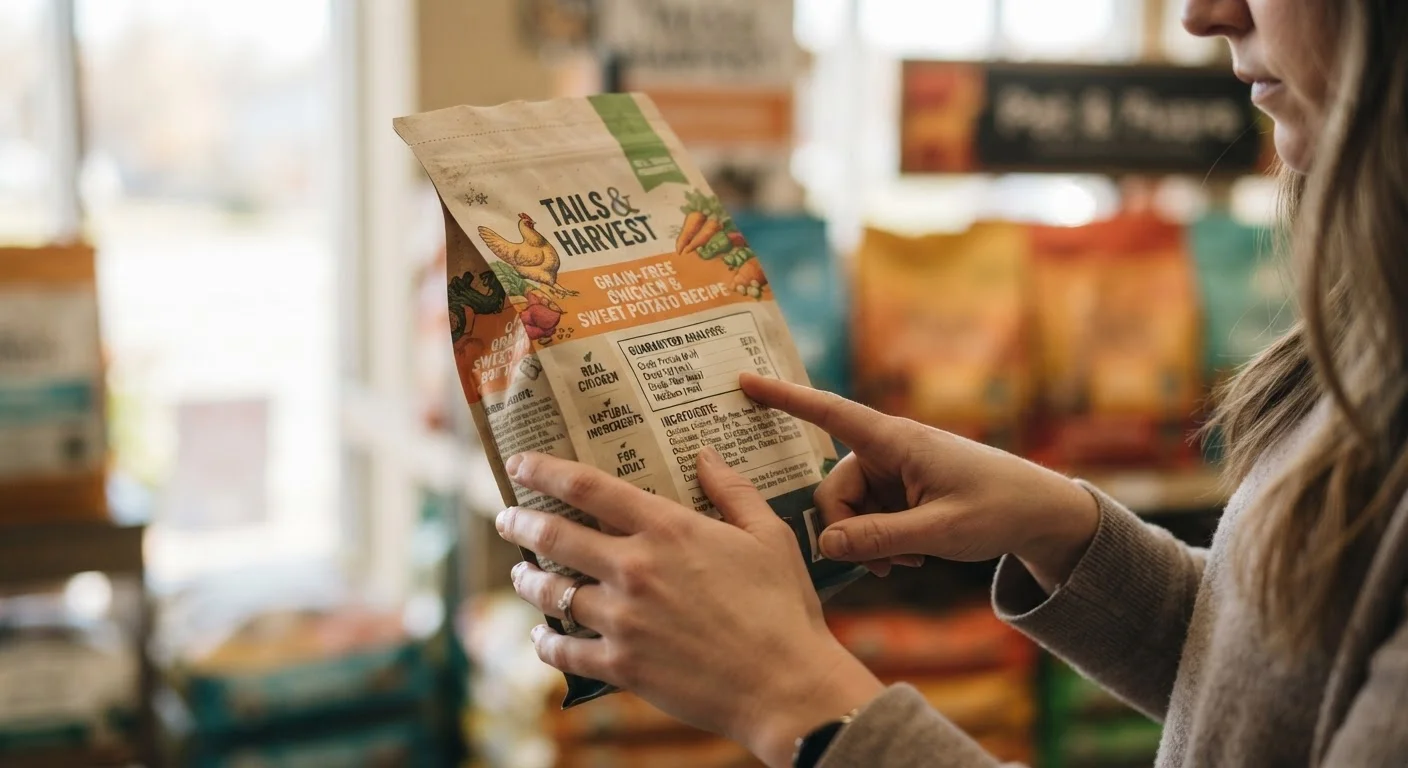
A dog food label is the regulated panel of information printed on pet food packaging that discloses ingredients, nutritional content, and feeding guidelines. In the United States, these labels are governed by a combination of federal FDA regulations and state-level standards largely modeled after guidelines from the Association of American Feed Control Officials (AAFCO). Understanding what each section means helps owners evaluate whether a food genuinely meets their dog's needs.
AAFCO does not directly regulate or approve individual pet foods, but its model regulations form the basis for most state pet food laws. The agency that enforces labeling compliance varies by state.
The Product Name Rules You Didn't Know Existed
Before you even flip the bag over, the product name itself carries regulated meaning. AAFCO's naming rules dictate how prominently an ingredient can be featured based on how much of it is actually present.
- The 95% rule: If a food is called 'Chicken Dog Food,' chicken must make up at least 95% of the total product weight (excluding water).
- The 25% rule: Words like 'dinner,' 'entrée,' or 'formula' signal that the named ingredient makes up 25-95% of the product.
- The 3% rule: Terms like 'with chicken' only require 3% of that ingredient.
- The 'flavor' rule: A 'chicken flavor' food may contain no chicken at all - only a detectable taste.
These distinctions matter most when comparing protein-forward foods. A bag labeled 'Chicken Dinner' and one labeled 'Chicken Dog Food' can differ dramatically in actual chicken content despite similar front-of-package imagery.
Decoding the Ingredient List
Ingredients are listed in descending order by pre-processing weight - a standard also used on human food labels, as explained in our guide to reading a nutrition facts label. For pet food, this creates a common point of confusion: fresh chicken contains roughly 75% water, so it weighs more than chicken meal before cooking. After moisture is removed during processing, chicken meal may actually deliver more protein per pound than fresh chicken listed first.
A few patterns to watch for:
- Ingredient splitting: Listing 'ground corn,' 'corn gluten meal,' and 'corn bran' separately keeps each lower on the list individually, even though corn is a dominant ingredient collectively.
- Meat meals: Terms like 'chicken meal' or 'salmon meal' refer to rendered, concentrated protein sources. The named species is a reasonable quality signal; unnamed 'meat meal' or 'poultry meal' is less specific.
- Preservatives: Mixed tocopherols (a form of vitamin E) are natural preservatives. Synthetic options like BHA and BHT are legal but have been the subject of ongoing research scrutiny.
Look at the First Five Ingredients as a Group
The first five ingredients typically make up the majority of a food's composition by weight. Scanning them together - rather than fixating on position one - gives a more honest picture of what the formula is primarily built from. If multiple protein sources appear in the top five alongside a single starch, that's meaningful context.
The Guaranteed Analysis: What Those Percentages Actually Mean
The guaranteed analysis panel lists four mandatory figures: minimum crude protein, minimum crude fat, maximum crude fiber, and maximum moisture. Some manufacturers voluntarily add omega fatty acids, calcium, phosphorus, or other nutrients.
Key caveats:
- These are guaranteed levels - a 'minimum 26% protein' means at least that much, but possibly more.
- The percentages reflect the food as packaged, not as digested. Digestibility and bioavailability aren't captured here.
- Comparing a dry food (10% moisture) to a wet food (78% moisture) using as-fed percentages is misleading. A dry-matter basis calculation - dividing the nutrient percentage by the dry-matter percentage - puts them on equal footing.
For dogs with specific health needs, such as kidney disease requiring restricted phosphorus, these label figures are a starting point for conversations with a veterinarian, not a standalone decision tool.
Dry-Matter Basis: A Fairer Comparison
To compare nutrients across wet and dry foods accurately, use the dry-matter basis calculation: divide the nutrient percentage by 100 minus the moisture percentage, then multiply by 100. For example, a wet food with 9% protein and 78% moisture has a dry-matter protein of roughly 41% - comparable to many dry foods. Your veterinarian or a board-certified veterinary nutritionist can help interpret these figures for your dog's specific needs.
AAFCO Statements and Life Stage Claims
The nutritional adequacy statement is arguably the most important line on the label. It tells you whether the food is intended as a complete diet and for whom. There are two ways a manufacturer can support this claim:
- Formulation method: The recipe meets AAFCO's published nutrient profiles on paper. This is the more common method.
- Feeding trial method: The food was actually fed to dogs under AAFCO protocols and shown to sustain them. This is a higher bar and worth noting when present.
Life stage matters significantly. A food formulated for 'adult maintenance' is not appropriate as the sole diet for a growing puppy, since puppies require higher levels of protein, calcium, and phosphorus. If you're navigating feeding choices across life stages, our breakdown of dry food, wet food, and raw diets covers how format interacts with nutritional completeness.
Also note: marketing terms such as 'holistic,' 'premium,' 'natural,' and 'human-grade' have no standardized regulatory definition in pet food. They are not quality signals in any enforceable sense - a point worth keeping in mind alongside the broader discussion of what label terms like 'natural' actually mean on food packaging generally.
For a deeper look at one of the most debated ingredient questions in dog nutrition, see our article on grain-free vs. grain-inclusive dog food.
3%
Minimum ingredient needed for 'with [ingredient]' claim
Under AAFCO model regulations, a product label can say 'with chicken' if chicken comprises as little as 3% of the formula by weight.
95%
Threshold for single-ingredient product name claim
AAFCO's '95% rule' requires the named ingredient to make up at least 95% of total product weight (excluding added water) for simple names like 'Chicken for Dogs.'
4
Mandatory items in guaranteed analysis panel
Every U.S. dog food label must disclose at minimum crude protein, crude fat, crude fiber, and moisture - all other nutrient disclosures are voluntary.
Feeding Guidelines and the Manufacturer Statement
Feeding guidelines are printed on every label as a legal requirement. They offer a reasonable starting range based on body weight, but they are not personalized recommendations. A dog's actual needs depend on age, activity level, metabolic rate, health status, and whether treats or table scraps are part of the daily intake. Dogs that get significant exercise may need more; less active dogs often need less than the label suggests.
The manufacturer's name and contact information must also appear on the label. This matters: it gives you a direct channel to ask about sourcing, quality control, or recall history. Reputable companies are generally transparent about these details.
Feeding nutrition and overall health work together. A well-chosen diet supports coat condition, energy, and digestion - and what your dog eats can show up in unexpected ways, including skin health. If you've noticed changes there, our overview of common dog skin conditions is worth a read alongside a veterinary consultation.
This article is for general informational and educational purposes only and is not a substitute for professional veterinary nutritional advice. Always consult your veterinarian before making significant changes to your dog's diet, especially if your dog has a health condition.