

Key Takeaways
Option A
Budgerigar (Budgie)
The compact, energetic, and budget-friendly starter bird.
Best for: Apartment dwellers, first-time bird owners, and households looking for a lively but lower-maintenance companion.
Option B
Cockatiel
The affectionate, interactive bird for dedicated owners.
Best for: Families or individuals who can offer daily hands-on interaction and enjoy a more expressive, bonding-oriented pet.
If you want a bird that suits apartment living and a smaller space
Budgerigar
Budgies are compact, produce less dander, and their vocalizations - while frequent - are softer and less piercing than a cockatiel's calls.
If you want a deeply bonded, emotionally expressive companion
Cockatiel
Cockatiels form strong attachments to their owners, communicate through crest position and vocalizations, and thrive with daily hands-on handling.
If you are a first-time bird owner with limited experience
Budgerigar
Budgies are forgiving of minor husbandry missteps, cost less to house and feed, and their smaller size makes handling and cage cleaning more manageable.
If you have children aged eight and older who want an interactive pet
Cockatiel
Cockatiels are robust enough to handle gentle, supervised interaction and are more likely to whistle, respond to their name, and engage in play.
If someone in your household has respiratory sensitivities or allergies
Budgerigar
Cockatiels are heavy powder-down producers; budgies generate significantly less airborne dander, making them a more tolerable choice for sensitive households.
Size, Appearance, and First Impressions
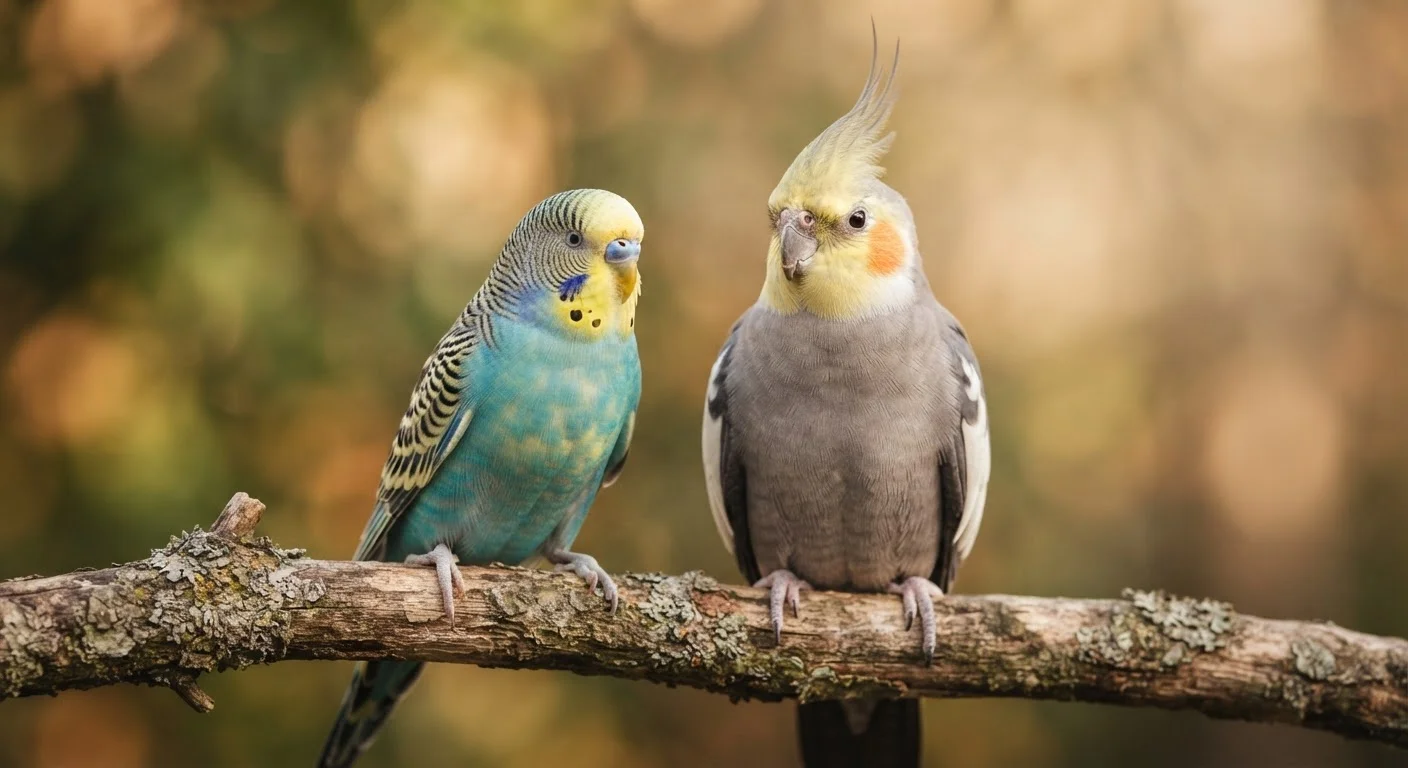
Budgerigars - commonly called budgies - are small parakeets native to Australia, typically weighing between 1 and 1.4 ounces and measuring around 7 inches from beak to tail. Their naturally bright green-and-yellow plumage has been selectively bred into dozens of color mutations, giving prospective owners a wide visual range to choose from.
Cockatiels are also Australian natives but belong to the cockatoo family. They weigh roughly 3 to 4 ounces and reach 12 to 13 inches in length - nearly twice the size of a budgie. Their most recognizable features are the expressive head crest and the orange cheek patches found on many color variants. That crest is more than decorative: it communicates mood, making cockatiels remarkably readable birds.
For households with limited space, the budgie's smaller footprint is a practical advantage. A properly sized budgie cage can fit comfortably in a bedroom or study, while a cockatiel requires a noticeably larger enclosure to allow adequate wing movement and enrichment placement.
Temperament, Socialization, and Handling
Budgies are sociable within their own species and can bond with humans, but they tend to be more independent than cockatiels. A single budgie kept without a companion bird will need substantial daily interaction from its owner to avoid boredom. Many budgie owners keep a pair precisely because the birds entertain and comfort each other - though a bonded pair may become less interested in human interaction over time.
Cockatiels are often described as "velcro birds" by experienced aviculturists. They actively seek proximity to their favored person, enjoy shoulder-perching, and can become stressed if left socially isolated for extended periods. This affectionate quality is a major draw for owners who want a genuinely interactive pet, but it also means cockatiels demand more consistent attention than budgies.
Both species can bite when frightened or mishandled, so gentle, consistent taming from a young age matters for either bird. For guidance on keeping either species mentally engaged once they're settled in, see our bird enrichment guide - foraging toys and varied perches make a meaningful difference in daily wellbeing.
| Criterion | Budgerigar | Cockatiel |
|---|---|---|
| Adult size | ~7 in, 1-1.4 oz | ~12-13 in, 3-4 oz |
| Typical lifespan | 7-12 years | 15-20 years |
| Noise level | Soft, continuous chatter | Louder; strong contact calls |
| Feather dust/dander | Low | High (powder-down bird) |
| Bonding style | Moderately social | Strongly people-oriented |
| Trainability | Can mimic words | Reliable whistler; more trainable |
| Space requirement | Smaller cage adequate | Larger cage required |
| Beginner-friendliness | High | Moderate |
Noise, Dust, and Household Compatibility
Noise tolerance is one of the most practical filters when choosing between these two species. Budgies chatter, chirp, and mimic sounds in a relatively high-pitched but soft register. The sound is continuous throughout the day but rarely disruptive through walls. Cockatiels, by contrast, produce louder contact calls - particularly males - and can reach volumes that travel easily through a home. A cockatiel's contact call when separated from its person is a meaningful consideration for apartment residents or light sleepers.
Dander is the other environmental factor worth weighing carefully. Cockatiels are powder-down birds: specialized feathers continuously break down into a fine white dust that coats cage surfaces, nearby furniture, and the air. Households with members who have asthma, bird-specific allergies, or general respiratory sensitivities should treat this as a significant factor. Budgies produce some dander but at substantially lower levels.
15-20 yrs
Typical cockatiel lifespan in captivity
Avian veterinary sources consistently cite this range for well-cared-for cockatiels, making them one of the longer-lived small companion birds.
2×
Approximate size difference between species
Cockatiels weigh roughly two to three times more than budgerigars, which directly affects cage sizing, enrichment needs, and handling.
~7-12 yrs
Typical budgerigar lifespan
Budgies on balanced diets with regular veterinary care commonly reach the higher end of this range or beyond.
Both species are sensitive to airborne household chemicals - non-stick cookware fumes, scented candles, and aerosol sprays can be harmful to pet birds. This is a care requirement shared equally by both species and should factor into any pre-adoption household assessment. Our preparation checklist covers the environmental checks worth completing before either bird arrives.
Lifespan, Health, and Long-Term Commitment
Lifespan is one of the starkest differences between these species. Well-cared-for budgies typically live 7 to 12 years. Cockatiels routinely reach 15 to 20 years in captivity, with some individuals living beyond that. This distinction carries real weight: a cockatiel adopted today may still be with the same family two decades from now, spanning moves, lifestyle changes, and family milestones.
Common health concerns for budgies include psittacosis (a bacterial infection), tumors - particularly in females - and iodine-deficiency goiter if fed a seed-only diet. Cockatiels are prone to respiratory infections, egg-binding in females, and feather-destructive behavior linked to stress or nutritional gaps. Both species benefit from a varied diet that goes beyond seed mixes to include leafy greens, vegetables, and formulated pellets, and both require annual wellness checks with an avian veterinarian.
If you enjoy comparing how different small pets stack up on care demands, our hamster vs. gerbil comparison applies a similar framework to another popular pairing.
Avian Veterinary Care Is Specialized
Not every general-practice veterinarian is experienced with birds. Before adopting either species, identify an avian-certified or avian-experienced vet in your area. The Association of Avian Veterinarians maintains a directory that can help US-based owners locate qualified practitioners. Annual wellness exams are recommended for both budgies and cockatiels even when the bird appears healthy.
This article is for general informational purposes only and does not constitute veterinary advice. Always consult a licensed avian veterinarian for guidance specific to your bird's health and care needs.