

Key Takeaways
Option A
Hamster
The solitary, self-contained small pet.
Best for: Owners who want a low-maintenance companion that thrives without a cage mate and suits a quieter household schedule.
Option B
Gerbil
The social, high-energy pair animal.
Best for: Owners who can commit to keeping bonded pairs and enjoy watching active, curious animals throughout the day.
If you want a single pet with a predictable evening activity window
Hamster
Hamsters are naturally solitary and most active after dusk, making them well-suited to owners with daytime schedules who interact with their pet in the evenings.
If you enjoy observing natural animal behavior throughout the day
Gerbil
Gerbils follow a polyphasic activity pattern - active in multiple short bursts - and their social interactions with a bonded companion are engaging to observe.
If you are considering a first small pet for an older child
Gerbil
Gerbils tend to be more tolerant of gentle handling and their daytime activity makes interaction more practical for school-age children.
If your household has limited space for a larger enclosure
Hamster
A single hamster can be appropriately housed in a smaller footprint than a bonded gerbil pair, though any enclosure should still meet minimum welfare standards.
If you want a longer-lived small pet commitment
Gerbil
Gerbils generally live one to two years longer than hamsters on average, giving owners a more extended companionship window.
Social Needs: A Fundamental Fork in the Road
One of the most consequential differences between hamsters and gerbils is how each species relates to its own kind. Hamsters are obligate solitary animals. Syrian hamsters - the most common pet variety - will defend territory aggressively and should never be housed with another hamster beyond early weaning age. Even dwarf hamster species, sometimes described as more tolerant, frequently develop conflict when housed together as adults. Fighting can cause serious injury or death, so single housing is the standard recommendation from exotic animal veterinarians.
Gerbils are the opposite. In the wild, they live in family groups and engage in constant social grooming, play, and cooperative burrowing. A lone gerbil is a stressed gerbil. Prospective owners should plan to adopt a bonded same-sex pair from the outset; introducing unfamiliar gerbils in adulthood can trigger a phenomenon called declanning, where previously bonded animals turn on each other. If you already care for other small pets and want to understand how social mismatches cause harm, the article on why guinea pigs and rabbits shouldn't share a cage illustrates how species-specific social needs must drive housing decisions.
Activity Patterns and What They Mean Day-to-Day
Hamsters are primarily nocturnal. They sleep deeply during daylight hours and become active - running, foraging, and exploring - in the evening and overnight. Disturbing a hamster during its sleep cycle causes stress and may lead to defensive biting. Owners who work standard daytime hours may find hamster activity aligns naturally with their evenings, but young children hoping to interact during the afternoon will often find a hamster unresponsive or irritable.
Gerbils follow a polyphasic pattern - meaning they cycle through activity and rest multiple times across a 24-hour period. This makes them more visible and interactive during daylight without being purely diurnal. Short, frequent bursts of digging, socializing, and exploration mean gerbils offer more daytime engagement, which many owners find rewarding.
2-3 yrs
Average hamster lifespan in captivity
Syrian and dwarf hamster lifespans are well-documented across veterinary literature and small mammal care guidelines.
3-5 yrs
Average gerbil lifespan in captivity
Gerbils consistently outlive hamsters in domestic settings when provided appropriate social housing and diet.
6-8 in
Minimum recommended substrate depth for hamsters
Animal welfare organizations and exotic veterinarians recommend this depth to support natural tunneling and reduce stress behaviors.
Understanding activity cycles also matters for enclosure placement. A hamster wheel spinning loudly at 2 a.m. next to a bedroom is a common and avoidable frustration. Solid-surface, silent-spinner wheels are an important investment for hamster setups.
Housing, Substrate, and Environmental Enrichment
Both species have burrowing instincts, but the depth of substrate required differs. Hamsters - particularly Syrians - benefit from a minimum of 6-8 inches of substrate to support natural tunneling. Many commercially sold hamster cages provide far less. Gerbils need comparable depth and also require hard materials like cardboard, coconut fiber, or untreated wood to shred and incorporate into burrow structures.
| Criterion | Hamster | Gerbil |
|---|---|---|
| Social structure | Solitary; must live alone | Social; needs bonded companion |
| Activity pattern | Nocturnal | Polyphasic (day and night) |
| Typical lifespan | 2-3 years | 3-5 years |
| Minimum substrate depth | 6-8 inches | 6-8 inches plus shredding material |
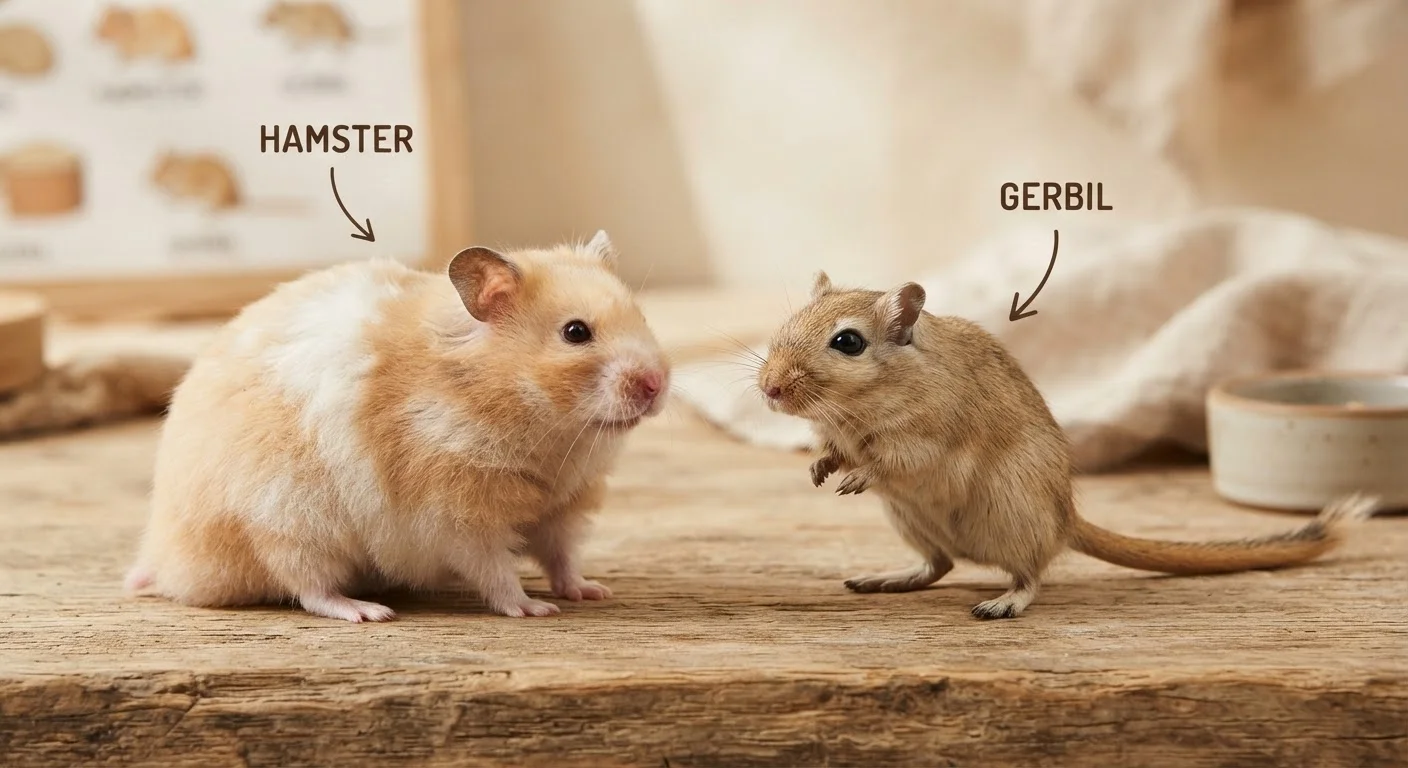
| Tail length | Very short or stubby | Long, tufted tail |
| Handling tolerance | Variable; stress-sensitive | Generally more tolerant |
| Housing companions | Never house together | Same-sex bonded pairs recommended |
Cage footprint recommendations have evolved. Animal welfare organizations generally suggest a minimum floor space of 40 inches by 20 inches for a Syrian hamster. A bonded gerbil pair needs at least as much floor space, plus vertical height for exploration. Marketed "starter kits" frequently fall short of these standards - always evaluate cage dimensions critically. For broader context on what small pet enclosures should genuinely provide, the article on rabbit enclosure requirements offers transferable principles about space, ventilation, and enrichment that apply across species.
Diet, Lifespan, and Veterinary Considerations
Hamsters and gerbils share a broadly omnivorous, seed-and-grain-based diet in the wild, but their nutritional requirements are not identical. Hamster-specific mixes tend to be higher in certain fats to support their faster metabolisms and cheek-pouch food-storing behavior. Gerbil diets should include slightly more protein and opportunities for foraging. Pre-mixed species-specific pellet or muesli diets, supplemented with occasional fresh vegetables and protein sources like mealworms, are appropriate for both - but cross-feeding commercial formulas is not recommended.
Lifespan is a practical planning factor. Syrian and dwarf hamsters typically live 2-3 years. Gerbils, when well cared for, commonly reach 3-5 years. Both species are prey animals and mask illness instinctively, so owners should establish a relationship with a veterinarian experienced in small mammal or exotic animal care before health issues arise. Routine weight monitoring at home - using a postal scale - can help catch gradual weight loss that signals illness early.
When to See a Vet - Don't Wait
Both hamsters and gerbils are prey species that instinctively hide signs of illness until they are seriously unwell. Any change in eating, activity level, coat condition, or body weight warrants prompt veterinary attention. Finding an exotic-experienced vet before you need one urgently is strongly advisable. This article provides general educational information and is not a substitute for professional veterinary advice.
If you are weighing small pets against more specialized exotics, the article on hedgehogs, chinchillas, and ferrets provides useful context on where the care demands escalate significantly.